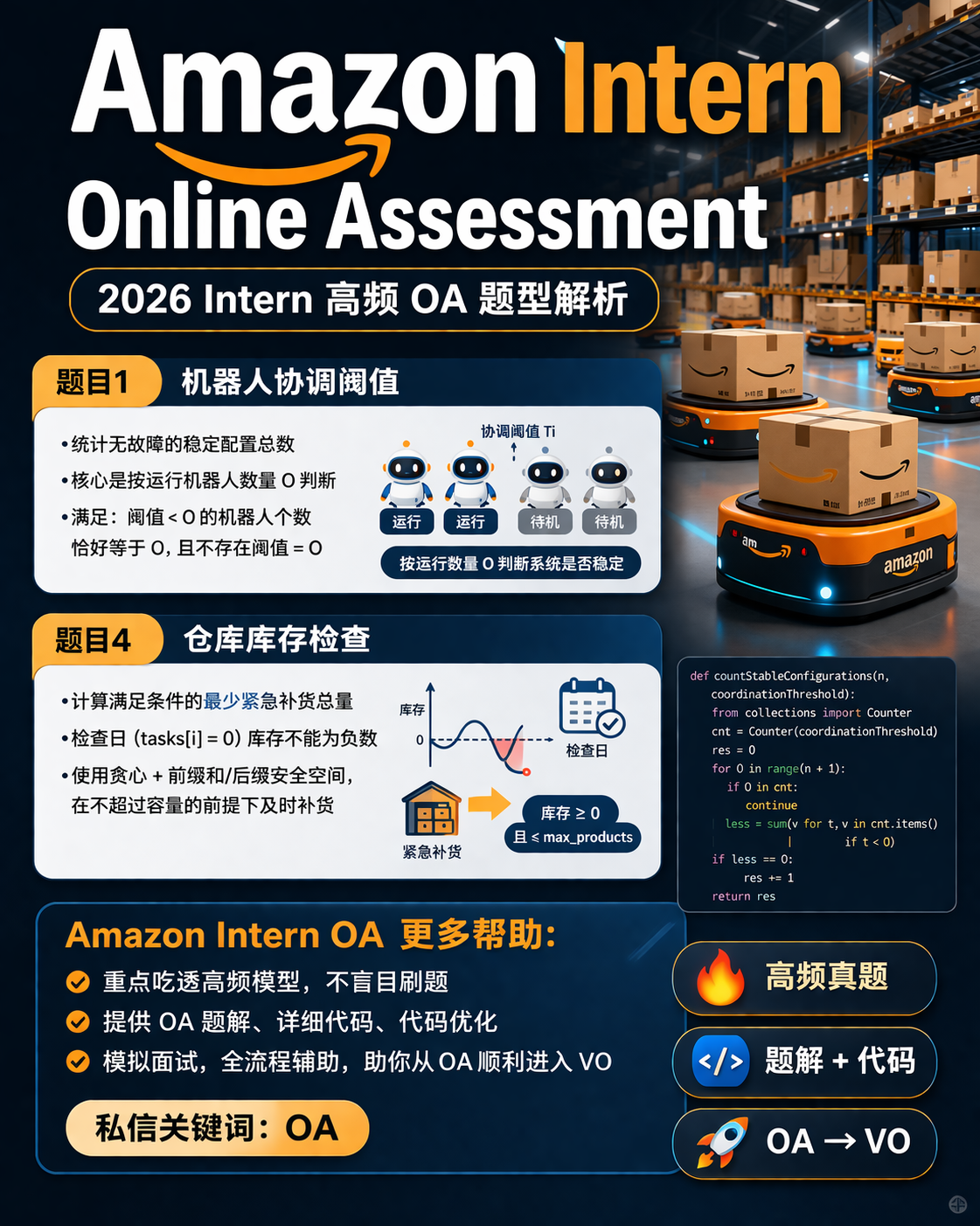
Recent Amazon Intern OA sets have again been leaning toward a familiar pattern: long business-style statements, moderate implementation difficulty, and a very high penalty for modeling the problem the wrong way in the first few minutes.
These two questions are a perfect example. Neither one is about advanced syntax or complicated code. What matters is whether you can convert the wording into a clean mathematical condition before you start implementing.
Many candidates finish problems like these with the same reaction:
The coding itself is not the hardest part. The real danger is misunderstanding what the system state actually means.
This article skips code and focuses only on the part that matters most in OA settings: how to think about both problems correctly.
Amazon OA Pattern Behind These Two Problems
| Problem | Core skill |
|---|---|
| Problem 3 | Counting by global state, threshold modeling, frequency reasoning |
| Problem 4 | Prefix sums, capacity constraints, inspection checkpoints, greedy planning |
| Shared theme | Model first, implement second |
That is very Amazon-like:
- The statement looks operational
- The real solution hides inside inequalities
- If the abstraction is wrong, even correct-looking code will go nowhere
Problem 3: How Many Stable Robot Configurations Exist?
Reframing the statement
Each robot is in one of two states:
OperatingStandby
Each robot i has a threshold coordinationThreshold[i].
Suppose the total number of operating robots is O.
Then:
- If robot
iis operating, the number of other operating robots must be at least its threshold - If robot
iis on standby, the total number of operating robots must be strictly smaller than its threshold
We need to count how many assignments produce no malfunction at all.
The first important move is not state enumeration
The naive instinct is to think in terms of subsets because each robot is either on or off. But the useful variable is not the subset itself. The useful variable is:
how many robots are operating in total
Call that number O.
Once O is fixed, each robot falls into exactly one of three categories:
- If its threshold is less than
O, it must be operating - If its threshold is greater than
O, it must be on standby - If its threshold is exactly
O, that robot makes the configuration impossible
That is the whole trick of the problem.
Why threshold equal to O immediately kills feasibility
This is the make-or-break observation.
If coordinationThreshold[i] = O:
- Putting robot
iinOperatingfails, because it only seesO - 1other operating robots - Putting it in
Standbyalso fails, because standby requires the total operating count to be strictly less thanO
So any threshold exactly equal to O means that operating count can never be part of a stable configuration.
The exact validity condition
For a fixed O, the configuration is valid if and only if:
- No robot has threshold exactly equal to
O - The number of robots with threshold less than
Ois exactlyO
The second condition matters because all robots with threshold less than O are forced into Operating, and the total number of operating robots must be exactly O.
So the problem is not “which robots should we turn on.” It is “which values of O are self-consistent.”
Why this becomes a linear scan
If we count how many times each threshold appears, then for every O = 0...n we can know:
- whether any threshold equals
O - how many thresholds are strictly less than
O
That makes each candidate O easy to validate in constant time during a sweep.
The final answer is simply the number of valid operating counts. For each valid O, the assignment is actually unique:
- thresholds less than
Omust operate - thresholds greater than
Omust stay in standby - thresholds equal to
Oare forbidden
Common ways people lose points here
- Treating it as a combinatorics problem over subsets
- Missing the “threshold equals
Ois impossible in both states” observation - Using “less than or equal to
O” instead of strict “less thanO” - Thinking there are still choices left after
Ois fixed
What Amazon is really testing
This is not testing brute force skill. It is testing whether you can:
- identify the right global variable
- convert local robot rules into a single consistency condition
- turn a state assignment problem into a counting problem
Once you see that reduction, the problem becomes much cleaner.
Problem 4: Minimum Emergency Restock Volume Under Inspection and Capacity Constraints
Read the objective carefully
The warehouse starts with inventory 0. Every evening, one event happens:
tasks[i] > 0: incoming productstasks[i] < 0: outgoing productstasks[i] = 0: inspection day
Every morning, the manager may add any number of products through emergency restocking.
The objective is not minimizing the number of restock actions. The objective is:
- inventory must be non-negative on every inspection day
- inventory must never exceed
max_productson any day - total emergency restock volume must be minimized
If you misread the objective, the greedy direction becomes wrong immediately.
Why “just fill the current deficit” is not enough
A common first thought is:
If inventory is negative on an inspection day, restock just enough to bring it back to zero.
That sounds reasonable, but it ignores the future:
- more incoming stock may arrive later
- restocking too much now may overflow capacity later
- restocking too little now may force repeated future restocks
So the problem cannot be solved by looking only at the current inspection checkpoint. You need future room as well.
The right viewpoint: lift the whole inventory curve
Without emergency restocking, the task array defines a baseline inventory trajectory.
Every restock effectively shifts the future trajectory upward.
That shift is constrained by two conditions:
- inventory on inspection days must stay at or above zero
- inventory on every day must stay at or below
max_products
So restocking is not just a local fix. It is a controlled upward adjustment applied to a future segment of the path.
The greedy idea: once you must restock, push to the current safe ceiling
Why?
Because the objective is minimum total added inventory under feasibility constraints, and once a restock is necessary, any extra volume that is still safely usable before hitting capacity can help protect future inspection days as well.
So when an inspection day becomes negative, the correct move is:
- compute the minimum amount needed to make the current inspection valid
- compute the maximum extra amount the future path can still absorb without exceeding capacity
- if the safe upper bound is below the required deficit, the instance is impossible
- otherwise, restock as much as the current safe bound allows
This is the stable greedy direction described in many accepted solutions to this style of OA problem.
Why prefix sums and future-space information matter
To decide how much can be added safely, you need to know where the future trajectory gets closest to the warehouse capacity limit.
That is why the standard reasoning uses:
- prefix sums to build the baseline inventory path
- suffix information that tells you how much vertical room remains in the future
Then, on each inspection day, you can answer two questions at once:
- How much must I add to make this inspection legal?
- How much can I add at most before some future day exceeds
max_products?
If the first number is larger than the second, there is no valid solution.
The intended greedy rhythm
While scanning the days, keep track of cumulative emergency inventory already added.
- On normal delivery and dispatch days, just move along the baseline trajectory
- On an inspection day, do nothing if the adjusted inventory is already non-negative
- If the adjusted inventory is negative, emergency restocking becomes mandatory
- The amount added should be the largest safe amount currently allowed, as long as it covers the present deficit
This makes each restock maximally useful for future days and prevents unnecessary repeated adjustments.
Most common mistakes
- Solving for minimum restock count instead of minimum total volume
- Looking only at the current deficit and ignoring future capacity
- Forgetting that the capacity constraint applies to every day, not only inspection days
- Assuming negative inventory is illegal on non-inspection days
- Using an overly conservative greedy choice that leads to avoidable repeated restocking
What this problem is actually testing
This is classic Amazon modeling:
- there is a timeline
- there are hard constraints
- there is a clear optimization target
- greedy works only if you first understand what a restock means geometrically
The real differentiator is not “do you know prefix sums.” It is whether you can see restocking as lifting a future inventory trajectory under a capacity ceiling.
What These Two Problems Are Screening For
One looks like counting, the other looks like warehouse simulation, but they are screening for the same thing:
- can you identify the right global state
- can you turn rules into necessary and sufficient conditions
- can you tell what exactly should be enumerated or greedily extended
Candidates who rush into implementation feel both problems are messy.
Candidates who model first usually realize that neither problem is code-heavy. They are both logic compression problems in a very standard Amazon OA style.
Final Takeaway
The two most valuable mindset shifts here are:
- Problem 3: do not enumerate robot states, enumerate the operating count
O - Problem 4: do not think of restocking as a local patch, think of it as lifting the future inventory curve
If you are preparing for Amazon Intern OA now, these are exactly the kinds of transformations worth practicing. In many cases, passing or failing is decided long before the code is finished.
🚀 oavoservice: Your Amazon OA Full-Score Support
For Amazon-style assessments, where statements are long, modeling is everything, and one small misunderstanding can ruin the entire submission, what you need is not just an answer, but a professional technical support team.
We provide:
✅ HackerRank full-score OA support — continuous coverage of high-frequency question pools
✅ Industry-standard code quality — clean logic and complete edge-case handling
✅ Real-time external assistance — discreet support without disrupting your workflow
✅ 24/7 availability — always ready when you need help
Do not let one tricky OA question block your path to Amazon.
We consistently provide professional online assessment services for major tech companies like Amazon, Adobe, Google, and TikTok, guaranteeing perfect scores. Feel free to contact us if you're interested.
👉 Add WeChat now: Coding0201
Secure your Amazon interview opportunity!
Telegram: @OAVOProxy
Gmail: [email protected]