Two Amazon OA problems testing binary search + greedy + prefix sums in combination. The ideas aren't hard but the implementation details matter — stay methodical. Full walkthrough below.
Exam Overview
| Item | Details |
|---|---|
| Platform | HackerRank |
| Questions | 2 |
| Difficulty | Medium / Medium-Hard |
| Role | SDE |
| Core Topics | Intervals, Binary Search, Prefix Sum, Greedy |
Q1: Max Interval Selection (Central Overlap)
Core Idea
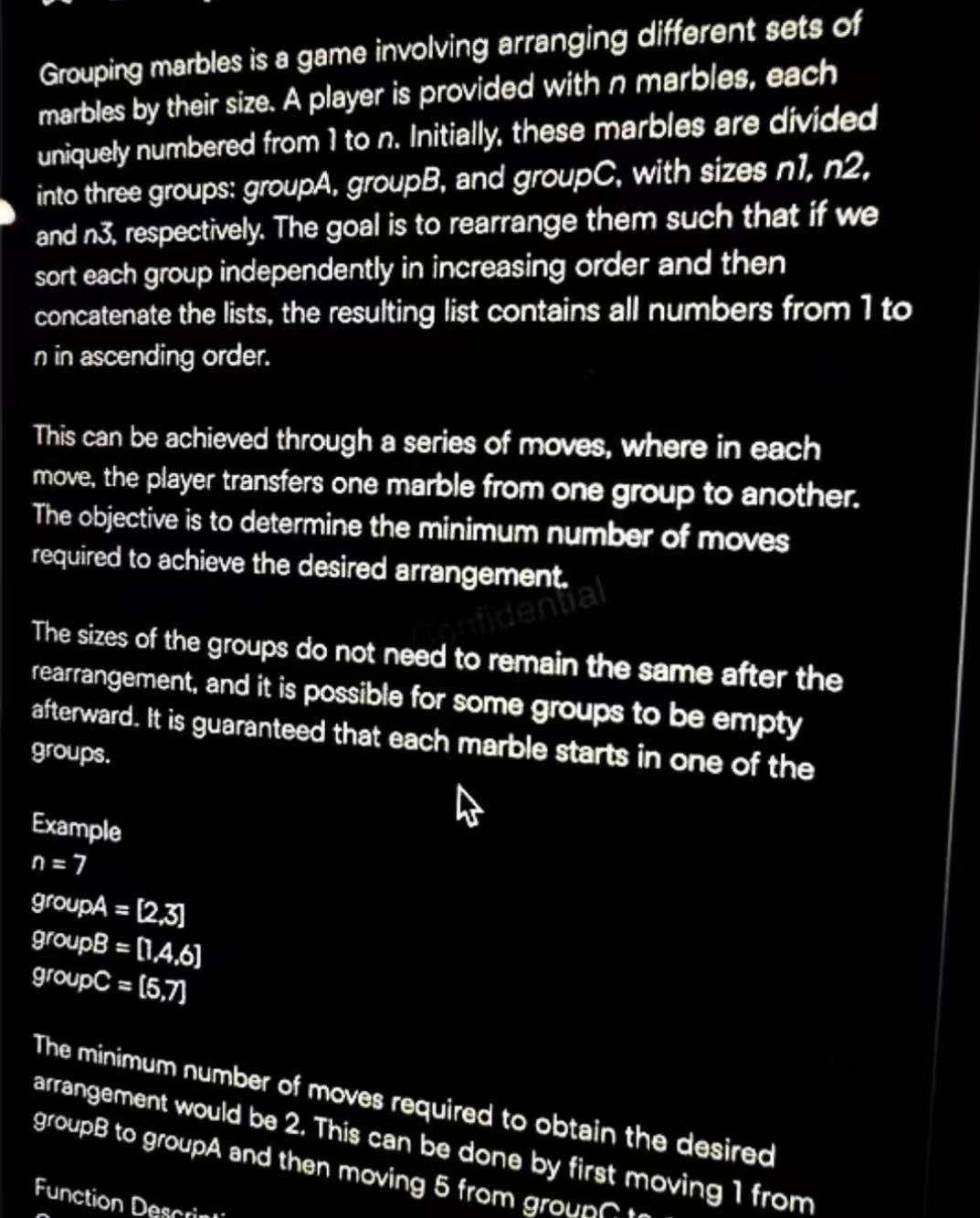
Given n intervals, select as many as possible such that there exists one "center interval" that intersects every other selected interval. Find the maximum number of intervals you can select.
Solution Approach
Brute Force (O(n²) — TLE)
Enumerate each interval as the center, count how many others it intersects, and take the maximum. With n up to 10⁵, this is too slow.
Optimized: Reverse Counting + Binary Search (O(n log n))
Key insight: Instead of counting intervals that do intersect the center, count intervals that definitely don't intersect — this is easy to do with binary search.
Two intervals [a, b] and [c, d] are non-overlapping if and only if:
b < c(current interval entirely to the left), ord < a(current interval entirely to the right)
Algorithm:
- Sort all intervals by left endpoint; also build an array sorted by right endpoint.
- For each interval
[a, b]as the center:- Binary search the right-endpoint array: count intervals with
right < a(entirely left → non-overlapping) - Binary search the left-endpoint array: count intervals with
left > b(entirely right → non-overlapping) - Non-overlapping count = sum of both
- Overlapping count = n − non-overlapping count
- Binary search the right-endpoint array: count intervals with
- Return the maximum overlapping count across all candidate centers.
Solution Template
import bisect

def solution(intervals):
    n = len(intervals)
    if n == 0:
        return 0

    left_sorted  = sorted(x[0] for x in intervals)
    right_sorted = sorted(x[1] for x in intervals)

    ans = 0
    for a, b in intervals:
        # Intervals with right endpoint < a: entirely to the left
        left_non_overlap  = bisect.bisect_left(right_sorted, a)
        # Intervals with left endpoint > b: entirely to the right
        right_non_overlap = n - bisect.bisect_right(left_sorted, b)

        ans = max(ans, n - left_non_overlap - right_non_overlap)

    return ans
Complexity
- Time: O(n log n) — sort once + n binary searches
- Space: O(n)
Key Insight
Counting "intersecting intervals" directly requires enumeration. Counting "non-overlapping intervals" can be done in O(log n) per query via binary search — this is the core optimization.
Q2: Ball Partition Min Moves
Core Idea
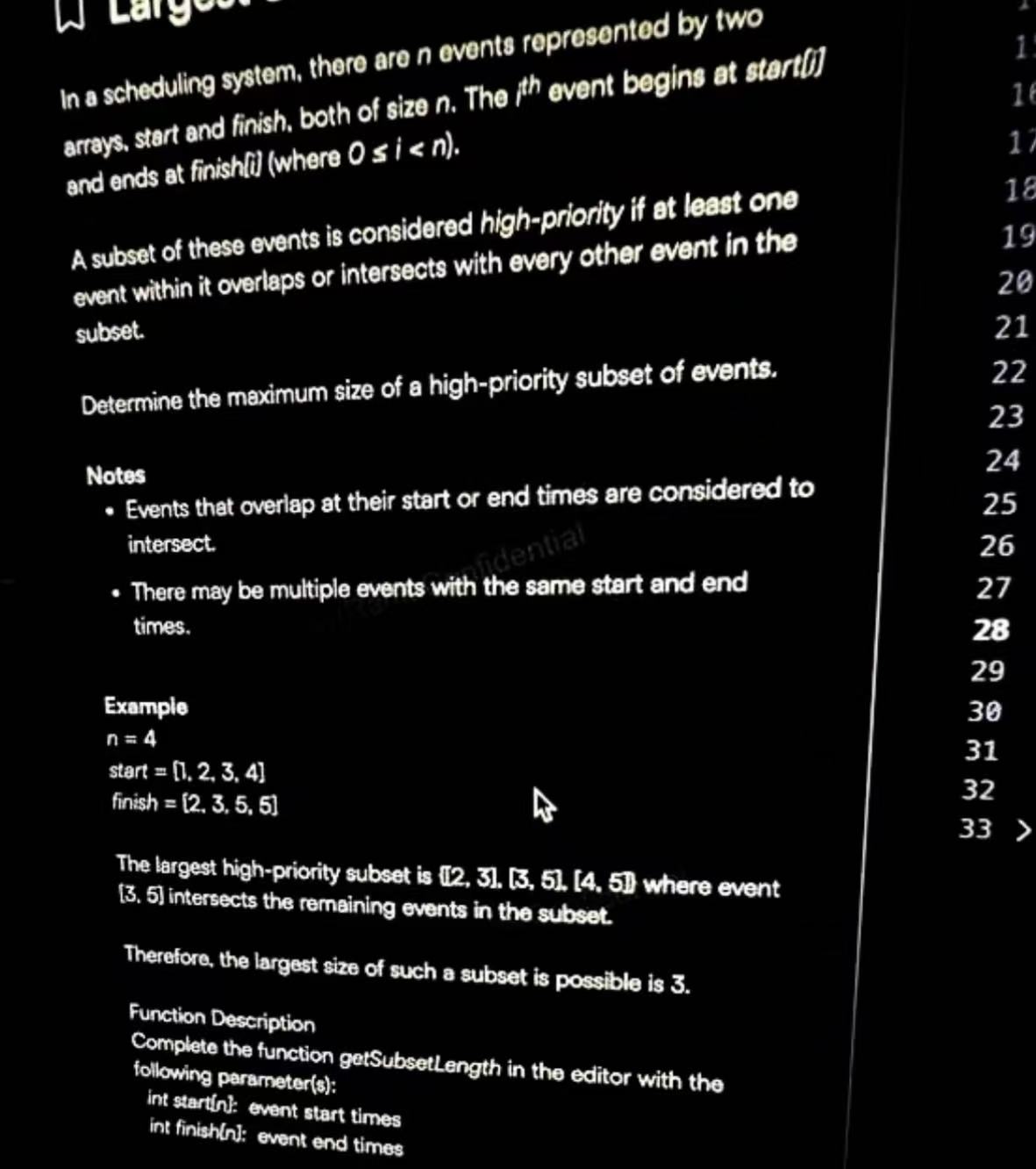
Balls numbered 1 to n are distributed across three groups A, B, C. You can move any ball to a different group. The goal: after all moves, concatenating A + B + C must equal 1, 2, 3, ..., n in order. Find the minimum number of moves.
Solution Approach
Key Observation
The final arrangement A + B + C = [1..n] means the groups must look like:
- A contains
[1..i] - B contains
[i+1..j] - C contains
[j+1..n]
for some 0 ≤ i ≤ j ≤ n (empty groups allowed).
Core Property
The relative order within each group doesn't matter — only whether each ball is in the correct group. Balls already in the right group need zero moves; all others need exactly one move.
Minimum moves = n − (number of balls already in the correct group)
Algorithm
- Record which group each ball currently belongs to.
- Build prefix sum arrays for each group:
prefix_a[k]= count of balls in{1..k}currently in Aprefix_b[k]= count of balls in{1..k}currently in Bprefix_c[k]= count of balls in{1..k}currently in C
- Enumerate split points
iandj; for each pair compute correctly-placed balls in O(1). - Return
n − max(correctly placed).
Solution Template
def solution(A, B, C):
    n = len(A) + len(B) + len(C)

    group = {}
    for ball in A: group[ball] = 0
    for ball in B: group[ball] = 1
    for ball in C: group[ball] = 2

    prefix_a = [0] * (n + 1)
    prefix_b = [0] * (n + 1)
    prefix_c = [0] * (n + 1)
    for k in range(1, n + 1):
        prefix_a[k] = prefix_a[k-1] + (1 if group[k] == 0 else 0)
        prefix_b[k] = prefix_b[k-1] + (1 if group[k] == 1 else 0)
        prefix_c[k] = prefix_c[k-1] + (1 if group[k] == 2 else 0)

    min_moves = n
    for i in range(0, n + 1):
        for j in range(i, n + 1):
            correct = (prefix_a[i]
                     + prefix_b[j] - prefix_b[i]
                     + prefix_c[n] - prefix_c[j])
            min_moves = min(min_moves, n - correct)

    return min_moves
Further optimization: The double loop is O(n²); it can be reduced to O(n) by precomputing suffix maximums — the template above illustrates the core logic.
Complexity
- Time: O(n) with suffix-max optimization
- Space: O(n)
Key Insight
Group-internal order is irrelevant — only group membership matters. Enumerating split points with prefix sums turns each "count correctly placed" query into O(1).
Side-by-Side Comparison
| Question | Core Technique | Time | Space |
|---|---|---|---|
| Q1 Interval Selection | Sort + binary search reverse count | O(n log n) | O(n) |
| Q2 Ball Partition | Enumerate split + prefix sums | O(n) | O(n) |
Common Mistakes
| Question | Mistake | Correct Approach |
|---|---|---|
| Q1 | Directly enumerate overlapping intervals O(n²) | Count non-overlapping via binary search |
| Q1 | Wrong bisect variant (left vs right) | Carefully distinguish strict vs non-strict bounds |
| Q2 | Factoring in intra-group order | Order within groups is irrelevant |
| Q2 | Forgetting empty-group edge cases | Allow i=0 or j=n in enumeration |
Amazon OA Strategy
On-site Pacing
- Read both problems first — allocate time based on relative difficulty
- Interval problems (Q1 type): Think "when do two intervals NOT overlap?" — reverse counting is usually cleaner
- Partition problems (Q2 type): Fix the final structure first, then use prefix sums to speed up counting
- Run through the provided examples; verify empty / single-element edge cases
Related LeetCode Practice
| # | Problem | Covers |
|---|---|---|
| 435 | Non-overlapping Intervals | Q1 interval non-overlap |
| 452 | Minimum Arrows to Burst Balloons | Q1 interval overlap |
| 56 | Merge Intervals | Q1 interval merging |
| 1043 | Partition Array for Maximum Sum | Q2 split-point enumeration |
| 813 | Largest Sum of Averages | Q2 prefix sum + enumerate |
🚀 Need Amazon OA Assistance?
oavoservice provides stable, long-term real-time OA/VO support for Google, Amazon, TikTok, Uber, Bloomberg, Microsoft and more — both domestic and overseas interviews covered. High question-bank coverage.
Add WeChat: Coding0201
What you get:
- ✅ Amazon OA real-time assistance (screen share + live typing hints)
- ✅ HackerRank real question bank (80%+ high-frequency coverage)
- ✅ 1-on-1 mock OA + detailed feedback
- ✅ VO interview support (algorithms + system design)
📱 WeChat: Coding0201 | 💬 Telegram: @OAVOProxy | 📧 [email protected]
Contact
Email: [email protected]
Telegram: @OAVOProxy