Another Amazon OA on HackerRank — full AC as usual, wrapped up in about 10 minutes. Two classic directions: batch simulation and linear greedy scan. Pure logic breakdown below, no code.
Exam Overview
| Item | Details |
|---|---|
| Platform | HackerRank |
| Questions | 2 |
| Difficulty | Medium |
| Role | Intern / New Grad SDE |
| Result | Full AC, ~10 minutes |
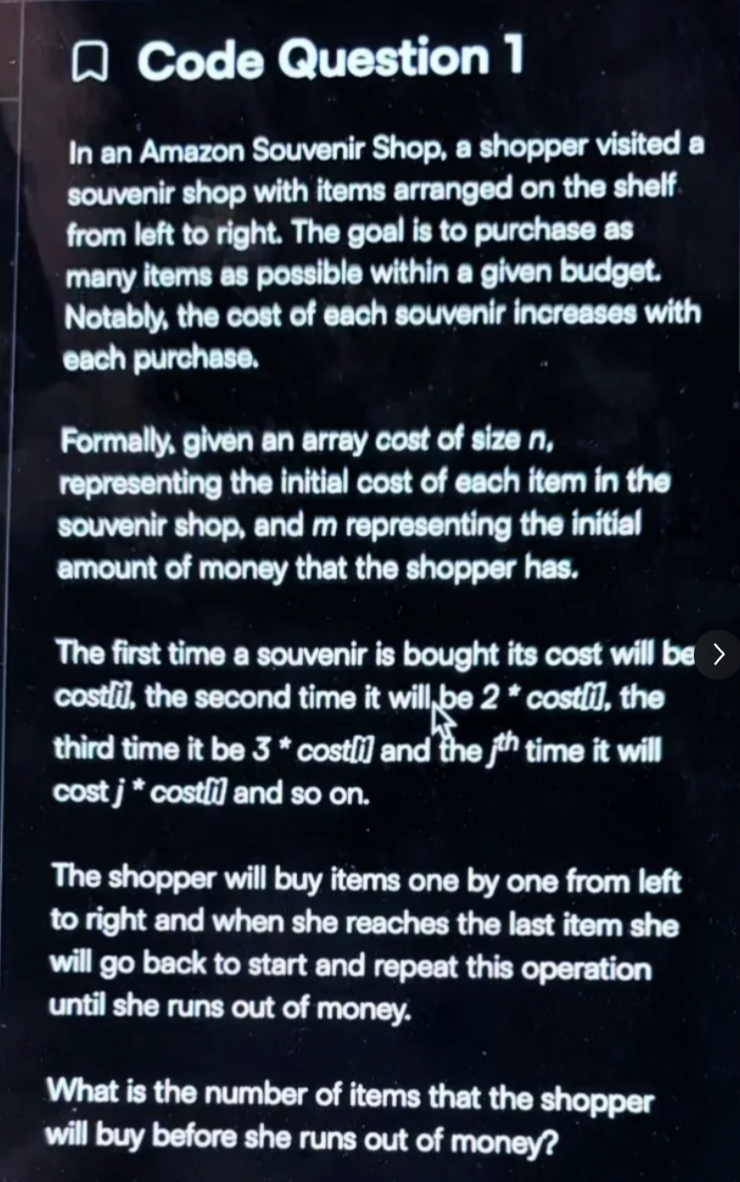
T1: Cyclic Shopping with Price Doubling
Problem Core
You have several items, each with an initial price. You have a starting balance and shop in cycles:
- Each time you buy an item, its price doubles
- You stop when you can no longer afford any item
- Find the total number of items purchased
Approach
Brute force: simulate one purchase at a time, always buying the cheapest affordable item — O(m·n) where m is total purchases. Prices grow exponentially so m stays small in practice, but can still be too slow for large inputs.
Correct approach: batch division simulation
Key observation: within a single "round", all item prices are fixed (not yet doubled). You can calculate how many full rounds you can afford at once.
Step-by-step:
- Compute the sum of all affordable items (price ≤ balance):
total_price - Compute full rounds:
rounds = balance // total_price - Update balance:
balance -= rounds * total_price - Update count:
count += rounds * number_of_affordable_items - After each round, all prices double — remove items that are now too expensive
- Repeat until no items are affordable or balance is exhausted
Why Is This Faster?
Each round eliminates at least one item (its doubled price exceeds balance), so the loop runs at most O(n log(balance)) times — far fewer iterations than item-by-item simulation.
Complexity
- Time: O(n² log(balance / min_price)) — at most n items eliminated across all rounds
- Space: O(n)
Key Insight
Price doubling means each item can only be bought a logarithmic number of times total. Batch division compresses "step-by-step simulation" into "bulk jumps" — the core optimization trick here.
T2: Minimum Increment Sum to Make Array Non-Decreasing
Problem Core
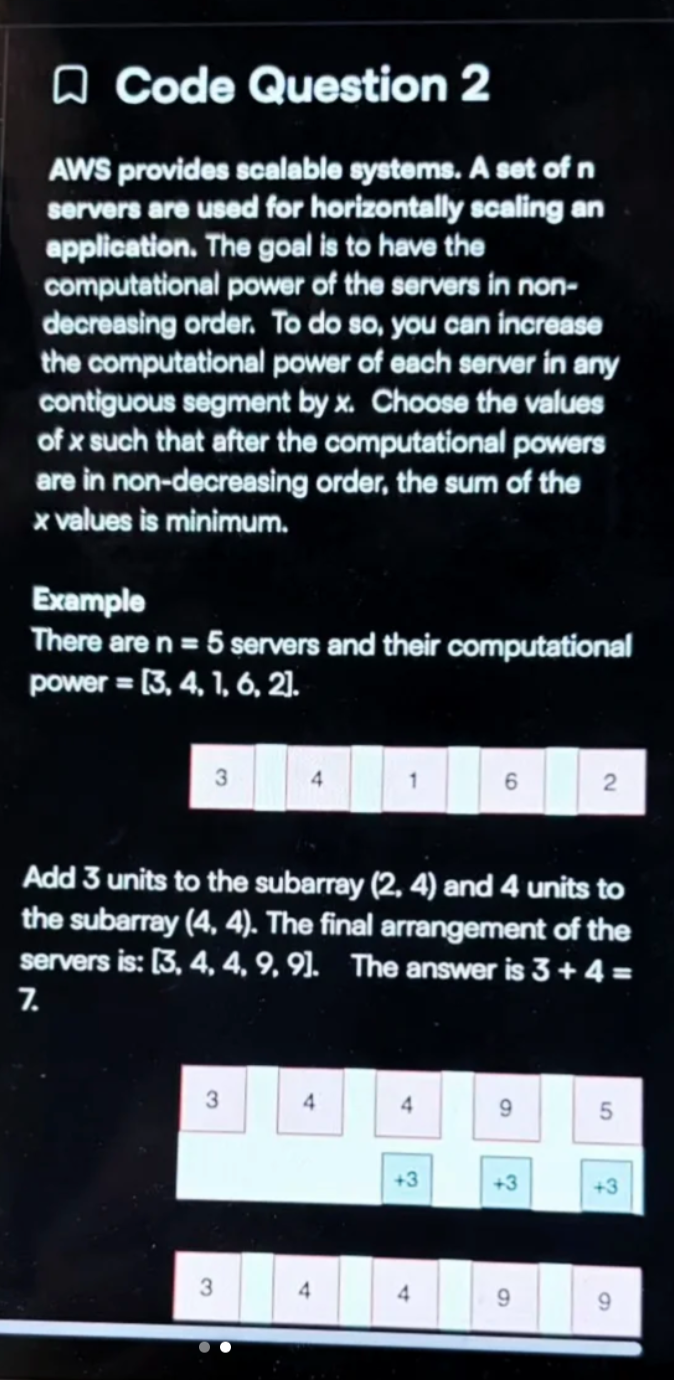
Given an array (framed as a power array in the problem), you can choose any contiguous subarray and add the same value to all its elements. Goal: make the entire array non-decreasing. Find the minimum total increment sum.
Approach
This looks like a DP problem at first glance, but there's an elegant greedy conclusion:
Scan the array and sum up all adjacent descending differences.
That is: iterate through the array, and whenever power[i] > power[i+1], add power[i] - power[i+1] to the answer.
Why is this optimal?
Every descent must be compensated — elements after a drop must be raised to at least the level before it. The most efficient strategy is to raise each element by exactly the deficit, no more. Consecutive operations can be merged, but the total increment required is always exactly the sum of all descending differences.
Complexity
- Time: O(n) — single linear scan
- Space: O(1)
Key Insight
No need to simulate the actual "add to subarray" operations. The answer is simply the sum of all adjacent descending differences — a classic greedy result where local optimality implies global optimality: every drop must be fixed, every rise needs no change.
Side-by-Side Comparison
| Problem | Core Technique | Time | Space |
|---|---|---|---|
| T1 Cyclic Shopping | Batch division + prune expensive items | O(n² log B) | O(n) |
| T2 Non-Decreasing Increment | Linear scan, sum descending diffs | O(n) | O(1) |
Common Pitfalls
| Problem | Pitfall | Correct Direction |
|---|---|---|
| T1 | Simulate one item at a time | Batch division — jump multiple rounds at once |
| T1 | Forgetting to prune after price doubles | Must remove unaffordable items each round |
| T2 | Trying DP to enumerate subarray operations | Greedy: answer = sum of all descending differences |
| T2 | Thinking you need to simulate "add" operations | One linear scan gives the answer directly in O(n) |
Amazon HackerRank OA Strategy
What to Expect
- Platform: HackerRank
- Problem style: simulation, greedy, array manipulation — tests rapid modeling ability
- Core test: can you recognize "brute force correct but too slow" and find the optimization?
- Data scales are large — watch out for O(n²) solutions
On-the-Day Tips
- T1-style cyclic simulation: when each step changes state, ask yourself whether you can "batch jump" instead of stepping one at a time
- T2-style array adjustment: for "minimum operations to satisfy property", try greedy first — local optimum often equals global optimum
- Trace through a small example on scratch paper to confirm logic before coding
- HackerRank test cases have strict edge coverage — watch for
balance = 0, single-element arrays, already non-decreasing inputs - Run the provided samples before submitting
Related LeetCode Practice
| # | Problem | Amazon OA Connection |
|---|---|---|
| 1648 | Sell Diminishing-Valued Colored Balls | T1: batch simulation thinking |
| 2141 | Maximum Running Time of N Computers | T1: division-based jumping |
| 665 | Non-decreasing Array | T2: non-decreasing check |
| 1827 | Minimum Operations to Make Array Increasing | T2: minimum increment |
🚀 Need Amazon OA Assistance?
oavoservice specializes in full-service OA/VO support for top North American tech companies. Amazon OA is one of our core service areas with extremely high coverage of both HackerRank and CodeSignal real question pools.
Add WeChat now: Coding0201
You'll get:
- ✅ Amazon OA real-time assistance (screen share + live typing hints)
- ✅ HackerRank / CodeSignal real question bank (80%+ high-frequency coverage)
- ✅ 1-on-1 mock OA + detailed feedback
- ✅ VO interview assistance (algorithms + system design)
📱 WeChat: Coding0201 | 💬 Telegram: @OAVOProxy | 📧 [email protected]
联系方式
Email: [email protected] Telegram: @OAVOProxy