Another Amazon OA done — both questions pulled from the high-frequency pool. Typical directions: one greedy simulation, one string hashing. Here's a complete breakdown of the thinking process, no code, focused entirely on problem decomposition and solution logic.
Exam Overview
| Item | Details |
|---|---|
| Platform | CodeSignal |
| Questions | 2 |
| Difficulty | Medium |
| Role | Intern / New Grad SDE |
| Result | Full AC |
T1: Virtual Machine Inventory Rental Scheduling
Problem Core
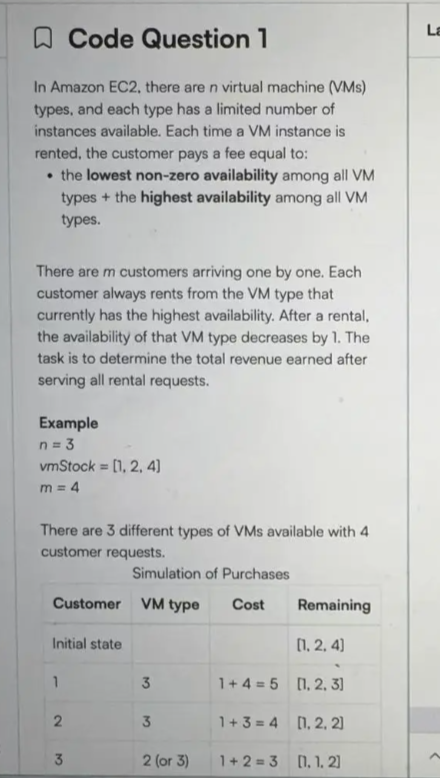
There are n types of virtual machines, each with a certain inventory count. m customers arrive one by one to rent. Each customer follows a fixed behavior:
- Always rents the type with the highest current inventory
- Rent = current maximum inventory + current minimum non-zero inventory
- After renting, that type's inventory decreases by 1
Find the total rent across all m transactions.
Approach
The key challenge: after each operation, you need to quickly answer two questions — what is the maximum inventory and what is the minimum non-zero inventory?
Sorting after every operation costs O(m·n log n) — too slow for large inputs.
The right approach: count array + dual pointers
Instead of tracking inventory per machine, use a cnt array to record how many machine types have exactly k units in stock. Example: inventory state [3, 3, 1, 5] becomes cnt[1]=1, cnt[3]=2, cnt[5]=1.
Maintain two pointers:
hipointer: always points to the current maximum non-zero inventory levellopointer: always points to the current minimum non-zero inventory level
Each rental step:
- Rent =
hi + lo, add to total - Decrement
cnt[hi](one fewer machine at this level) - Increment
cnt[hi-1](that machine drops to levelhi-1) - Update pointers as needed:
- If
cnt[hi]drops to zero, movehileft - If
hi-1 < lo, a new lower inventory level was just created — updatelodown - If
cnt[lo]drops to zero, moveloright
- If
Complexity
- Time: O(n + m) — each rental is O(1); pointers move at most max_inventory steps total
- Space: O(max_inventory) — size of the count array
Key Insight
The elegance here: you don't need to track which specific machine has what inventory — only how many machines have exactly k units. Shifting from tracking individuals to tracking the distribution lets dual pointers maintain max and min in O(1) per step.
T2: Maximum Equal Partition of String Prefix
Problem Core
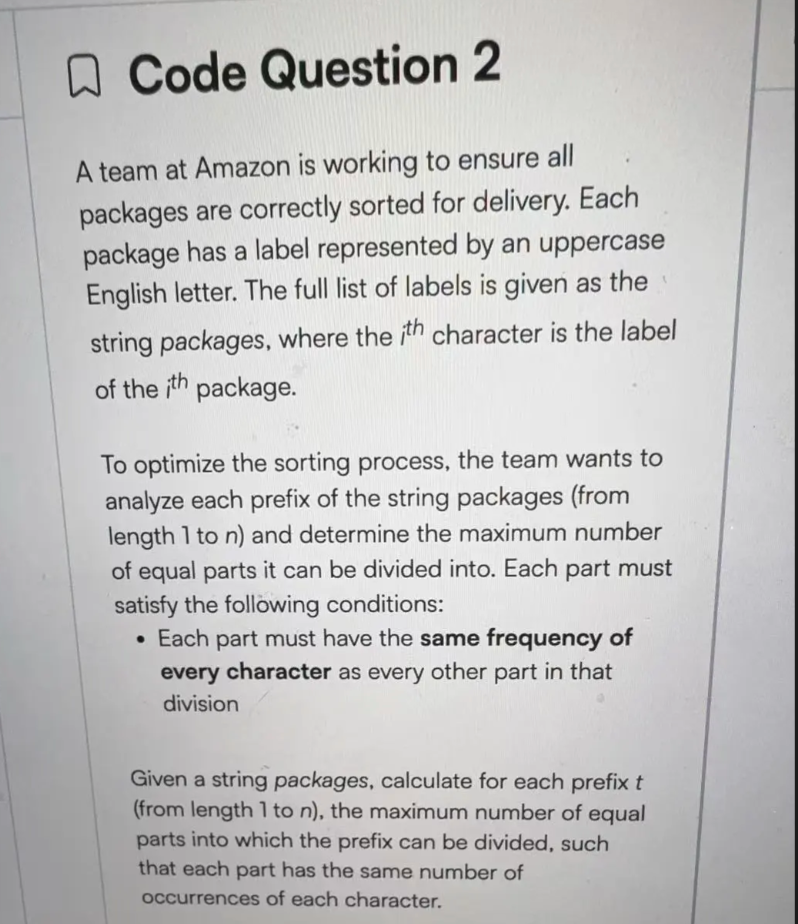
Given a string S of uppercase letters. For each prefix of S, find: what is the maximum number of equal segments the prefix can be split into, such that every segment has exactly the same character frequency for every letter?
Return an array where element i is the answer for the length-i prefix.
Approach
Brute force: for each prefix, enumerate segment length and compare character frequencies segment by segment — O(n² · 26) or worse. Won't pass.
Optimization: random hashing to compare segment frequencies
Comparing two segments' character frequencies requires checking 26 values. Can we compress that into a single number?
Core construction:
- Assign each letter A-Z a random 64-bit integer (random weight)
- Define each position's hash contribution = the random weight of the letter at that position
- Compute a prefix sum array
Hof these hash contributions
Then H[r] - H[l] represents the hash sum of the interval [l+1, r].
Key property: two segments have identical character frequencies if and only if their hash values are equal (holds with overwhelming probability).
Enumeration strategy:
- Enumerate segment length
L(from 1 to n) - For a prefix of length
k*L, verify that blocks 1, 2, ..., k all have equal hash values - If the first k blocks all match, update the answer for prefix length
k*Lto k
Complexity: for each L, you check n/L blocks. Total operations = n/1 + n/2 + ... + n/n = n·H(n) (harmonic series) = O(n log n).
Why Does Random Hashing Work?
If two segments have different character frequencies, the probability their hash values collide is roughly 1/2^64 — negligible for any realistic input size. This is the classic "randomized dimension reduction" trick used in competitive programming and technical interviews.
Complexity
- Time: O(n log n) — harmonic series enumeration
- Space: O(n) — prefix hash array
Side-by-Side Comparison
| Problem | Core Technique | Time | Space |
|---|---|---|---|
| T1 VM Rental | Count array + dual pointers | O(n + m) | O(max_val) |
| T2 Prefix Partition | Random hash + harmonic enumeration | O(n log n) | O(n) |
Common Pitfalls
| Problem | Pitfall | Correct Direction |
|---|---|---|
| T1 | Re-sorting after every step | Count array — O(1) update |
| T1 | Heap for max but ignoring min | Dual pointers tracking both hi and lo |
| T2 | Comparing all 26 frequency values directly | Random hash compresses to a single integer |
| T2 | Enumerating all segment pairs — O(n²) | Harmonic series enumeration — O(n log n) |
Amazon OA Strategy
What to Expect
- Platform: CodeSignal
- Problem style: simulation, greedy, hashing — tests engineering-oriented thinking
- Core test: can you take a "brute-force correct" solution and optimize it to an acceptable complexity?
- Data scales are typically large — O(n²) will almost never pass
On-the-Day Tips
- Read the full problem before coding — Amazon problem statements are long, and critical constraints often appear in the last few lines
- Start with brute force, then optimize — it clarifies the state space and transitions
- For T1-style simulation: first ask "what state do I need to maintain?", then "how do I update it efficiently?"
- For T2-style string problems: "equal frequency" → think hashing; "enumerate length" → think harmonic series
- Run through the examples before submitting — CodeSignal has hidden test cases
Related LeetCode Practice
| # | Problem | Amazon OA Connection |
|---|---|---|
| 295 | Find Median from Data Stream | T1: dynamic dual-extreme maintenance |
| 1539 | Kth Missing Positive Number | T1: count array thinking |
| 1316 | Distinct Echo Substrings | T2: string hashing |
| 1044 | Longest Duplicate Substring | T2: random hash + enumeration |
🚀 Need Amazon OA Assistance?
oavoservice specializes in full-service OA/VO support for top North American tech companies. Amazon OA is one of our core service areas with extremely high coverage of the real question pool.
Add WeChat now: Coding0201
You'll get:
- ✅ Amazon OA real-time assistance (screen share + live typing hints)
- ✅ CodeSignal real question bank (80%+ high-frequency coverage)
- ✅ 1-on-1 mock OA + detailed feedback
- ✅ VO interview assistance (algorithms + system design)
📱 WeChat: Coding0201 | 💬 Telegram: @OAVOProxy | 📧 [email protected]
联系方式
Email: [email protected] Telegram: @OAVOProxy