Two Booking OA problems — one classic 2D DP, one string processing + sorting challenge. Clean thinking matters but so do the details. Full walkthrough below.
Exam Overview
| Item | Details |
|---|---|
| Platform | HackerRank |
| Questions | 2 |
| Difficulty | Medium / Medium |
| Role | SDE |
| Core Topics | Dynamic Programming, HashMap, HashSet, Custom Sorting |
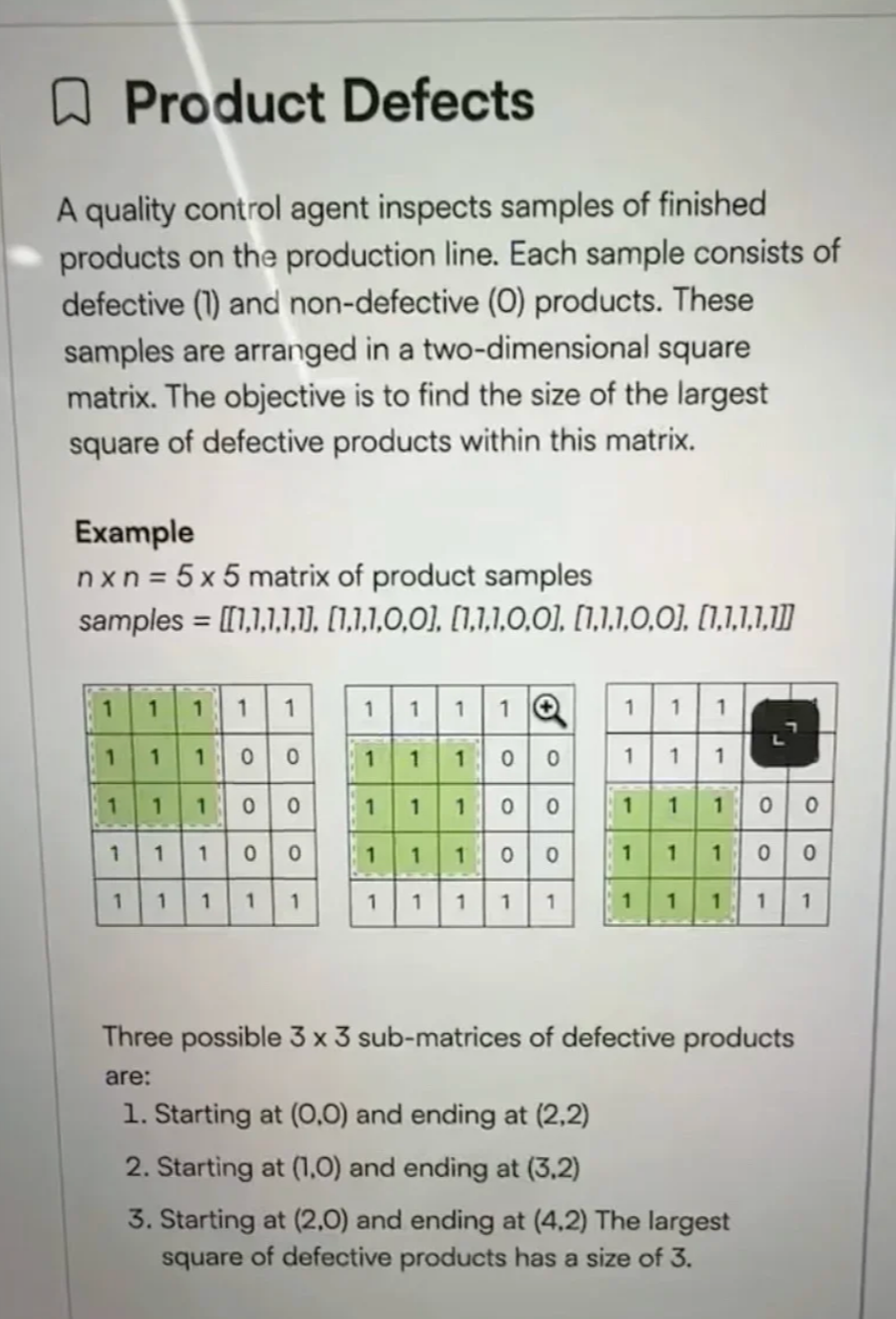
Q1: Maximal Square
Core Idea
Given a 2D matrix of '0's and '1's, find the largest square containing only 1s and return its area.
Solution Approach
Brute Force (O(mn·min(m,n)²) — TLE)
Enumerate each cell as the top-left corner of a square, try expanding the side length, and check whether the region is all 1s. Too slow for large matrices.
Optimal: 2D Dynamic Programming O(mn)
Definition: dp[i][j] = the side length of the largest all-1 square whose bottom-right corner is at (i, j).
Transition:
- If
matrix[i][j] == '0':dp[i][j] = 0 - If
matrix[i][j] == '1':
$$dp[i][j] = \min(dp[i-1][j],\ dp[i][j-1],\ dp[i-1][j-1]) + 1$$
Intuition: The largest square ending at (i, j) is constrained by the smallest of its three neighbors (top, left, top-left) — the "weakest link" determines the square's size.
Answer: Traverse the entire dp table, record the maximum side length max_side, return max_side * max_side.
Solution Template
def maximalSquare(matrix):
    if not matrix:
        return 0

    m, n = len(matrix), len(matrix[0])
    dp = [[0] * n for _ in range(m)]
    max_side = 0

    for i in range(m):
        for j in range(n):
            if matrix[i][j] == '1':
                if i == 0 or j == 0:
                    dp[i][j] = 1
                else:
                    dp[i][j] = min(dp[i-1][j], dp[i][j-1], dp[i-1][j-1]) + 1
                max_side = max(max_side, dp[i][j])

    return max_side * max_side
Complexity
- Time: O(mn) — single pass through the matrix
- Space: O(mn) — reducible to O(n) with a rolling array
Key Insight
dp[i][j]only depends on three neighbors. Taking the minimum reflects that a square's side length is determined by its shortest "edge" — a classic matrix DP state definition.
Q2: Hotel Review Keyword Scoring
Core Idea
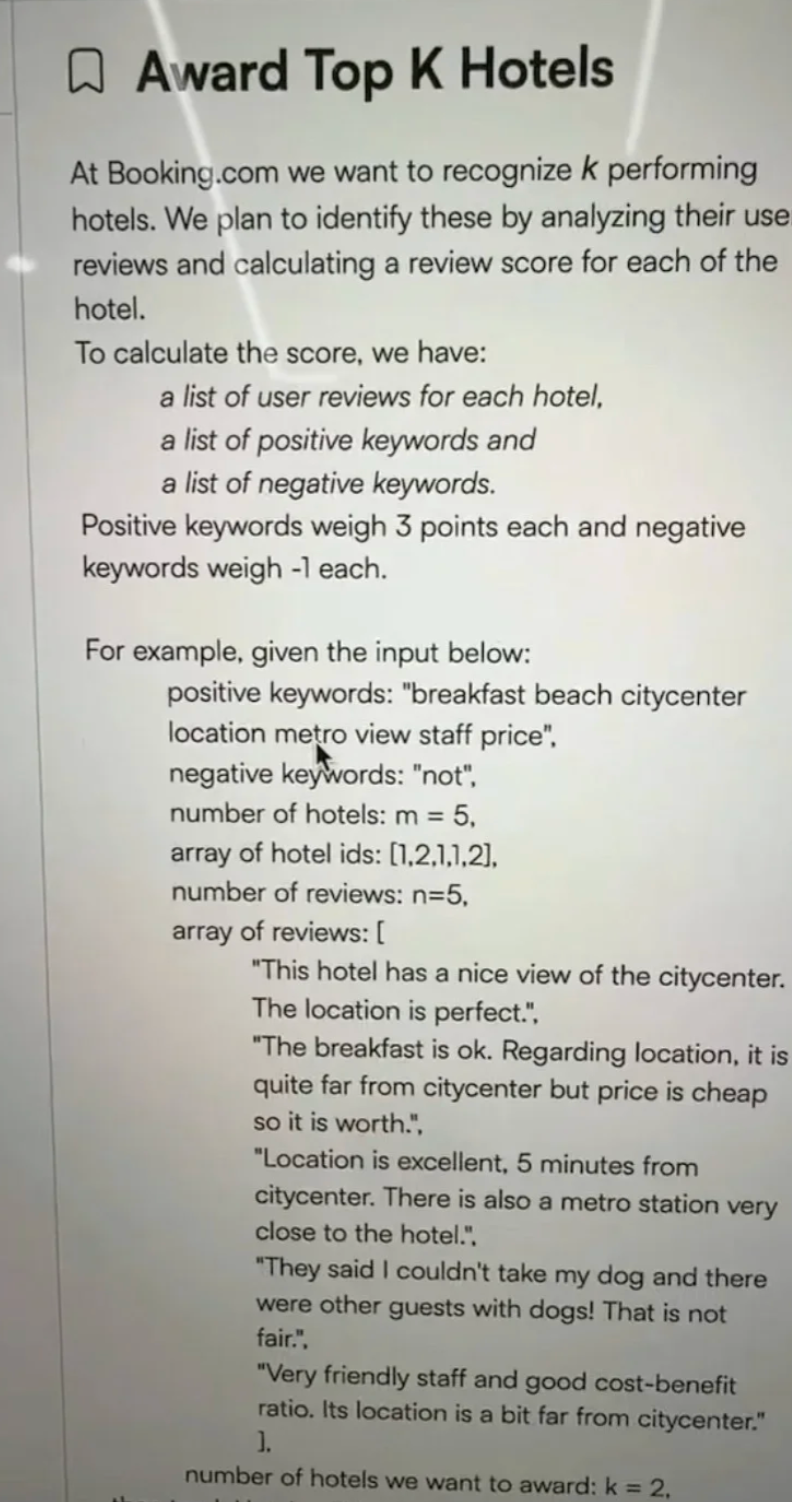
Given two sets of keywords (positive and negative) and a list of hotel reviews (each tagged with a HotelID), compute a total score per hotel based on keyword hits, then return the top-k hotel IDs sorted by score descending, with ties broken by ID ascending.
Solution Approach
Overall flow:
- Load positive and negative keywords into two
HashSets for O(1) lookup - For each review:
- Strip punctuation with regex, convert to lowercase
- Split into words
- For each word: +1 if in positive set, −1 if in negative set
- Accumulate into
HashMap<HotelID, TotalScore>
- Convert the map to a list, sort with a custom comparator: score descending, then ID ascending
- Return the first k hotel IDs
Solution Template
import re
from collections import defaultdict

def topKHotels(positive_words, negative_words, reviews, k):
    pos_set = set(positive_words)
    neg_set = set(negative_words)

    score_map = defaultdict(int)  # HotelID -> TotalScore

    for hotel_id, review_text in reviews:
        # Strip punctuation, lowercase, split
        words = re.sub(r'[^\w\s]', '', review_text.lower()).split()
        for word in words:
            if word in pos_set:
                score_map[hotel_id] += 1
            elif word in neg_set:
                score_map[hotel_id] -= 1

    # Custom sort: score descending, ID ascending on tie
    sorted_hotels = sorted(score_map.keys(),
                           key=lambda h: (-score_map[h], h))

    return sorted_hotels[:k]
Complexity
- Time: O(W log W), where W = total words across all reviews (sort dominates)
- Space: O(H + K), where H = number of hotels, K = total keywords
Key Insight
HashSet gives O(1) keyword lookup; HashMap accumulates scores in one pass. The custom comparator handles both sort dimensions (score desc, ID asc) cleanly in a single
sorted()call.
Side-by-Side Comparison
| Question | Core Technique | Time | Space |
|---|---|---|---|
| Q1 Maximal Square | 2D DP, min of 3 neighbors + 1 | O(mn) | O(mn) |
| Q2 Hotel Scoring | HashSet + HashMap + custom sort | O(W log W) | O(H + K) |
Common Mistakes
| Question | Mistake | Correct Approach |
|---|---|---|
| Q1 | Enumerate all squares, O(mn²) TLE | Use DP recurrence, single O(mn) pass |
| Q1 | Use sum instead of min in transition | Take min — square is limited by shortest edge |
| Q2 | Linear scan through keyword list | Use HashSet for O(1) lookup |
| Q2 | Ignore tie-breaking rule on equal scores | Custom comparator: score desc then ID asc |
Booking OA Strategy
On-site Pacing
- Read both problems first — allocate time by relative difficulty
- Q1 type (matrix DP): Think "bottom-right corner" as the anchor — transition almost always involves min/max of three neighbors
- Q2 type (string counting): Nail the data structures first (HashSet lookup + HashMap accumulate), then handle sorting
- Run through examples; verify edge cases (empty matrix, k larger than hotel count)
Related LeetCode Practice
| # | Problem | Covers |
|---|---|---|
| 221 | Maximal Square | Q1 identical |
| 1277 | Count Square Submatrices with All Ones | Q1 variant |
| 85 | Maximal Rectangle | Q1 advanced |
| 692 | Top K Frequent Words | Q2 sorting pattern |
| 1 | Two Sum | Q2 HashMap fundamentals |
🚀 Need Booking OA Assistance?
oavoservice provides stable, long-term real-time OA/VO support for Google, Amazon, TikTok, Booking, Uber, Bloomberg, Microsoft and more — both domestic and overseas interviews covered. High question-bank coverage.
Add WeChat: Coding0201
What you get:
- ✅ Booking OA real-time assistance (screen share + live typing hints)
- ✅ HackerRank real question bank (80%+ high-frequency coverage)
- ✅ 1-on-1 mock OA + detailed feedback
- ✅ VO interview support (algorithms + system design)
📱 WeChat: Coding0201 | 💬 Telegram: @OAVOProxy | 📧 [email protected]
Contact
Email: [email protected]
Telegram: @OAVOProxy