TikTok / ByteDance OA All 4 Questions AC Debrief
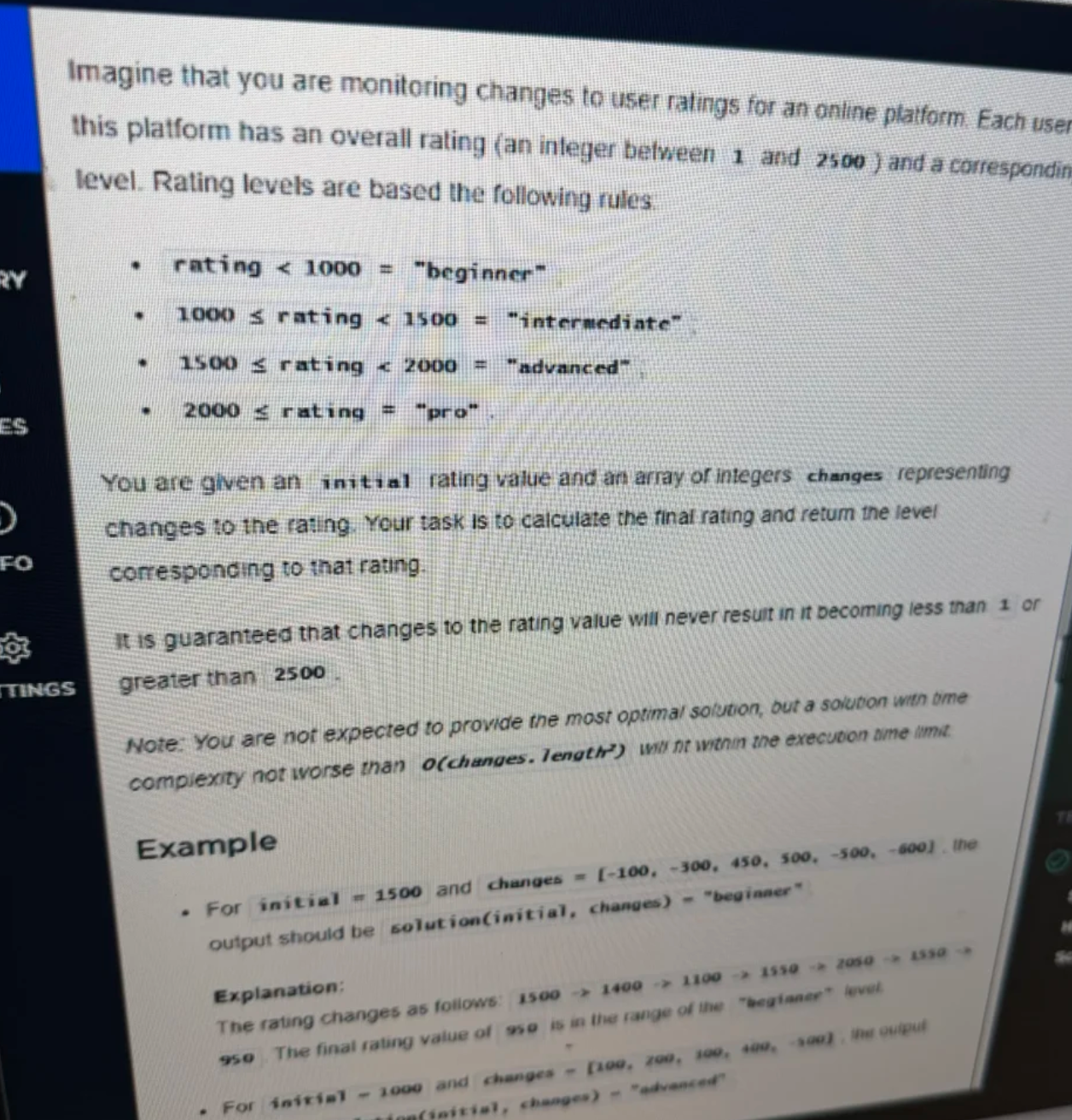
Just finished a ByteDance OA this morning — same CodeSignal platform as TikTok. 70 minutes, 4 questions, solved in ~15 minutes. All questions are drawn from a question bank. Here's the full breakdown.
Exam Overview
| Item | Details |
|---|---|
| Platform | CodeSignal |
| Duration | 70 minutes |
| Questions | 4 |
| Difficulty | Easy ~ Medium |
| Role | Intern / New Grad SDE |
| Result | All AC, ~15 minutes |
T1: Interval Lookup
Problem Summary
Given an initial value and an array, compute initial + sum(array), determine which interval it falls into, and return the corresponding label string.
Solution
def interval_lookup(initial: int, arr: list, intervals: list, labels: list) -> str:
    total = initial + sum(arr)
    for i, (lo, hi) in enumerate(intervals):
        if lo <= total < hi:
            return labels[i]
    return labels[-1]

# Example
print(interval_lookup(5, [3,2,1], [(0,5),(5,10),(10,20)], ["low","mid","high"]))
# total=11 → "high"
Time: O(n + k) | Space: O(1)
Key points:
- Watch open/closed boundaries (
<vs<=) - For large k use binary search: O(n + log k)
T2: Vowel Word Flip
Problem Summary
For each word where both first and last characters are vowels, reverse the middle characters, keeping first and last unchanged.
Solution
def vowel_word_flip(words: list) -> list:
    vowels = set('aeiouAEIOU')
    result = []
    for word in words:
        if len(word) >= 2 and word[0] in vowels and word[-1] in vowels:
            result.append(word[0] + word[1:-1][::-1] + word[-1])
        else:
            result.append(word)
    return result

# Example
print(vowel_word_flip(["abcde", "hello"]))
# abcde → a + "bcd"[::-1] + e = "adcbe"
Time: O(n·m) | Space: O(n·m)
Key points:
- Guard
len >= 2for single-char words - Python slice
[::-1]reverses in one line
T3: Battery Scheduler
Problem Summary
Use phone for t minutes with n batteries of varying capacity and charge rate. Rotate batteries — when one dies, switch to a charged one. Find the minimum number of fully-charged batteries needed.
Solution
import heapq

def min_batteries(t: int, capacity: list, charge_rate: list) -> int:
    n = len(capacity)
    ready = [(0, i) for i in range(n)]
    heapq.heapify(ready)
    charging = []
    current_time = 0
    batteries_used = 0

    while current_time < t:
        while charging and charging[0][0] <= current_time:
            heapq.heappush(ready, heapq.heappop(charging))
        if not ready:
            return -1
        _, idx = heapq.heappop(ready)
        batteries_used += 1
        use_until = current_time + capacity[idx]
        if use_until >= t:
            return batteries_used
        charge_time = use_until + capacity[idx] / charge_rate[idx]
        heapq.heappush(charging, (charge_time, idx))
        current_time = use_until

    return batteries_used
Time: O(k log n) | Space: O(n)
Key points:
- min-heap tracks earliest available charged battery
- charge_time = use_until + capacity / charge_rate
- If
use_until >= t, current battery covers the rest
T4: Chain Traversal
Problem Summary
Given a chain (linear graph), output the traversal order starting from either endpoint.
Solution
from collections import defaultdict

def chain_traversal(n: int, edges: list) -> list:
    adj = defaultdict(list)
    for u, v in edges:
        adj[u].append(v)
        adj[v].append(u)

    start = next((node for node in range(1, n+1) if len(adj[node]) == 1), 1)
    path, prev, curr = [start], None, start

    while True:
        nxt = next((nb for nb in adj[curr] if nb != prev), None)
        if nxt is None:
            break
        path.append(nxt)
        prev, curr = curr, nxt

    return path

print(chain_traversal(5, [(1,2),(2,3),(3,4),(4,5)]))
# [1, 2, 3, 4, 5]
Time: O(n) | Space: O(n)
Key points:
- Endpoint = degree-1 node
- Track only
prev, no full visited set needed on a chain - No BFS/DFS — plain while-loop simulation
Complexity Summary
| Question | Algorithm | Time | Space |
|---|---|---|---|
| T1 Interval Lookup | if-else | O(n+k) | O(1) |
| T2 Vowel Flip | set + slice | O(n·m) | O(n·m) |
| T3 Battery Scheduler | Greedy + heap | O(k log n) | O(n) |
| T4 Chain Traversal | Adj list + while | O(n) | O(n) |
Common Mistakes
| Q | Pitfall | Fix |
|---|---|---|
| T1 | Open/closed boundary confusion | Read carefully, use < vs <= |
| T2 | Single-char word edge case | Guard len >= 2 |
| T3 | Mixed time units for charge | Unify to minutes: use_until + cap/rate |
| T4 | Full visited set causes issues | On a chain, just track prev |
CodeSignal OA Strategy
TikTok / ByteDance OA Profile
- Platform: CodeSignal (same as Meta)
- Duration: 70 min, 4 questions
- Source: Random draws from a question bank — high repeat rate
- Difficulty: Easy~Medium, no Hard DP or complex graph theory
- Scoring: Partial credit per test case
Exam Day Tips
- Scan all 4 questions first — start with the easiest
- T1/T2 should take under 5 min each — secure full marks first
- T3/T4 need simulation — watch edge cases, budget 20 min
- Run provided examples before submitting
- Review edge cases if time allows: empty arrays, single node, t=0
Related LeetCode Problems
| # | Problem | Relevant To |
|---|---|---|
| 1893 | Check if Range is Covered | T1 |
| 557 | Reverse Words in a String III | T2 |
| 1642 | Furthest Building You Can Reach | T3 |
| 1971 | Find if Path Exists in Graph | T4 |
🚀 Need TikTok / ByteDance OA Assistance?
oavoservice specializes in full-service OA/VO support for North American big tech. TikTok / ByteDance OA is one of our highest-frequency services with excellent question bank coverage.
Add WeChat: Coding0201
- ✅ TikTok OA real-time assistance (screen share + live typing)
- ✅ CodeSignal question bank (80%+ coverage of high-frequency questions)
- ✅ 1-on-1 mock OA + detailed feedback
- ✅ VO interview assistance (algorithm + system design)
📱 WeChat: Coding0201 | 💬 Telegram: @OAVOProxy | 📧 [email protected]
联系方式
Email: [email protected] Telegram: @OAVOProxy