Question 1: Maximum Score Game
Problem Description
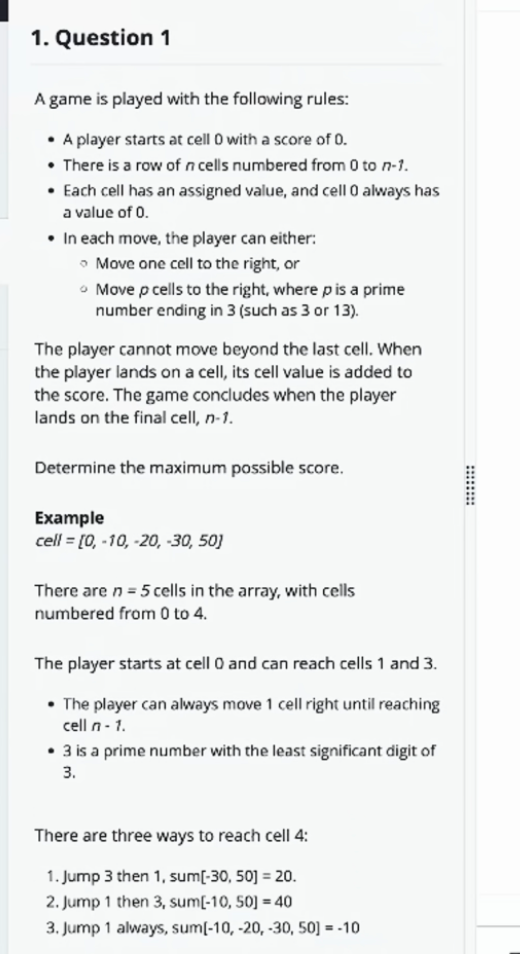
A game is played with the following rules:
- A player starts at cell 0 with a score of 0
- There are n cells numbered from 0 to n-1, each with an assigned value
- Cell 0 always has a value of 0
- In each move, the player can either:
- Move 1 cell to the right, or
- Move p cells to the right, where p is a prime number ending in 3 (such as 3, 13, 23, 43, etc.)
- The player cannot move beyond the last cell
- When the player lands on a cell, its value is added to the total score
- The game ends when the player reaches cell n-1
Determine: The maximum possible score to reach the final cell
Solution Approach
Step 1: Preprocess Prime Numbers
First, find all prime numbers ending in 3 that don't exceed n. These primes are: 3, 13, 23, 43, 53, 73, 83, etc.
def get_primes_ending_with_3(max_n):
    """Get all primes <= max_n with last digit 3"""
    primes = []

    def is_prime(num):
        if num < 2:
            return False
        if num == 2:
            return True
        if num % 2 == 0:
            return False
        for i in range(3, int(num**0.5) + 1, 2):
            if num % i == 0:
                return False
        return True

    for num in range(3, max_n, 10):  # Numbers ending in 3: 3, 13, 23, 33...
        if is_prime(num):
            primes.append(num)

    return primes
Step 2: Dynamic Programming Solution
Use a DP array where dp[i] represents the maximum score to reach cell i.
Key Idea:
- Initialize:
dp[0] = 0(starting point), other positions to negative infinity (unreachable) - State transition: For each reachable position i, try all possible moves
- Move 1 step to i+1
- Move p steps to i+p (p is a prime ending in 3)
- Update target positions with the maximum value
def max_score_game(cells, n):
    """
    Calculate maximum cumulative score

    Args:
        cells: Array of cell values
        n: Total number of cells

    Returns:
        Maximum score to reach the final cell
    """
    # Preprocess primes
    primes = get_primes_ending_with_3(n)

    # DP initialization
    dp = [-float('inf')] * n
    dp[0] = cells[0]  # Starting cell value is 0

    # State transition
    for i in range(n):
        if dp[i] == -float('inf'):
            continue  # Skip unreachable positions

        # Try moving 1 step
        if i + 1 < n:
            dp[i + 1] = max(dp[i + 1], dp[i] + cells[i + 1])

        # Try moving p steps (p is a prime ending in 3)
        for p in primes:
            if i + p < n:
                dp[i + p] = max(dp[i + p], dp[i] + cells[i + p])
            else:
                break  # Subsequent primes are larger, no need to continue

    return dp[n - 1]
Step 3: Example Walkthrough
Given: cells = [0, -10, -20, -30, 50], n = 5
- Start: dp[0] = 0
- From 0:
- Move 1 step to 1: dp[1] = 0 + (-10) = -10
- Move 3 steps to 3: dp[3] = 0 + (-30) = -30
- From 1 (dp[1] = -10):
- Move 1 step to 2: dp[2] = -10 + (-20) = -30
- Move 3 steps to 4: dp[4] = -10 + 50 = 40 ✓
- From 2 (dp[2] = -30):
- Move 1 step to 3: dp[3] = max(-30, -30 + (-30)) = -30
- Move 3 steps to 5: Out of bounds
- From 3 (dp[3] = -30):
- Move 1 step to 4: dp[4] = max(40, -30 + 50) = 40
Final Answer: 40
Time Complexity Analysis
- Preprocess primes: O(n log log n) (Sieve method)
- DP traversal: O(n × k), where k is the count of primes ending in 3 (usually small)
- Total: O(n log log n)
Common Pitfalls
❌ Pitfall 1: Forgetting to initialize unreachable positions to negative infinity ✅ Solution: Clearly distinguish between reachable and unreachable states
❌ Pitfall 2: Incomplete prime preprocessing, missing some primes ✅ Solution: Use sieve method or verify each number to ensure all primes ending in 3 are found
❌ Pitfall 3: Not handling negative cell values correctly ✅ Solution: Initialize DP to negative infinity and handle all values properly
Question 2: Minimum Operations
Problem Description
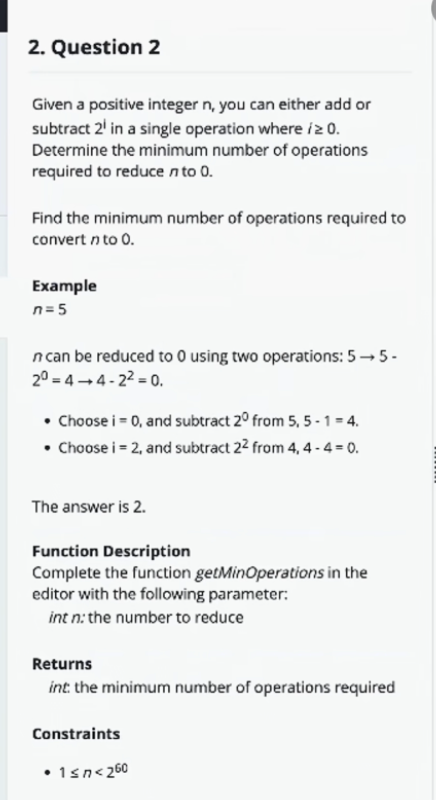
Given a positive integer n, in each operation you can either:
- Add 2^i (i ≥ 0), or
- Subtract 2^i (i ≥ 0)
Determine: The minimum number of operations required to reduce n to 0
Solution Approach
Core Observation: Binary Greedy
The key to this problem is observing the binary representation of n and utilizing the properties of binary carries.
Key Rules:
- If the current bit is 0, shift right directly (equivalent to dividing by 2)
- If the current bit is 1, eliminate it by adding or subtracting
Detailed Algorithm
def min_operations(n):
    """
    Calculate minimum operations to reduce n to 0

    Args:
        n: Positive integer

    Returns:
        Minimum number of operations
    """
    operations = 0

    while n > 0:
        # Observe the last two binary digits of n
        last_two_bits = n & 3  # Get last two bits: n % 4

        if last_two_bits == 0:
            # 00: Shift right directly
            n >>= 1
        elif last_two_bits == 1:
            # 01: Subtract 1 (becomes 00), then shift right
            n -= 1
            operations += 1
        elif last_two_bits == 2:
            # 10: Shift right directly
            n >>= 1
        else:  # last_two_bits == 3
            # 11: Add 1 (carry over to become 100), then shift right
            n += 1
            operations += 1

        operations += 1  # Count the shift operation

    return operations
Algorithm Explanation
Why does this work?
Observe the last two binary digits:
- 00: Last bit is 0, shift right directly
- 01: Last bit is 1, subtract 1 to make it 00, then shift right
- 10: Last bit is 0, shift right directly
- 11: Both last two bits are 1, adding 1 causes a carry (becomes 100), then shift right
Benefits of this approach:
- Each operation eliminates at least one bit
- Carries can merge multiple 1s
- Greedy strategy guarantees optimality
Example Walkthrough
For n = 5:
n = 5 = 101₂

Step 1: Last two bits are 01
  - Subtract 1: 5 - 1 = 4 = 100₂ (operation 1)
  - Shift right: 4 >> 1 = 2 = 10₂ (operation 2)

Step 2: Last two bits are 10
  - Shift right: 2 >> 1 = 1 = 1₂ (operation 3)

Step 3: Last two bits are 01
  - Subtract 1: 1 - 1 = 0 (operation 4)
  - Shift right: 0 >> 1 = 0 (operation 5)

Total operations: 5

Verification: 5 → 4 → 2 → 1 → 0
            (sub 1) (÷2) (÷2) (sub 1)
Wait, let me reconsider. The problem asks for operations where each operation is adding or subtracting a power of 2.
Reconsidering the Problem
Actually, we need to reconsider: each operation is adding or subtracting a power of 2, and we want the minimum number of such operations.
This is equivalent to representing n using the minimum number of powers of 2.
For example:
- n = 5 = 4 + 1 = 2² + 2⁰ (2 operations)
- n = 5 = 8 - 3 = 8 - 2 - 1 = 2³ - 2¹ - 2⁰ (3 operations)
So the optimal is 2 operations.
Improved Algorithm
def min_operations_v2(n):
    """
    Calculate minimum operations to reduce n to 0 (improved version)

    Uses the count of 1s in binary representation as the base
    """
    operations = 0

    while n > 0:
        last_two_bits = n & 3

        if last_two_bits == 0:
            # 00: Shift right
            n >>= 1
        elif last_two_bits == 1:
            # 01: Subtract 1
            n -= 1
            operations += 1
        elif last_two_bits == 2:
            # 10: Shift right
            n >>= 1
        else:  # last_two_bits == 3
            # 11: Add 1 (carry)
            n += 1
            operations += 1

    return operations
For n = 5:
5 = 101₂
Last two bits are 01 → Subtract 1 → 4 = 100₂ (operation 1)
Last two bits are 00 → Shift right → 2 = 10₂
Last two bits are 10 → Shift right → 1 = 1₂
Last two bits are 01 → Subtract 1 → 0 (operation 2)

Total operations: 2 ✓
Time Complexity Analysis
- Loop iterations: O(log n) (at least one bit is eliminated each time)
- Each iteration: O(1)
- Total: O(log n)
Common Pitfalls
❌ Pitfall 1: Confusing "operations" with "shift operations" ✅ Solution: Only additions and subtractions count as operations; shifts are free
❌ Pitfall 2: Not utilizing the carry property ✅ Solution: When the last two bits are 11, adding 1 creates a carry that can merge multiple 1s
❌ Pitfall 3: Incorrect greedy strategy ✅ Solution: Observe the last two bits and follow the rules
Interview Strategy
Time Management
Question 1 (Maximum Score Game):
- Understand problem: 3-5 minutes
- Design algorithm: 5-7 minutes
- Code implementation: 10-15 minutes
- Test and verify: 5 minutes
- Total: 25-35 minutes
Question 2 (Minimum Operations):
- Understand problem: 2-3 minutes
- Analyze binary patterns: 5-8 minutes
- Code implementation: 8-10 minutes
- Test and verify: 3-5 minutes
- Total: 18-26 minutes
On-Site Tips
Question 1:
- Confirm the definition of primes (ending in 3)
- Clarify boundary conditions (cannot exceed n-1)
- Start with simple examples to derive the solution
Question 2:
- Use several examples to find patterns
- Observe binary representations
- Explain why adding or subtracting 1 is optimal
Common Questions
Q: Will the algorithm work if n is very large (close to 2^60)?
A: Yes. Question 2 has O(log n) time complexity, so even n = 2^60 requires only about 60 iterations. Question 1 requires preprocessing primes, but the density of primes ending in 3 is sufficient and won't be a bottleneck.
Q: What if all cell values in Question 1 are negative?
A: You still need to reach the final cell, so choose the path with the smallest total loss. The DP algorithm handles this automatically.
Q: Is there an alternative approach to Question 2?
A: Yes. Question 2 is essentially finding the minimum number of powers of 2 to represent n. You could also use BFS or memoized search, but binary greedy is optimal.
Complete Code Implementation
def get_primes_ending_with_3(max_n):
    """Get all primes <= max_n with last digit 3"""
    primes = []

    def is_prime(num):
        if num < 2:
            return False
        if num == 2:
            return True
        if num % 2 == 0:
            return False
        for i in range(3, int(num**0.5) + 1, 2):
            if num % i == 0:
                return False
        return True

    for num in range(3, max_n, 10):
        if is_prime(num):
            primes.append(num)

    return primes


def max_score_game(cells):
    """Calculate maximum cumulative score"""
    n = len(cells)
    primes = get_primes_ending_with_3(n)

    dp = [-float('inf')] * n
    dp[0] = cells[0]

    for i in range(n):
        if dp[i] == -float('inf'):
            continue

        # Move 1 step
        if i + 1 < n:
            dp[i + 1] = max(dp[i + 1], dp[i] + cells[i + 1])

        # Move p steps
        for p in primes:
            if i + p < n:
                dp[i + p] = max(dp[i + p], dp[i] + cells[i + p])
            else:
                break

    return dp[n - 1]


def min_operations(n):
    """Calculate minimum operations to reduce n to 0"""
    operations = 0

    while n > 0:
        last_two_bits = n & 3

        if last_two_bits == 0:
            n >>= 1
        elif last_two_bits == 1:
            n -= 1
            operations += 1
        elif last_two_bits == 2:
            n >>= 1
        else:  # last_two_bits == 3
            n += 1
            operations += 1

    return operations


# Test cases
if __name__ == "__main__":
    # Test Question 1
    cells = [0, -10, -20, -30, 50]
    print(f"Maximum score: {max_score_game(cells)}")  # Output: 40

    # Test Question 2
    print(f"Minimum operations: {min_operations(5)}")  # Output: 2
🚀 Need Interview Assistance?
oavoservice provides professional OA/VO assistance services to help you quickly pass technical interviews at major tech companies like Microsoft, Amazon, and more.
👉 Contact WeChat: Coding0201
联系方式
Email: [email protected] Telegram: @OAVOProxy