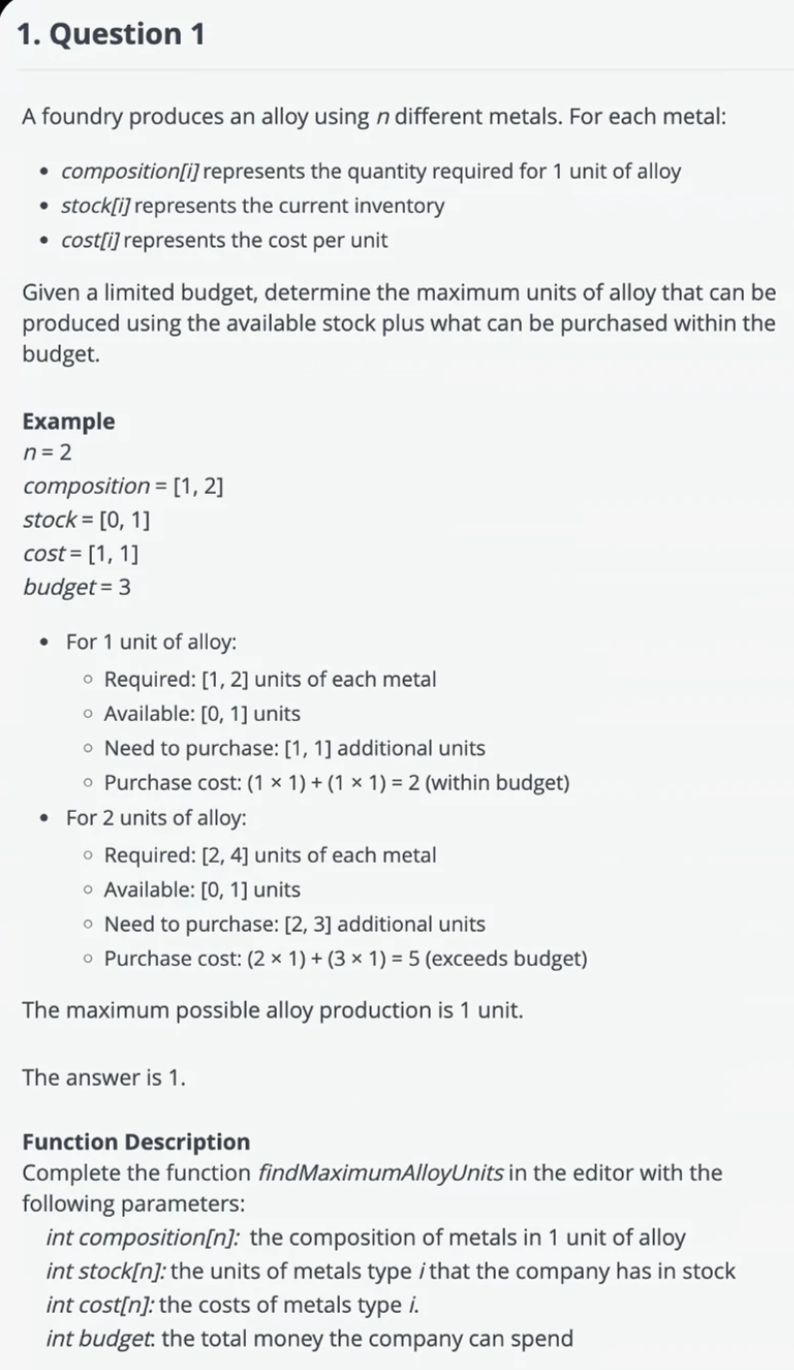
Microsoft OA — 75 minutes, 2 questions, full AC. T1 is a classic binary search on answer. T2 is an interval overlap counting problem. Pure logic breakdown below, no code.
Exam Overview
| Item | Details |
|---|---|
| Duration | 75 minutes |
| Questions | 2 |
| Difficulty | Medium |
| Role | Intern / New Grad SDE |
| Result | Full AC |
T1: Maximum Alloy Production (Binary Search on Answer)
Problem Core
Given n types of metals, each with:
composition[i]: units of metal i needed per alloy unit producedstock[i]: current inventory of metal icost[i]: purchase price per unit of metal i
With a total budget, find the maximum number of alloy units that can be produced.
Approach
Key observation: as production quantity x increases, the total cost increases monotonically. This is exactly the condition for binary search on the answer.
Binary search framework:
- Range: left = 0, right = a large upper bound (e.g. 10^9, or estimated from budget / min_cost + max_stock)
- For each candidate
x, runcheck(x)to see if it's feasible
check(x) logic:
- For each metal
i, compute required amount:total = x * composition[i] - If
stock[i] >= total, no purchase needed - Otherwise, buy
(total - stock[i])units at cost(total - stock[i]) * cost[i] - Sum all purchase costs — return true if total cost
<= budget
Result: the largest x for which check(x) returns true.
Complexity
- Time: O(n log C) — C is the binary search upper bound, n is number of metals
- Space: O(1)
Key Insight
Monotonicity is the prerequisite for binary search: more production always means more cost. The check(x) function is a single linear pass. Make sure the upper bound is large enough — use (budget / min_cost + max_stock) as a safe estimate to avoid truncating the answer.
T2: Maximum Team Size with Center Employee
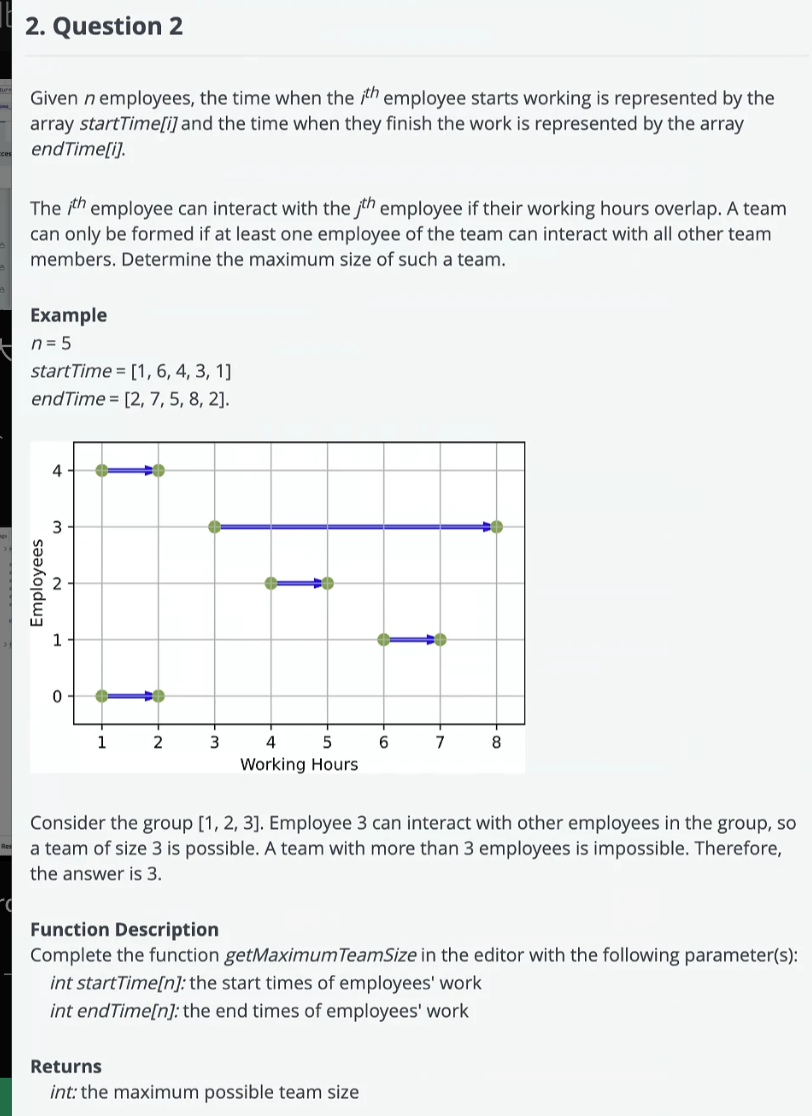
Problem Core
Given each employee's work time interval [startTime[i], endTime[i]]. Two employees can interact if their intervals overlap.
Find the largest team such that one center employee overlaps with every other member. Return the maximum team size.
Approach
Equivalent restatement: find the employee i whose interval overlaps with the most other intervals (including themselves).
Overlap condition: intervals [s1, e1] and [s2, e2] overlap if and only if:
max(s1, s2) <= min(e1, e2)
Equivalently: s2 <= e1 AND e2 >= s1.
Brute force: enumerate every employee i as center, count overlapping employees — O(n²). Works for small inputs.
Optimized approach O(n log n):
- Sort all intervals by
start - For each interval
ias center:- All intervals
jwithstart[j] <= end[i]are candidates (binary search for right boundary) - Among those, exclude intervals where
end[j] < start[i](use a left pointer that advances asend[j]becomes too small)
- All intervals
- Valid count = right pointer - left pointer
Sweep line note: this problem is not asking for global maximum overlap at a point in time, but "how many intervals does a specific interval overlap with" — two-pointer on sorted intervals is more direct.
Complexity
- Brute force: O(n²)
- Optimized: O(n log n) — sort + two-pointer linear scan
- Space: O(n)
Key Insight
"Center employee overlaps with everyone" = "find the interval that overlaps with the most other intervals". Sorting then two-pointer is the standard pattern for "how many intervals does interval i intersect".
Side-by-Side Comparison
| Problem | Core Technique | Time | Space |
|---|---|---|---|
| T1 Alloy Production | Binary search on answer + linear check | O(n log C) | O(1) |
| T2 Max Team | Sort + two-pointer interval overlap count | O(n log n) | O(n) |
Common Pitfalls
| Problem | Pitfall | Correct Direction |
|---|---|---|
| T1 | Enumerating production quantity directly | Recognize monotonicity, apply binary search |
| T1 | Upper bound too small, answer gets truncated | Estimate upper bound from budget and costs |
| T2 | Using BFS / graph connectivity | Not connectivity — need "one node covers all" |
| T2 | Brute force O(n²) times out | Sort + two-pointer brings it to O(n log n) |
Microsoft OA Strategy
What to Expect
- Duration: 75 minutes — fewer questions but higher quality
- Problem style: binary search, intervals, greedy — tests clarity of algorithmic thinking
- Core test: can you recognize problem structure (monotonicity, interval properties) and choose the right framework?
- Data scales are large — O(n²) typically won't pass
On-the-Day Tips
- "Maximum X satisfying constraint" type problems: check for monotonicity first — if monotone, binary search on answer
- Interval overlap/coverage problems: sort first, then consider two pointers or sweep line
- Set the binary search upper bound carefully to avoid truncating the answer
- The overlap condition
max(s1,s2) <= min(e1,e2)is equivalent to two inequalities — memorize both forms - Test edge cases: single employee, all overlapping, no overlapping
Related LeetCode Practice
| # | Problem | Connection |
|---|---|---|
| 2861 | Maximum Number of Alloys | T1: identical problem type |
| 875 | Koko Eating Bananas | T1: binary search on answer classic |
| 2779 | Maximum Beauty of an Array | T2: interval coverage counting |
| 56 | Merge Intervals | T2: interval sorting |
🚀 Need Microsoft OA Assistance?
oavoservice specializes in full-service OA/VO support for top North American tech companies. Microsoft OA is one of our core service areas with extremely high real question pool coverage.
Add WeChat now: Coding0201
You'll get:
- ✅ Microsoft OA real-time assistance (screen share + live typing hints)
- ✅ Real question bank (80%+ high-frequency coverage)
- ✅ 1-on-1 mock OA + detailed feedback
- ✅ VO interview assistance (algorithms + system design)
📱 WeChat: Coding0201 | 💬 Telegram: @OAVOProxy | 📧 [email protected]
联系方式
Email: [email protected] Telegram: @OAVOProxy