Robinhood APM Program Pre-Screen Real Questions|Warrior vs Monster + Bank System Complete Analysis
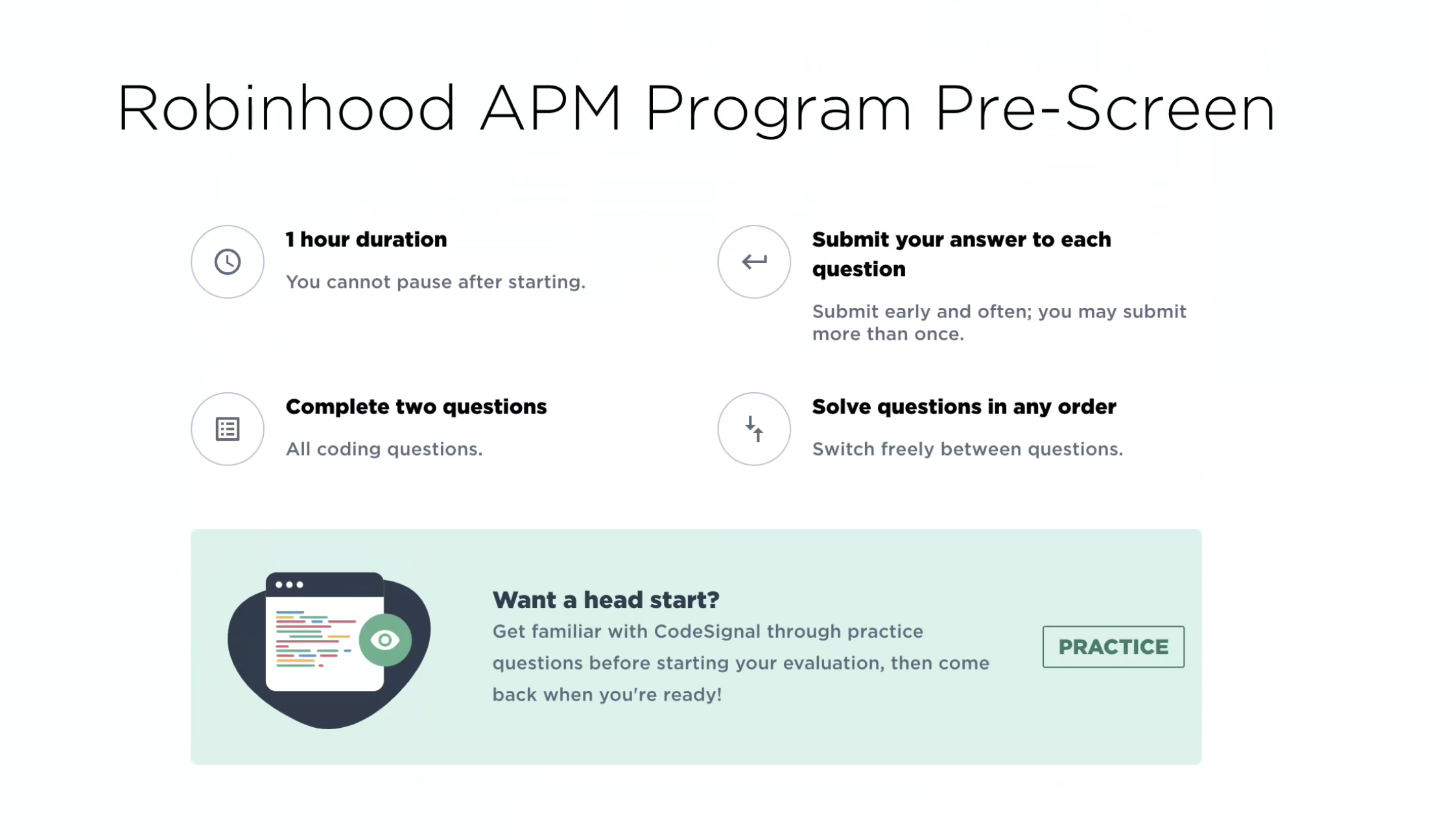
Introduction: Robinhood's APM (Associate Product Manager) Program is one of Silicon Valley's most competitive entry-level programs. The Pre-Screen OA typically includes 2-3 high-difficulty algorithm problems that test candidates' system design thinking, resource optimization ability, and real-time event processing skills.
This article provides an in-depth review of two classic real questions: Warrior vs Monster (Greedy + DP) and Bank System (Event-Driven + Priority Queue), helping you score full marks on the OA and build a strong foundation for VO interviews.
Problem 1: Warrior vs Monster
📌 Problem Background
In an intense KvK (Kingdom vs Kingdom) event, your warrior alliance needs to defeat a monster to earn points. The core of this problem is resource allocation optimization — how to defeat the monster with minimal warrior casualties.
🎯 Problem Requirements
Input:
healthPoints: Array of warrior health pointsattackDamage: Array of warrior attack damage valuesmonsterHealth: Monster's health points
Output:
- Maximum number of warriors remaining after defeating the monster
- Return 0 if it's impossible to defeat the monster
Core Rules:
- Each turn, command one warrior to attack the monster
- If the monster survives, it counter-attacks that warrior
- Warriors with health ≤ 0 die
- If all warriors die, you lose
💡 Example Analysis
Input:
healthPoints = [110, 30, 50]
attackDamage = [12, 11, 20]
monsterHealth = 100

Output: 2

Detailed Process:
1. Deploy Warrior 2 (attack 20) to attack 4 times
   - Monster health: 100 - 20*4 = 20
   - Warrior 2 health: 50 - 12*4 = 2

2. Deploy Warrior 1 (attack 12) to attack 2 times
   - Monster health: 20 - 12*2 = -4 (dead)
   - Warrior 1 health: 110 - 12*1 = 98

Result: Warriors 1 and 2 survive, total 2 warriors
🔥 Solution Approach
Step 1: Feasibility Check
if sum(attackDamage) <= monsterHealth:
    return 0  # Total damage insufficient, cannot win
Step 2: Greedy Strategy
Key Insight: Number of counter-attacks a warrior can endure = (warrior_health - 1) // monster_damage
To maximize surviving warriors:
- Deploy warriors that can endure more damage first
- Let high-damage warriors attack as much as possible
Step 3: Complete Code (Python)
def maxWarriors(healthPoints, attackDamage, monsterHealth):
    """
    Calculate maximum warriors remaining after defeating monster

    Time Complexity: O(n log n)
    Space Complexity: O(n)
    """
    if sum(attackDamage) <= monsterHealth:
        return 0

    n = len(healthPoints)
    warriors = [(attackDamage[i], healthPoints[i], i)
                for i in range(n)]
    warriors.sort(reverse=True)

    remaining_health = monsterHealth
    alive_count = 0

    for damage, health, idx in warriors:
        attacks_needed = (remaining_health + damage - 1) // damage
        damage_taken = attacks_needed * 12

        if damage_taken < health:
            alive_count += 1
            remaining_health -= attacks_needed * damage
        else:
            remaining_health -= (health // 12) * damage

        if remaining_health <= 0:
            break

    return alive_count
📊 Complexity Analysis
| Approach | Time Complexity | Space Complexity | Notes |
|---|---|---|---|
| Greedy Sort | O(n log n) | O(n) | Recommended |
| Binary Search | O(n² log n) | O(n) | Requires exact validation |
| Dynamic Programming | O(n²) | O(n) | Small datasets |
Problem 2: Bank System
📌 Problem Background
Design an automated banking system to process deposit and withdrawal requests. This problem tests event-driven architecture and time management — how to correctly handle delayed events under strict timestamp constraints.
🎯 Problem Requirements
Input:
balances: Array of initial account balancesrequests: List of transaction requests
Request Format:
deposit <timestamp> <holder_id> <amount>- Deposit moneywithdraw <timestamp> <holder_id> <amount>- Withdraw money (with 2% cashback)
Cashback Rules:
- 2% of withdrawn amount (rounded down) is returned 24 hours later
- If cashback and other operations occur at same timestamp, cashback is processed first
Output:
- Final balance array, or return
[-request_id]for first invalid request
💡 Example Analysis
Input:
balances = [1000, 1500]
requests = [
    "withdraw 1613327630 2 480",
    "withdraw 1613327644 2 800",
    "withdraw 1614105244 1 100",
    "deposit 1614108844 2 200",
    "withdraw 1614108845 2 150"
]

Output: [900, 295]

Detailed Process:
Initial: [1000, 1500]

1. withdraw 1613327630 2 480
   Account 2: 1500 - 480 = 1020
   Cashback: 480 * 0.02 = 9 (at timestamp 1613414030)
   Result: [1000, 1020]

2. withdraw 1613327644 2 800
   Account 2: 1020 - 800 = 220
   Cashback: 800 * 0.02 = 16 (at timestamp 1613414044)
   Result: [1000, 220]

3. At timestamp 1613414030: Cashback 9
   Result: [1000, 229]

4. At timestamp 1613414044: Cashback 16
   Result: [1000, 245]

5. withdraw 1614105244 1 100
   Account 1: 1000 - 100 = 900
   Result: [900, 245]

6. deposit 1614108844 2 200
   Account 2: 245 + 200 = 445
   Result: [900, 445]

7. withdraw 1614108845 2 150
   Account 2: 445 - 150 = 295
   Result: [900, 295]
🔥 Solution Approach
Step 1: Data Structure Design
Use Priority Queue (Min-Heap) to efficiently manage cashback events:
import heapq

class BankSystem:
    def __init__(self, balances):
        self.balances = balances.copy()
        self.cashback_heap = []  # (timestamp, account_id, amount)
Step 2: Complete Code (Python)
import heapq

def accountBalanceAfterRequests(balances, requests):
    """
    Process bank requests and return final balances

    Time Complexity: O(n log m), n=requests, m=pending cashbacks
    Space Complexity: O(m)
    """
    balances = balances.copy()
    cashback_heap = []

    for i, req in enumerate(requests):
        parts = req.split()
        op_type = parts[0]
        timestamp = int(parts[1])
        holder_id = int(parts[2])
        amount = int(parts[3])

        while cashback_heap and cashback_heap[0][0] <= timestamp:
            cb_time, acc_id, cb_amount = heapq.heappop(cashback_heap)
            balances[acc_id] += cb_amount

        if holder_id < 1 or holder_id > len(balances):
            return [-i - 1]

        account_idx = holder_id - 1

        if op_type == "deposit":
            balances[account_idx] += amount
        else:
            if balances[account_idx] < amount:
                return [-i - 1]

            balances[account_idx] -= amount

            cashback = amount * 2 // 100
            if cashback > 0:
                cashback_time = timestamp + 86400
                heapq.heappush(cashback_heap,
                             (cashback_time, account_idx, cashback))

    return balances
📊 Complexity Analysis
| Metric | Complexity | Notes |
|---|---|---|
| Time Complexity | O(n log m) | n=requests, m=pending cashbacks |
| Space Complexity | O(m) | Storage for pending cashback events |
🎓 Interview Key Points Summary
Warrior vs Monster
✅ Understand problem essence - This is a resource allocation optimization problem
✅ Greedy strategy correctness - Why deploy high-damage warriors first?
✅ Edge case handling - Warriors dying exactly, monster dying exactly
✅ Follow-up questions:
- What if warriors can choose not to attack?
- What if there are multiple monsters?
- What if warriors can heal?
Bank System
✅ Time management - How to correctly handle timestamps and delayed events?
✅ Data structure choice - Why use heap instead of other structures?
✅ Edge cases - Account validation, balance checks, cashback calculation
✅ Error handling - How to return first invalid request index?
✅ Follow-up questions:
- What if multiple cashbacks occur at same timestamp?
- How to support querying balance at specific time?
- How to handle very large cashback amounts?
🚀 OA/VO Interview Strategy
OA Phase
- ⏱️ Time Management: Two problems usually have 90-minute limit, allocate 40 min/problem
- 💻 Code Quality: Focus on edge cases and error handling
- 📝 Clear Comments: Help interviewer quickly understand your approach
VO Interview
- 🎤 Clear Communication: Explain complex algorithms in simple language
- 🔍 Deep Discussion: Prepare answers for follow-up questions
- 🏗️ System Thinking: Demonstrate understanding of overall architecture
📚 Related Resources
Official Documentation
Learning Resources
- LeetCode - Greedy Algorithm
- LeetCode - Priority Queue
- Wikipedia - Event-Driven Architecture
- 1point3acres - Robinhood OA Discussion
Related Problems
- LeetCode 1882 - Process Tasks Using Servers
- LeetCode 2402 - Meeting Rooms III
- LeetCode 1834 - Single-Threaded CPU
💼 Need Professional Assistance?
oavoservice provides professional Robinhood OA/VO assistance services:
✅ OA Assistance - Full-score pass on all test cases
✅ VO Support - Real-time hints and code suggestions
✅ Interview Proxy - Senior engineers accompany you throughout
✅ System Design Coaching - Help you understand big tech thinking
Contact Information
- 📱 WeChat: Coding0201
- 💬 Telegram: @OAVOProxy
- 📧 Email: [email protected]
- 🔗 Website: oavoservice.com
To speed up contact and evaluation, please provide:
- Company: Robinhood
- Position: APM Program
- Interview Date: Specific date
- Needs: OA Assistance / VO Support / Interview Proxy
Published: March 16, 2026
Difficulty: ⭐⭐⭐⭐⭐ (Hard)
Tags: Robinhood, APM Program, OA Assistance, VO Support, Interview Proxy, Greedy Algorithm, Dynamic Programming, Event-Driven, Priority Queue, System Design
Update History:
- 2026-03-16: Initial publication with complete analysis of both problems
联系方式
Email: [email protected] Telegram: @OAVOProxy