This TikTok CodeSignal Backend OA set is not algorithmically heavy, but it is very representative. The first two problems are warm-ups, the third is a stateful simulation, and the fourth is a clean prefix lookup problem.
The main challenge is not finding an advanced template. It is translating each rule into a state that stays consistent while you simulate it. This is especially true for the memory allocation problem: if you over-engineer it, the implementation can become harder than the problem itself.
This recap skips code and focuses on how to think through the four problems during the assessment.
Assessment Overview
| Item | Detail |
|---|---|
| Platform | CodeSignal |
| Company | TikTok |
| Role direction | Backend / SWE |
| Number of problems | 4 |
| Topics | Interval lookup, array simulation, memory allocation simulation, numeric prefix HashSet |
| Overall difficulty | Easy to Medium |
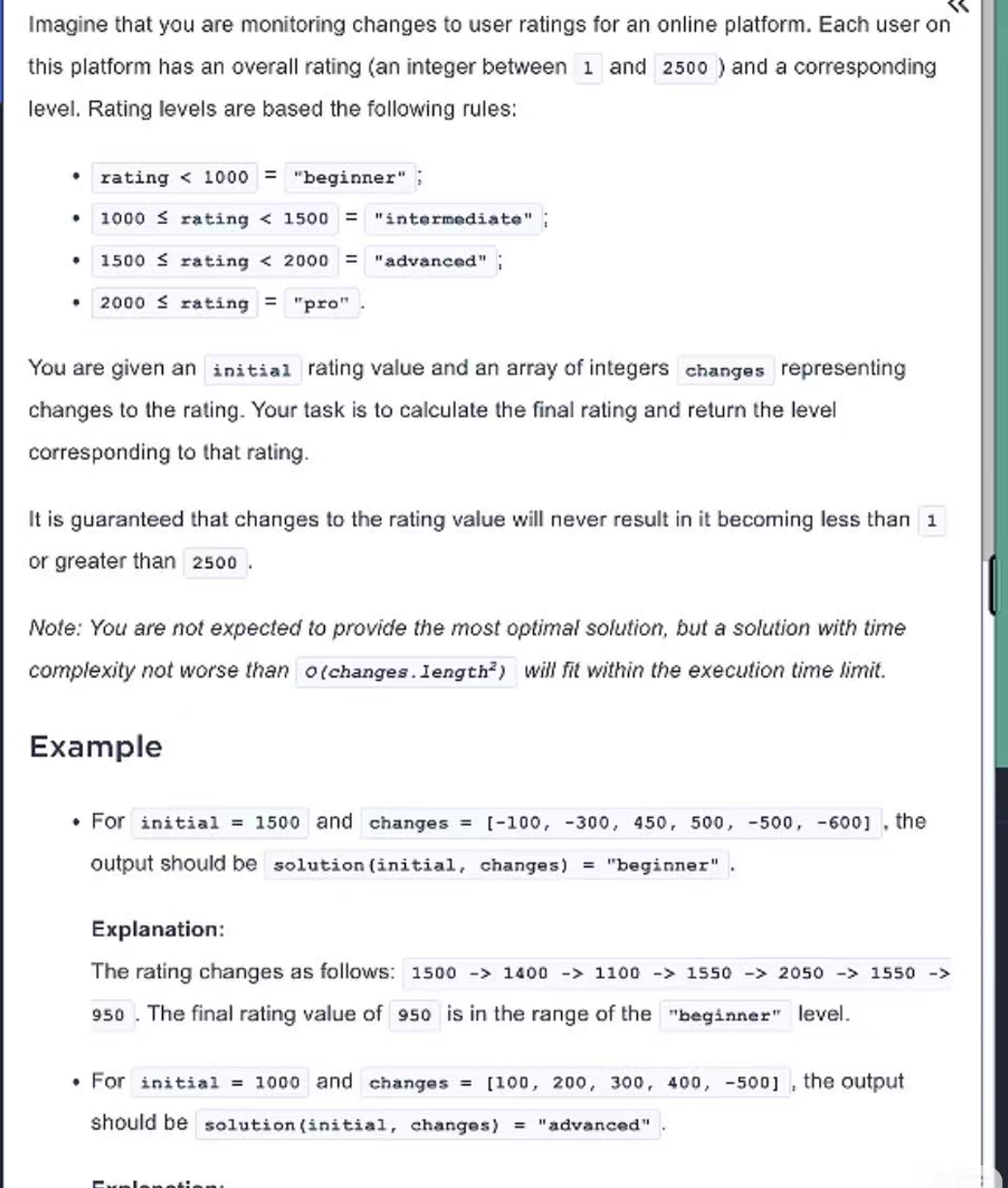
Q1: Final Rating Level
What the problem asks
You are given an initial rating and an array of rating changes. Add all changes to the initial value, then return the level for the final rating:
- below 1000 is beginner
- 1000 to 1499 is intermediate
- 1500 to 1999 is advanced
- 2000 or above is pro
The statement guarantees the rating will stay within the valid range, so there is no need to handle invalid values.
How to approach it
This is simply a sum followed by interval lookup. Compute the final rating, then check which range contains it.
There is no hidden optimization here. Even though CodeSignal says an optimal solution is not required, the natural solution is already linear in the number of changes.
Common mistakes
- Misreading 1000, 1500, and 2000 as exclusive boundaries
- Treating 999 and 1000 as the same level
- Returning the level after an intermediate update instead of after all changes
This problem should be finished quickly. Save time for the simulation questions.
Q2: Array Reduction from the Leftmost Non-Zero Element
What the problem asks
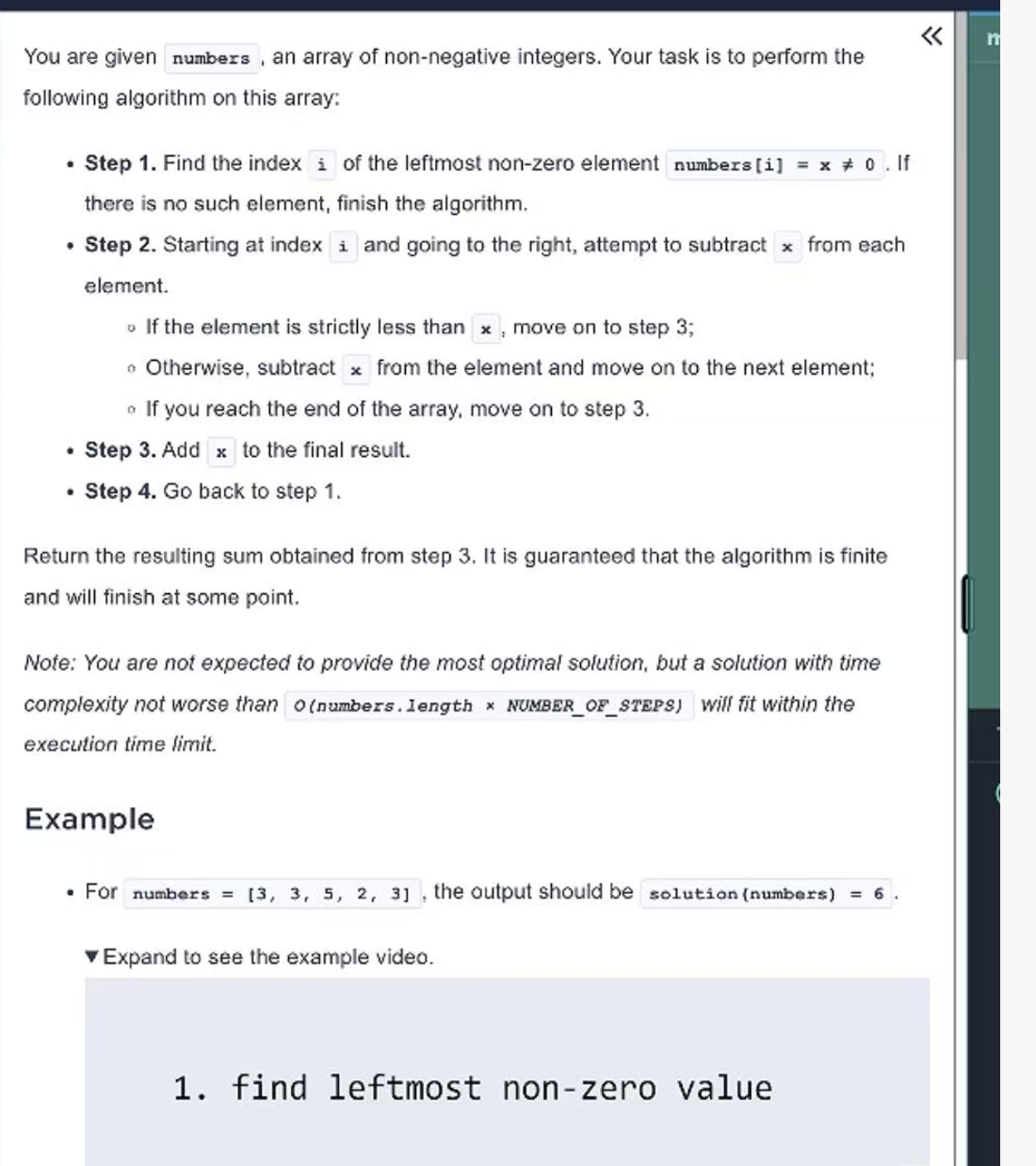
You are given an array of non-negative integers. In each round, find the leftmost non-zero element and call its value x. Starting from that index, move right and try to subtract x from each element.
If you meet an element strictly smaller than x, the round stops. Regardless of where the round stops, add x to the final answer, then repeat the process.
When the array has no non-zero elements left, return the accumulated answer.
How to approach it
Direct simulation is enough:
- Find the first non-zero element from the left
- Use its current value as the round value
- Move right and subtract that value while possible
- Stop when an element is too small
- Add the round value to the answer
- Start over from the left
The problem itself allows a straightforward process, so there is no need to force a clever formula.
Why the direct simulation is stable
The start of each round depends on the current array state. This is not a fixed-window problem, and it is not something that naturally resolves in one pass without preserving the process.
For an OA, this is exactly the kind of problem where overthinking can hurt. Unless the constraints demand something stronger, implementing the rules literally is the safest path.
Common mistakes
- Using the original array value instead of the current value of the leftmost non-zero element
- Stopping when an element equals
x; equality is still subtractable - Adding the number of modified elements to the answer instead of adding
x - Forgetting to restart the search from the left after each round
Q3: 8-Aligned Memory Allocator
What the problem asks
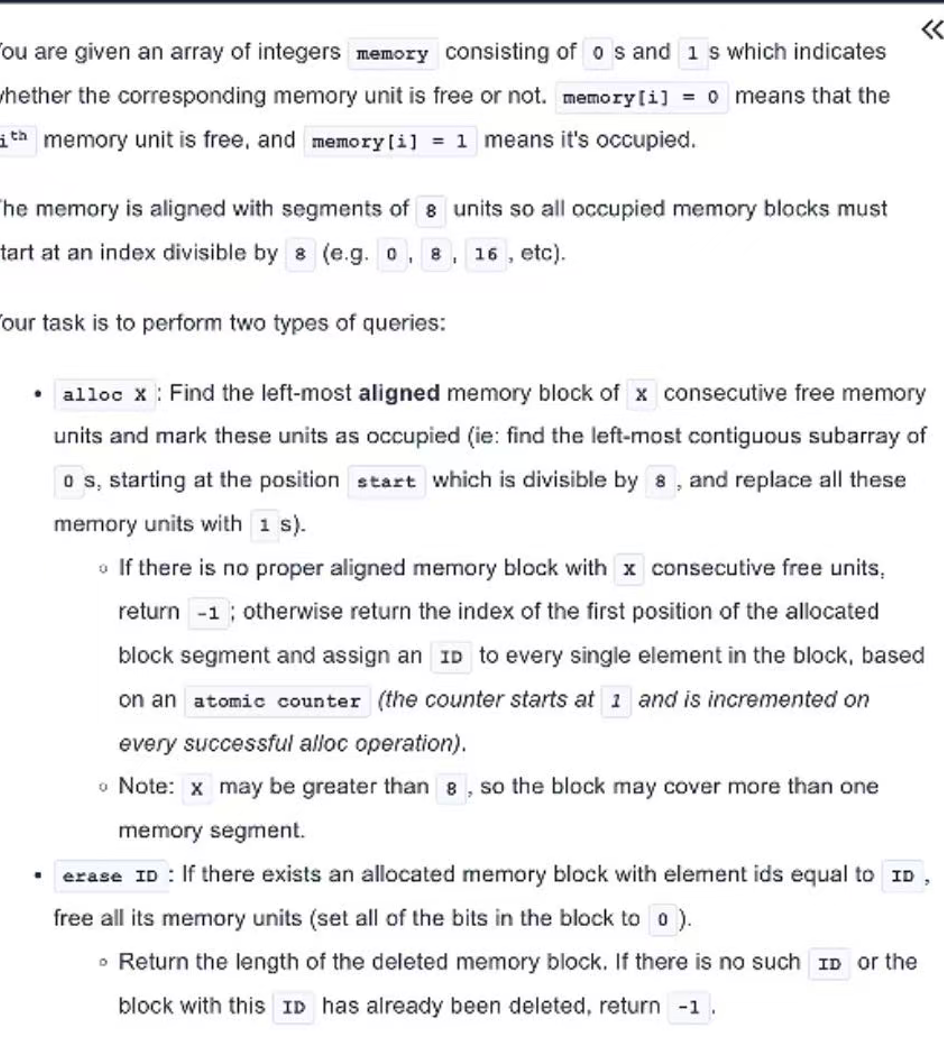
You are given a memory array made of 0s and 1s. A 0 means the unit is free, and a 1 means it is occupied. Allocated blocks must start at an index divisible by 8, such as 0, 8, or 16.
There are two query types:
alloc x: find the leftmost aligned block ofxconsecutive free units, mark it occupied, assign a new ID, and return the starting index; return -1 if no such block existserase ID: if the block with that ID still exists, free the entire block and return its length; otherwise return -1
Every successful allocation receives the next ID from a counter.
How to approach it
This does not need to be a real malloc implementation. A direct simulation is enough.
For alloc x:
- Only consider starting indices divisible by 8
- For each candidate start, check whether the next
xunits are all free - The first valid start is the answer
- After allocating, mark the segment occupied and record the ID-to-segment relationship
For erase ID:
- Check whether the ID is still active
- If it is active, restore the corresponding segment to free and return its length
- If it is missing or already deleted, return -1
The statement can also be solved by scanning the whole array for matching IDs if you store IDs directly. Conceptually, though, it is cleaner to separate memory occupancy from allocation metadata.
The real issue is state consistency
The tricky part is that the memory input itself is only 0 or 1, but erase needs to know which allocated segment belongs to a specific ID.
So keep two ideas separate:
- memory state: whether each unit is currently free
- allocation state: which segment each active ID owns
As long as both states are updated together, the problem is mechanical.
Common mistakes
- Allowing allocation to start at any free index instead of only 8-aligned indices
- Forgetting that
xcan be greater than 8, so one block can span multiple aligned segments - Incrementing the allocation ID after a failed
alloc - Returning something other than -1 for an already deleted ID
- Returning the start index for
eraseinstead of the freed length - Overwriting occupied units that are already 1 in the initial memory array
Q4: Longest Common Numeric Prefix Between Two Arrays
What the problem asks
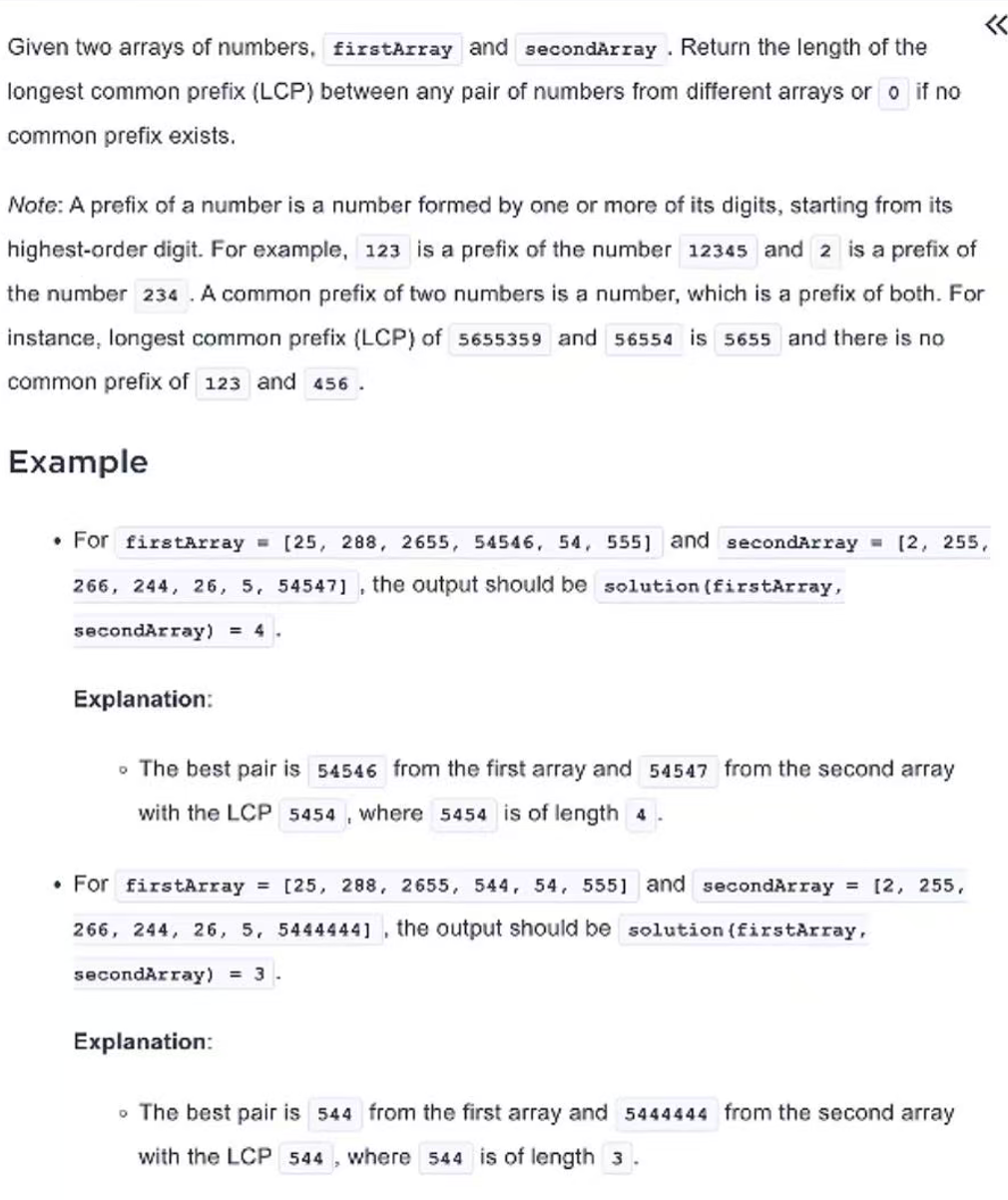
You are given two arrays of integers, firstArray and secondArray. A numeric prefix is formed from the highest-order digits of a number. For example, 123 is a prefix of 12345.
The task is to choose one number from each array and return the length of the longest common prefix between them. If no common prefix exists, return 0.
How to approach it
Treat the numbers as strings.
First, iterate through firstArray and insert every prefix of every number into a set. Then iterate through secondArray, generate each number's prefixes, and check whether each prefix exists in that set. Whenever it does, update the best length.
There is no need to compare every pair of numbers directly. Pairwise comparison would multiply the two array sizes and is unnecessary.
Why the prefix set works
The problem only asks whether some number in firstArray has a given prefix. It does not matter which number it is.
Once all prefixes from firstArray are in a set, any matching prefix from secondArray proves that a valid pair exists. The answer is just the longest length among all matches.
Common mistakes
- Confusing numeric prefixes with array prefixes
- Forgetting that the entire number can be a prefix
- Treating prefixes as numeric ranges when string conversion is simpler
- Returning the prefix value instead of its length
- Forgetting to return 0 when there is no match
Time Strategy for This Set
| Problem | Suggested strategy |
|---|---|
| Q1 | Sum and check the boundaries immediately |
| Q2 | Simulate exactly as stated |
| Q3 | Define allocation state clearly before implementing |
| Q4 | Store all prefixes from firstArray, then scan prefixes from secondArray |
Overall, this TikTok Backend OA set is testing rule translation more than advanced algorithms. Q1 and Q2 should be quick. Q3 is about keeping IDs, ranges, and 8-alignment consistent. Q4 is about avoiding unnecessary pairwise comparison with a HashSet.
oavoservice Note
TikTok / ByteDance CodeSignal OA problems often wrap simple simulations in longer statements. During the actual assessment, avoid reaching for a complex template too early. Translate the input, state, and return value first; that usually matters more than using a fancy data structure.
For TikTok Backend OA preparation, focus on:
- interval boundary checks
- literal simulation
- memory or resource allocation state management
- string-based numeric processing
- HashSet / HashMap lookup patterns
These problems are not always hard, but they reward calm execution.
TikTok OA 2026 Prep Exchange & Next Steps
If you are preparing for TikTok / ByteDance SDE / Intern / New Grad 2026 OA, feel free to reach out:
- Want full Python or Java walkthroughs for a specific problem
- Need more variants or practical debugging templates
- Want a preview of TikTok next-round interviews (Behavioral / BQ / System Design)
- Want to understand Programhelp's OA support style, including privacy-focused and risk-aware assistance workflows
Wishing you a smooth TikTok OA in 2026 and an offer you are excited about. Stay consistent and keep pushing.
Need real interview questions? Contact WeChat Coding0201: Get Questions.
Contact
Email: [email protected]
Telegram: @OAVOProxy