TikTok CodeSignal OA is 70 minutes total. This post covers Q3 and Q4 — the two questions that actually differentiate candidates. Q1 and Q2 are warm-ups; the real challenge starts at Q3. Real screenshots included below.
Exam Overview
| Item | Details |
|---|---|
| Platform | CodeSignal |
| Total Time | 70 minutes |
| Questions | 4 |
| This Article | Q3 + Q4 (last two) |
| Role | SWE / Backend |
Q3: Real Screenshot
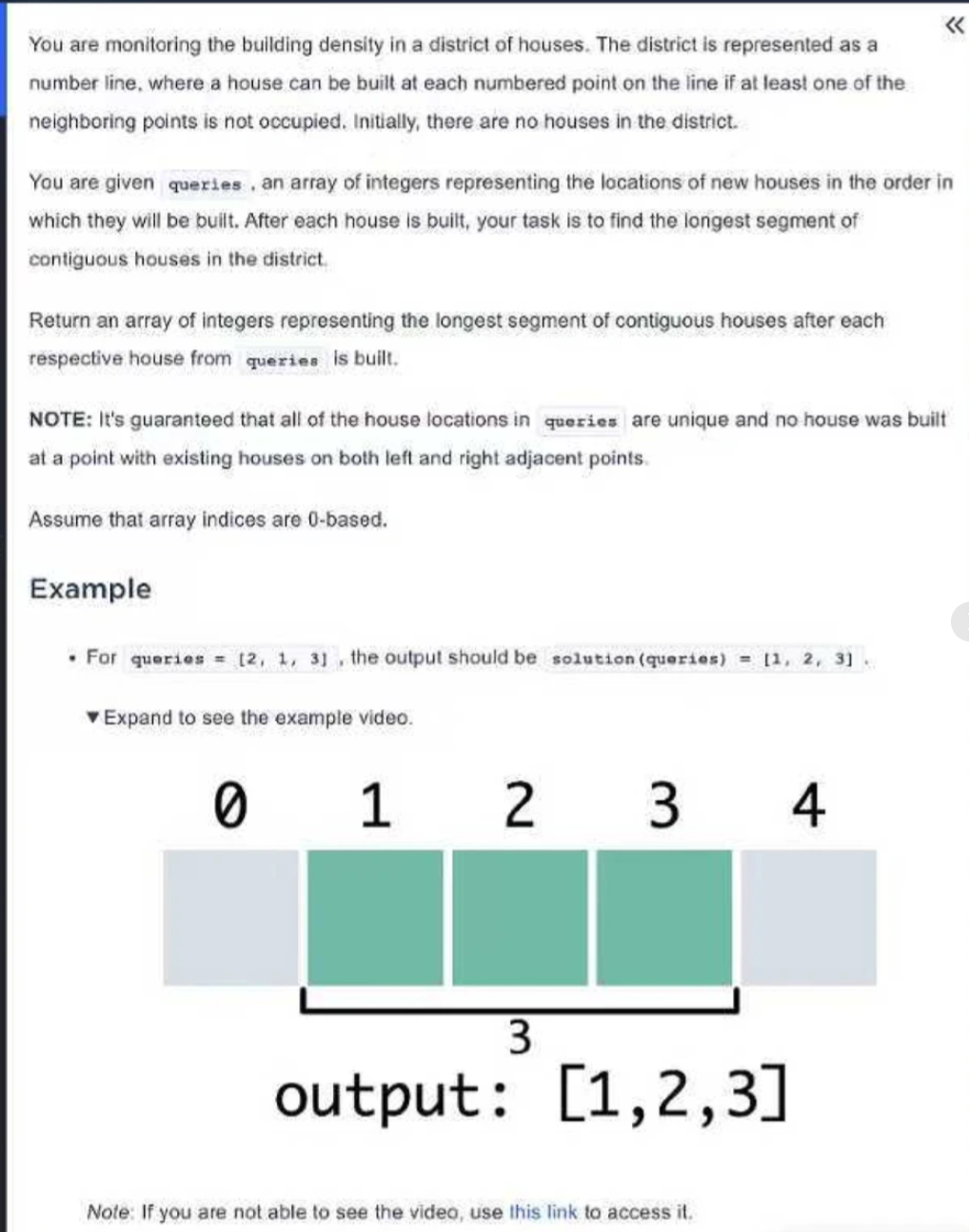
Core Idea
Given a string array or integer sequence, you need to apply grouping / counting / interval merging rules to find the optimal answer. Q3 on CodeSignal typically tests:
- HashMap frequency counting
- Sliding window
- Prefix sums
- Sorting + greedy
Solution Approach
Step 1: Identify the constraint
Read carefully and pin down the core constraint. Most Medium-level Q3s reduce to a known pattern once you strip the story wrapper.
Step 2: Brute force → optimize
Sketch the O(n²) brute force first, then ask: can a HashMap or two pointers bring this to O(n) or O(n log n)?
Step 3: Handle edge cases
- Empty array / empty string
- All elements identical
- Single-element input
Solution Template
def solution(arr):
    from collections import defaultdict

    count = defaultdict(int)
    result = 0

    for val in arr:
        # Query historical state before updating
        result += count[val]
        count[val] += 1

    return result
Time Complexity: O(n)
Space Complexity: O(n)
Pattern Reference
| Pattern | Technique | When to Use |
|---|---|---|
| Pair counting | HashMap one-pass | Two Sum variants |
| Interval merging | Sort + linear scan | Overlapping intervals |
| String matching | Sliding window + Set | No-repeat substrings |
| Prefix counting | Prefix sum + HashMap | Subarray sum |
Q4: Real Screenshot
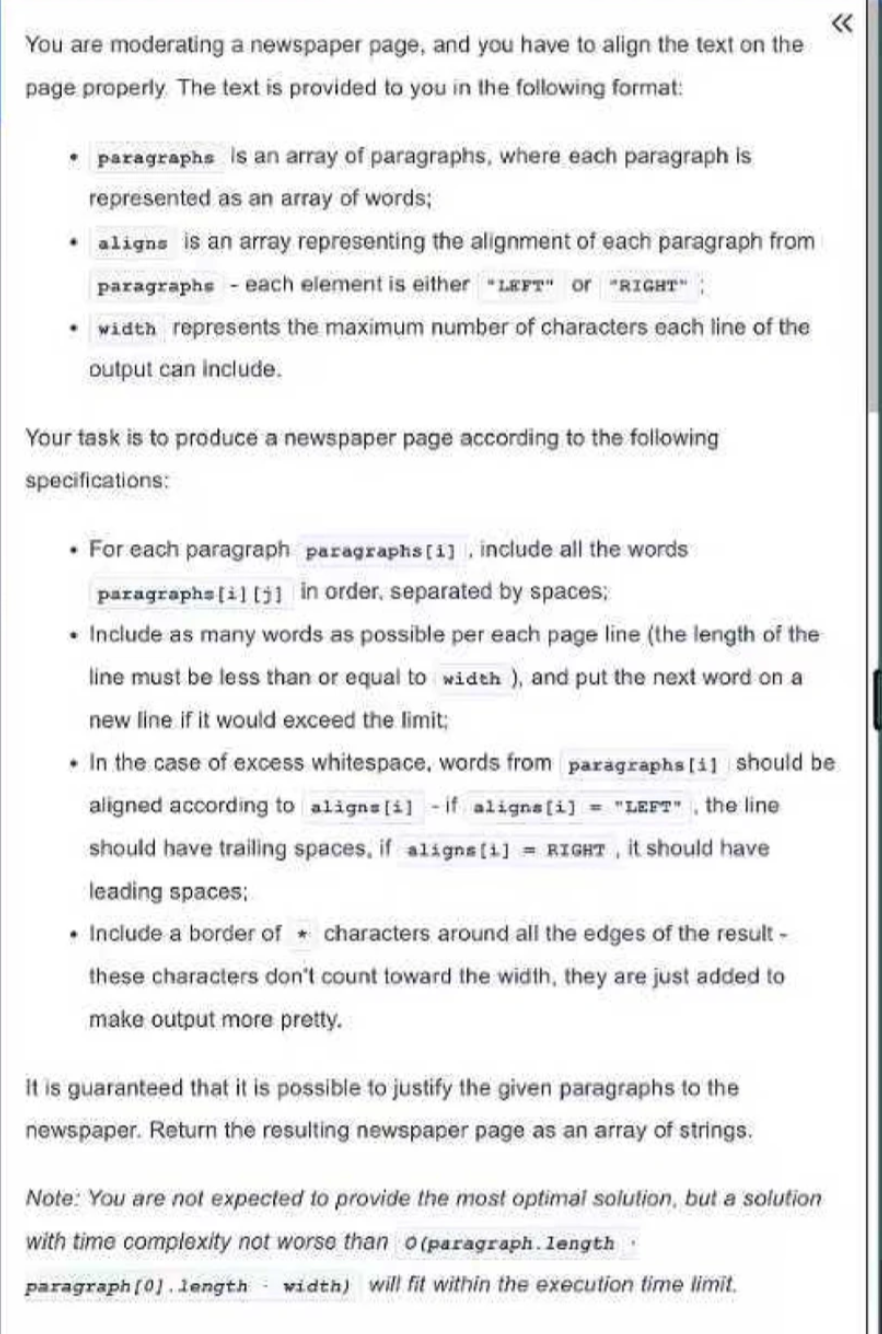
Core Idea
The final question is almost always the hardest — a graph traversal / state machine / complex simulation. Common topics:
- BFS / DFS graph traversal
- State machine simulation (with cycle detection)
- Dynamic programming
- Complex string processing
Solution Approach
Model the state space
- Define what a "state" is — current position, visited nodes, remaining resources, etc.
- Define transition rules — how you move from one state to the next.
- Define termination conditions — success, failure (obstacle), and infinite loop.
Multi-termination state machine template
def solution(n, m, obstacles, teleports):
    obstacle_set = set(map(tuple, obstacles))
    teleport_map = {(t[0], t[1]): (t[2], t[3]) for t in teleports}

    row, col = 0, 0
    visited = set()
    steps = 0

    while True:
        state = (row, col)

        # 1. Cycle detection (must come first)
        if state in visited:
            return -2  # Infinite loop
        visited.add(state)

        # 2. Obstacle check
        if state in obstacle_set:
            return -1  # Blocked

        steps += 1

        # 3. Goal check
        if row == n - 1 and col == m - 1:
            return steps  # Reached destination

        # 4. Teleport
        if state in teleport_map:
            row, col = teleport_map[state]
            continue

        # 5. Regular move (right)
        col += 1

        # 6. Out-of-bounds check
        if col >= m:
            return -3  # Can't reach goal

    return -3
Time Complexity: O(n × m) — each cell visited at most once
Space Complexity: O(n × m) — visited set
On-site Strategy for Q4
When Q4 looks overwhelming:
- List all termination conditions first — write them as comments before any code
- Draw a small example — manually simulate 2-3 steps on paper
- Start with the simplest path — get basic cases passing, then add edge cases
- Always add cycle detection —
visitedset is non-negotiable
Side-by-Side Comparison
| Question | Core Technique | Time | Space | Difficulty |
|---|---|---|---|---|
| Q3 | HashMap + single pass | O(n) | O(n) | Medium |
| Q4 | State machine + cycle detection | O(n×m) | O(n×m) | Hard |
Common Mistakes
| Question | Mistake | Correct Approach |
|---|---|---|
| Q3 | Nested loops O(n²) | HashMap one-pass O(n) |
| Q3 | Ignoring negative / zero edge cases | Check input range upfront |
| Q4 | Forgetting cycle detection | Always add visited set |
| Q4 | Wrong termination order | Check loop → obstacle → goal |
TikTok OA Strategy
CodeSignal Platform Notes
- Auto-graded; you cannot see test cases
- 70 minutes — pace yourself
- Q1/Q2 warm-up (
15 min total); Q3/Q4 are the real test (55 min) - Some companies review code quality, not just pass rate
Recommended Time Split
| Question | Target Time | Strategy |
|---|---|---|
| Q1 | 5-8 min | Fast AC, don't get stuck |
| Q2 | 8-12 min | Watch edge cases |
| Q3 | 20-25 min | Think before you type |
| Q4 | 25-30 min | Write termination framework first |
Related LeetCode Practice
| # | Problem | Covers |
|---|---|---|
| 1 | Two Sum | Q3 HashMap |
| 560 | Subarray Sum Equals K | Q3 Prefix Sum |
| 542 | 01 Matrix | Q4 BFS |
| 200 | Number of Islands | Q4 Graph Traversal |
| 289 | Game of Life | Q4 State Machine |
🚀 Need TikTok OA Assistance?
oavoservice specializes in real-time OA/VO support for top tech companies. TikTok CodeSignal OA is one of our core service scenarios with high question bank coverage.
Add WeChat: Coding0201
What you get:
- ✅ Real-time TikTok OA assistance (screen share + live typing hints)
- ✅ CodeSignal real question bank (80%+ high-frequency coverage)
- ✅ 1-on-1 mock OA + detailed feedback
- ✅ VO interview support (algorithms + system design)
📱 WeChat: Coding0201 | 💬 Telegram: @OAVOProxy | 📧 [email protected]
Contact
Email: [email protected]
Telegram: @OAVOProxy