Overview
Uber New Grad OA contains two algorithm questions testing comprehensive application of bit manipulation and sliding window. This article provides complete solution approaches, code implementations, and optimization techniques.
Question 1: Minimum Operations to Zero
Problem Description
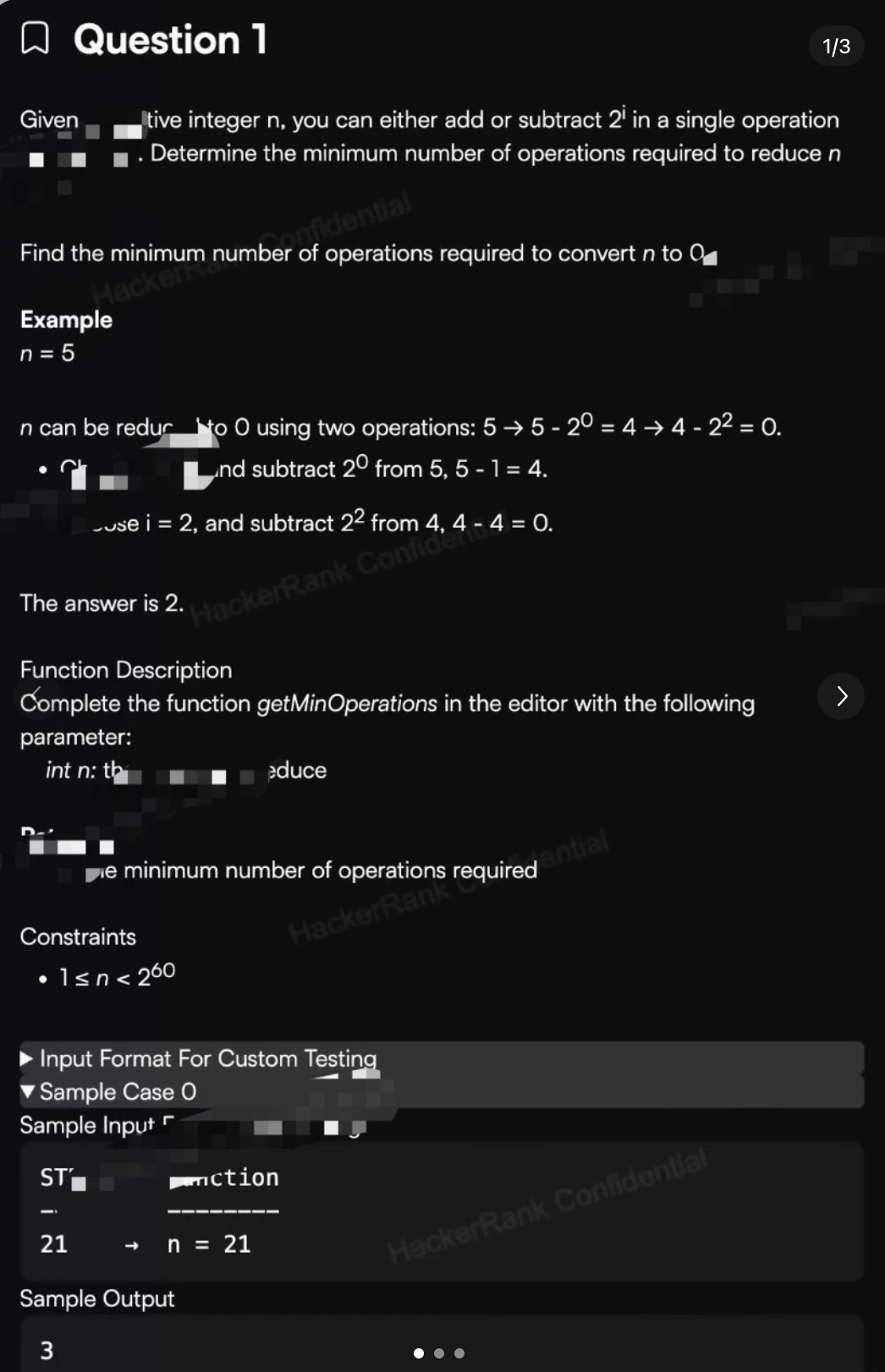
Given a positive integer n, you can perform one of the following operations in a single step:
- Add a power of 2 (2^i)
- Subtract a power of 2 (2^i)
Find the minimum number of operations required to reduce n to 0.
Example:
Input: n = 5
Output: 2

Explanation:
5 → 5 - 2^0 = 4 → 4 - 2^2 = 0
Or: 5 → 5 - 1 = 4 → 4 - 4 = 0
Example 2:
Input: n = 21
Output: 3

Explanation:
21 in binary: 10101
Requires 3 operations
Constraints:
- 1 ≤ n < 2^60
Solution Approach
Key Observation
The key to this problem is binary representation:
- Every positive integer can be represented in binary
- Adding/subtracting powers of 2 = changing bit values
- Goal is to turn all bits to 0 with minimum operations
Method 1: Greedy + Bit Manipulation ⭐ Optimal
Core Idea:
- Count the number of consecutive 1-bit segments
- Consecutive 1s can be merged through one "carry" operation
- Example:
111(7) =1000(8) - 1, only needs 2 operations
Algorithm Steps:
10101 (21)
↓
Segments of consecutive 1s: [1], [1, 1]
Segments = 2 isolated 1s + 1 consecutive segment = 3
Optimization Trick:
- Consecutive 1s: can be optimized with "addition carry"
- Isolated 1s: directly subtract
Code Implementation
def getMinOperations(n):
    """
    Calculate minimum operations to reduce n to zero

    Approach: Count segments of 1s in binary
    - Consecutive 1s count as one segment
    - Each segment needs 1-2 operations
    """
    if n == 0:
        return 0

    operations = 0
    prev_bit = 0

    while n > 0:
        current_bit = n & 1  # Get lowest bit

        # If current bit is 1 and previous bit is 0 (new segment starts)
        if current_bit == 1 and prev_bit == 0:
            operations += 1

        prev_bit = current_bit
        n >>= 1  # Right shift by 1

    return operations

# Test cases
print(getMinOperations(5))   # Output: 2
print(getMinOperations(21))  # Output: 3
print(getMinOperations(15))  # Output: 1 (1111 -> 10000 - 1)
Time Complexity: O(log n) - traverse binary bits
Space Complexity: O(1)
Method 2: Brian Kernighan Algorithm
def getMinOperations_v2(n):
    """
    Using Brian Kernighan algorithm
    Each iteration removes the rightmost 1
    """
    operations = 0

    while n:
        # Check if there are consecutive 1s
        if n & (n >> 1):
            # Has consecutive 1s, carry
            n += (n & -(n & (n >> 1)))
        else:
            # No consecutive 1s, directly subtract
            n &= n - 1
        operations += 1

    return operations
Common Pitfalls
❌ Mistake 1: Directly count number of 1s
# Wrong example
def wrong_solution(n):
    return bin(n).count('1')  # For 111 returns 3, actually needs 2
❌ Mistake 2: Not considering consecutive 1s optimization
# 15 = 1111, direct count is 4, but actually needs only 1 (16 - 1)
✅ Correct Approach: Count segments of consecutive 1s, not number of 1s
Question 2: Minimum Length Good Subarray
Problem Description
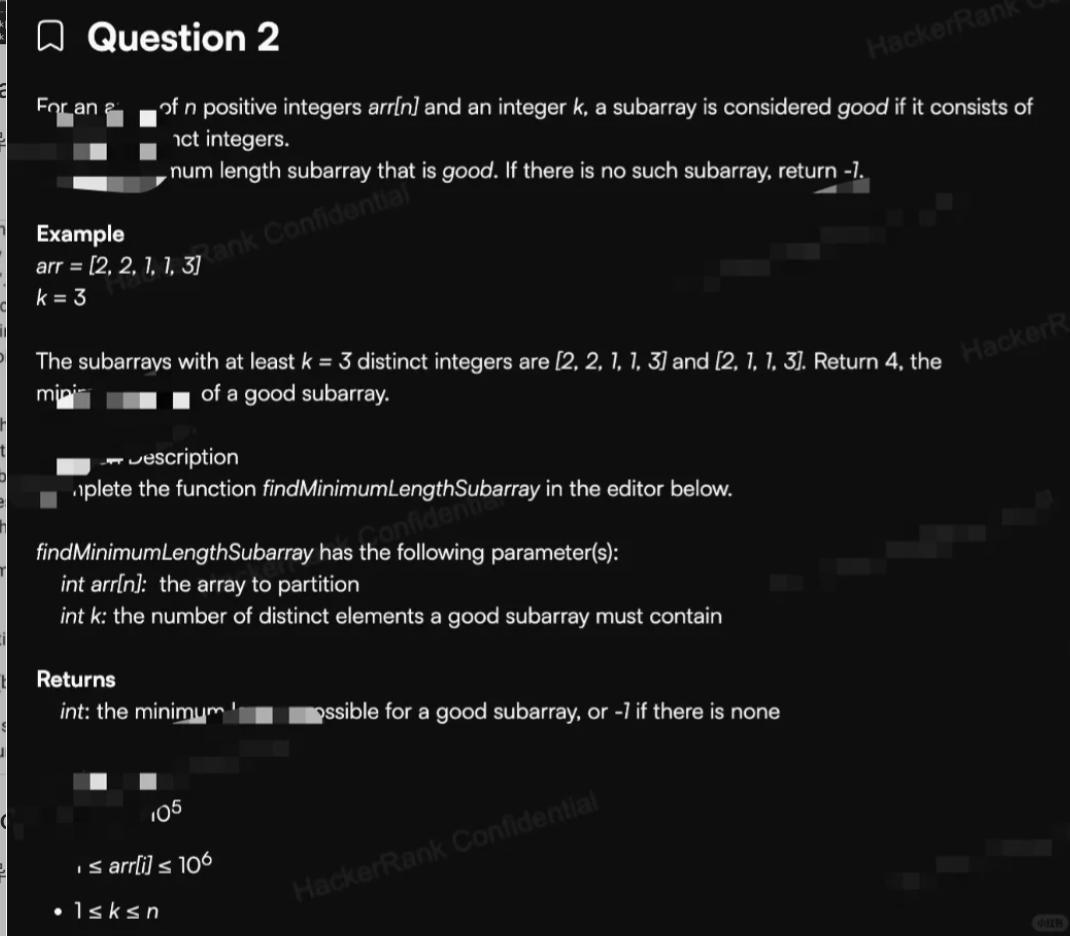
Given an array of n positive integers arr[n] and an integer k, a subarray is considered good if it contains at least k distinct integers.
Find the minimum length of a good subarray. If no such subarray exists, return -1.
Example:
Input: arr = [2, 2, 1, 1, 3], k = 3
Output: 4

Explanation:
Subarrays with at least 3 distinct integers:
- [2, 2, 1, 1, 3] (length 5)
- [2, 1, 1, 3] (length 4) ✓ shortest
Constraints:
- 1 ≤ n ≤ 10^6
- 1 ≤ arr[i] ≤ 10^6
- 1 ≤ k ≤ n
Solution Approach
Core Idea: Sliding Window
This is a classic sliding window problem:
- Maintain a window tracking distinct integers count
- When window has ≥ k distinct integers, try to shrink window
- Record minimum window length that satisfies condition
Algorithm Steps
arr = [2, 2, 1, 1, 3], k = 3

Step 1: [2] - 1 distinct integer
Step 2: [2, 2] - 1 distinct integer
Step 3: [2, 2, 1] - 2 distinct integers
Step 4: [2, 2, 1, 1] - 2 distinct integers
Step 5: [2, 2, 1, 1, 3] - 3 distinct integers ✓

Now try to shrink window:
Step 6: [2, 1, 1, 3] - 3 distinct integers ✓ (length 4)
Step 7: [1, 1, 3] - 2 distinct integers ✗

Answer: 4
Code Implementation
def findMinimumLengthSubarray(arr, k):
    """
    Use sliding window to find shortest subarray with at least k distinct integers

    Time Complexity: O(n)
    Space Complexity: O(k)
    """
    from collections import defaultdict

    n = len(arr)
    if k > n:
        return -1

    # Count of each number in window
    window = defaultdict(int)
    left = 0
    min_length = float('inf')

    for right in range(n):
        # Expand window
        window[arr[right]] += 1

        # When window has >= k distinct integers, try to shrink
        while len(window) >= k:
            min_length = min(min_length, right - left + 1)

            # Shrink window
            window[arr[left]] -= 1
            if window[arr[left]] == 0:
                del window[arr[left]]
            left += 1

    return min_length if min_length != float('inf') else -1

# Test cases
print(findMinimumLengthSubarray([2, 2, 1, 1, 3], 3))  # Output: 4
print(findMinimumLengthSubarray([1, 2, 3, 4], 2))     # Output: 2
print(findMinimumLengthSubarray([1, 1, 1, 1], 2))     # Output: -1
Optimized Version: More Concise Implementation
def findMinimumLengthSubarray_v2(arr, k):
    """
    Optimized version: using Counter
    """
    from collections import Counter

    if k > len(set(arr)):
        return -1

    window = Counter()
    left = 0
    min_length = float('inf')

    for right, num in enumerate(arr):
        window[num] += 1

        while len(window) >= k:
            min_length = min(min_length, right - left + 1)
            window[arr[left]] -= 1
            if window[arr[left]] == 0:
                del window[arr[left]]
            left += 1

    return min_length if min_length != float('inf') else -1
Time Complexity: O(n) - each element visited at most twice
Space Complexity: O(k) - hash table stores at most k distinct elements
Common Pitfalls
❌ Mistake 1: Using brute force O(n²)
# Timeout!
def brute_force(arr, k):
    min_len = float('inf')
    for i in range(len(arr)):
        for j in range(i, len(arr)):
            if len(set(arr[i:j+1])) >= k:
                min_len = min(min_len, j - i + 1)
    return min_len if min_len != float('inf') else -1
❌ Mistake 2: Not properly maintaining window
# Forgetting to delete elements with count 0
window[arr[left]] -= 1
# Should add:
if window[arr[left]] == 0:
    del window[arr[left]]
✅ Correct Approach: Use sliding window + hash table, O(n) time complexity
On-Site Strategy
Time Allocation Suggestion
| Question | Difficulty | Suggested Time | Priority |
|---|---|---|---|
| Question 1 | Medium | 20-25 minutes | ⭐⭐⭐ |
| Question 2 | Medium | 25-30 minutes | ⭐⭐⭐⭐ |
Total Time: 45-55 minutes (leave 5-10 minutes for review)
Debugging Tips
Question 1 Debugging:
def debug_operations(n):
    """Print each operation step"""
    print(f"n = {n}, binary = {bin(n)}")
    operations = 0
    prev_bit = 0

    while n > 0:
        current_bit = n & 1
        if current_bit == 1 and prev_bit == 0:
            operations += 1
            print(f"New segment found at position, operations = {operations}")
        prev_bit = current_bit
        n >>= 1

    return operations
Question 2 Debugging:
def debug_window(arr, k):
    """Print window state"""
    from collections import defaultdict

    window = defaultdict(int)
    left = 0

    for right in range(len(arr)):
        window[arr[right]] += 1
        print(f"Window [{left}:{right+1}]: {dict(window)}, distinct = {len(window)}")

        while len(window) >= k:
            print(f"  → Found valid window, length = {right - left + 1}")
            window[arr[left]] -= 1
            if window[arr[left]] == 0:
                del window[arr[left]]
            left += 1
Knowledge Points Summary
Question 1 Topics
- ✅ Bit manipulation basics
- ✅ Binary representation
- ✅ Greedy algorithm
- ✅ Mathematical optimization
Question 2 Topics
- ✅ Sliding window
- ✅ Hash table application
- ✅ Two pointers technique
- ✅ Time complexity optimization
Related Problems
Question 1 Related
- LeetCode 191: Number of 1 Bits
- LeetCode 338: Counting Bits
- LeetCode 201: Bitwise AND of Numbers Range
Question 2 Related
- LeetCode 340: Longest Substring with At Most K Distinct Characters
- LeetCode 904: Fruit Into Baskets
- LeetCode 3: Longest Substring Without Repeating Characters
🚀 Need OA/VO Assistance?
oavoservice provides professional interview assistance services:
✅ Real-time Code Support - Full OA/VO assistance
✅ Real Question Bank - 1000+ latest questions
✅ Mock Interviews - 1-on-1 simulation training
✅ Resume Optimization - Improve interview pass rate
👉 Add WeChat Now: Coding0201
👉 Visit Website: oavoservice.com
Last Updated: 2026-03-15
Difficulty Rating: ⭐⭐⭐ Medium
Pass Rate: ~65%
Company: Uber New Grad OA
联系方式
Email: [email protected] Telegram: @OAVOProxy