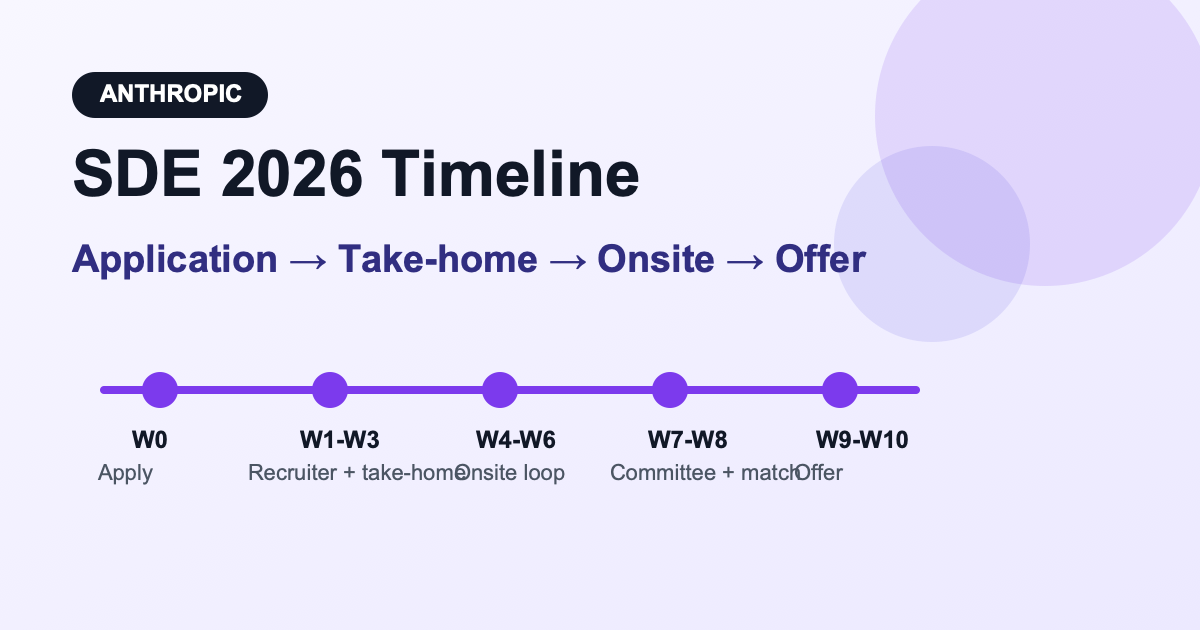
Anthropic's hiring loop has visibly accelerated — the 2024 SDE pipeline averaged 12-16 weeks, and 2026 is now 8-10 weeks. That compresses your prep window and means every step has to land on time.
This article isn't another "what questions do they ask" piece — it's a real 10-week timeline from a candidate, walking through what you should do each week, what your competitors are doing, and what Anthropic is privately judging. Sourced from a Member of Technical Staff (MTS) who joined the Inference team in April 2026.
Pipeline Overview (W0 → W10)
| Week | Stage | Candidate Action | Anthropic Internal |
|---|---|---|---|
| W0 | Application | Refer + apply | ATS auto-tags |
| W1 | Recruiter Screen | 30-min phone | Recruiter writes Notion card |
| W2 | Take-home Coding | 4-6h independent | Auto-test + human review |
| W3 | Take-home Review Call | 60 min defense | Reviewer hire/no-hire |
| W4-6 | Onsite Loop | 5 × 60 min | Each interviewer writes packet |
| W7 | Hiring Committee | Wait | Committee scores |
| W8 | Team Match | 2-3 chats | HMs assess fit |
| W9 | Offer & Negotiation | Comp talks | Recruiter routes approval |
| W10 | Accept → Onboard | NDA / I-9 | Stock grant filed |
Important: once Anthropic's pipeline stalls, restart is hard. If you're a week late at W3 due to a scheduling conflict, your full onsite gets pushed 2-3 weeks. Block W2-W7 as "face slots" upfront.
W0: Application
What you should do
| Task | Time | Priority |
|---|---|---|
| Find an Anthropic referral | 1-3 days | ⭐⭐⭐ |
| Rewrite resume to "impact-driven" format | 2 hrs | ⭐⭐⭐ |
| Pin ML / LLM projects on GitHub profile | 30 min | ⭐⭐ |
| Cover letter highlighting alignment / safety interest | 1 hr | ⭐ |
Key: Anthropic's ATS (Greenhouse) splits "alumni referral" vs "public-link applicant" into two queues — referrals advance ~5-7 days faster. Without a referral, cold-messaging current Anthropic SWEs on LinkedIn has a ~15% reply rate.
What's happening internally
The ATS auto-scores against:
- Education tier (PhD in ML / NLP / Distributed Systems → +2)
- Years of experience (0-2 → New Grad pool, 3-7 → MTS pool)
- Keyword match: transformer, distributed training, LLM serving, RLHF, CUDA
Reject rate: ~93% drop here at W0.
W1: Recruiter Phone Screen
What you should do
30 minutes — not technical, more vibe + logistics. Recruiter asks:
- Why Anthropic vs OpenAI / DeepMind / xAI?
- Which Claude feature impressed you most?
- Current base / total comp & expectations
- Available onsite windows
- Your view on alignment / safety
Strong answer: cite a specific Claude release feature (e.g., "Claude 3.7's chain-of-thought control during long-context reasoning") — generic "I use Claude daily" sounds rehearsed.
What's happening internally
Recruiter writes a Notion card with three axes:
- Tech fit (does your stack match a hiring team)
- Mission fit (genuine vs performative interest in AI safety)
- Logistics fit (timing, visa, comp expectations)
Any low score → pipeline ends.
W2: Take-home Coding (4-6 hours independent)
What you should do
Take-home arrives as a GitHub repo invite via email with a 48-hour return window (actual work 4-6 hrs).
Recent prompts focus on practical engineering:
- Build a simple LLM agent loop (with tool calling)
- Implement retrieval-augmented chat (SQLite as vector store)
- Write a text post-processing pipeline (sentence split, clean, dedupe)
- Reproduce a paper's figure (paper PDF + dataset given)
Scoring rubric:
| Dimension | Weight |
|---|---|
| Correctness | 30% |
| Code readability | 25% |
| Test coverage | 20% |
| Engineering hygiene (git history, README, type hints) | 15% |
| Design notes | 10% |
Most common point losses:
- README only has "how to run", no "trade-offs I considered"
- Single mega-commit (reviewer can't trace your reasoning)
- Zero unit tests
- Used niche libraries reviewer can't run → instant fail
What's happening internally
Reviewer runs your code + reads git history + skims README — scores within 1 hour. Frequent commits + a design-doc-style README signals strong hire.
W3: Take-home Review Call (60 min defense)
What you should do
This round is not new code. You walk through your take-home and answer deep-dive questions:
- "Why SQLite over FAISS?"
- "Does this design hold from 10K to 10M rows?"
- "How does your prompt template handle token overflow?"
- "Why do tests cover only the happy path?"
Strategy: proactively list "trade-offs I knew but didn't fix" — beats waiting for the reviewer to find them.
What's happening internally
Reviewer files a card: strong hire / hire / lean hire / lean no-hire / no-hire. Only strong hire / hire advance to onsite.
W4-W6: Onsite Loop (5 × 60 min)
| Round | Content |
|---|---|
| Round 1 | Coding I — string/tree LC Medium-Hard |
| Round 2 | Coding II — practical (crawler, agent loop, text processing) |
| Round 3 | System Design — distributed inference / annotation platform |
| Round 4 | ML Deep-dive — Transformer internals, RLHF, attention math |
| Round 5 | Behavioral + Mission Fit |
What you should do
In the 2 weeks before W4:
- Grind LC top-100 + Anthropic-tagged questions (~50)
- Re-read Transformer & LoRA papers; whiteboard attention math
- Prep 2-3 STAR stories, each touching 3+ HHH values
- Watch 1-2 public Anthropic talks (Dario Amodei's NeurIPS keynote is mandatory)
W7: Hiring Committee
You're idle this week — committee runs closed-door reviews of all 5 packets.
Note: Anthropic's HC is unlike Google's — the committee actively debates with interviewers, no "rubric auto-pass" rule. So 1× strong hire + the rest lean hires can still advance.
W8: Team Match
You'll do 2-3 × 30-minute chats with hiring managers. No new technical questions, but expect "what would you ship in your first 3 months?"
Anthropic 2026 main hiring teams:
- Inference (serving optimization, latency)
- Pretraining (foundation training infra)
- RLHF & Alignment
- Claude App / API Platform
- Safety & Trust
- Research Engineering
What you should do
Look up hiring managers on Anthropic's blog + Twitter → find their GitHub / Twitter → know their latest paper or post. Bringing it up naturally during the chat substantially improves match rate.
W9: Offer & Negotiation
Anthropic 2026 Comp (MTS levels)
| Level | Base | Equity (4y vest) | Sign-on |
|---|---|---|---|
| MTS I | $250-300K | $400-700K | $50-100K |
| MTS II | $320-400K | $800K-$1.5M | $100-150K |
| Senior MTS | $400-500K | $1.5M-$3M | $150-200K |
| Staff MTS | $500K+ | $3M+ | Negotiated |
Equity type: Anthropic is private — ISO options + RSU mix with strike price and cliffs. Latest valuation ~$170B (Q4 2025), but secondary liquidity is limited; offer-letter equity numbers are theoretical until 2027+ tender offers.
Negotiation Levers
- Base: ±10% range
- Equity: ±20% (most flexible)
- Sign-on: 50K-100K stretch
Heuristic: a competing OpenAI / DeepMind / xAI offer can boost equity 30-50%.
W10: Accept → Onboard
What you should do
Sign NDA + I-9 + tax forms via HelloSign. Day 1 stack:
- MacBook Pro / Linux Workstation (your choice)
- Anthropic Slack workspace invite
- Internal Claude.ai unlimited token account
- GPU cluster access (Pretraining / Inference teams)
FAQ
Q1: Is Anthropic still hiring aggressively in 2026?
Yes — but the emphasis shifted: 2024 was Researcher-heavy, 2026 leans Inference / Production / Trust & Safety. Pure ML Researcher PhDs are better off targeting OpenAI / DeepMind / Meta FAIR.
Q2: Can I land Anthropic SDE without ML background?
Yes — Inference / Platform / Tools teams welcome pure SWEs (no Transformer math required, but distributed systems + GPU memory + CUDA basics expected). Pretraining / RLHF teams require ML background.
Q3: Take-home or LeetCode — which matters more?
Take-home > LeetCode. Take-home weight is ~30% of pipeline score; LC-style coding only ~15%. A take-home that reads like a public OSS project significantly raises onsite tolerance.
Q4: Can I apply via internal transfer?
No. Anthropic has no NG / Intern conversion (and no intern program). All roles are external. Contractor → FT conversion happens in Trust & Safety.
Q5: MTS vs Senior MTS rubric?
| Dimension | MTS I | MTS II | Senior MTS |
|---|---|---|---|
| Independence | Mentored | Owns medium projects | Leads multi-person work |
| Tech depth | One area, proficient | One area, deep | Cross 2-3 areas, deep |
| Impact scope | Single team | 2 teams | Cross-org |
| Equity multiplier | 1× | 1.5× | 2.5× |
Promotion cycle: MTS I → MTS II ~18-24 mo; MTS II → Senior MTS ~24-36 mo.
Q6: If onsite fails, when can I reapply?
Cooldown is 6-12 months — failing on Coding allows 6, while failing System Design or Behavioral typically requires 12. Strongly recommended: reapply to a different team — different hiring managers re-grade.
Preparing for Anthropic / OpenAI / xAI SDE / MTS roles?
AI lab hiring is evolving fast — take-home weight up, equity flexibility up, pipeline shorter. We've curated 2026 cycle interview question banks for Anthropic / OpenAI / DeepMind / xAI plus take-home templates and an equity-negotiation cheat sheet.
Add WeChat Coding0201 or contact us.
Contact
Email: [email protected] Telegram: @OAVOProxy