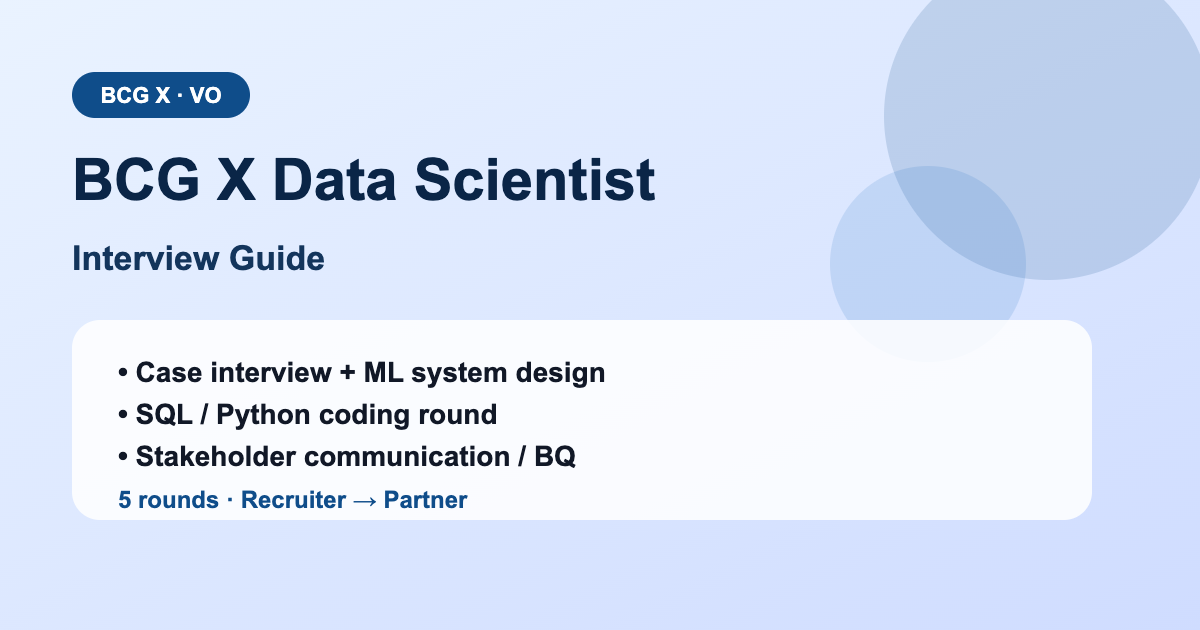
BCG X (formerly BCG GAMMA, rebranded in 2022 after merging with PlatinionUS) is BCG's hybrid AI / Data Science / Software Engineering arm — comparable to McKinsey QuantumBlack and Bain Aether. Their Data Scientist role tests both consulting business sense and engineering rigor at the same time — so the loop is ~1.5x longer than a typical Tech Co., and rejections usually fall into "knows ML but not business" or vice versa.
This article distills the five-round flow, scoring focus per round, and the most common pitfalls, based on 1point3acres, Glassdoor, Reddit, and candidate debriefs.
BCG X DS Loop Overview
| Round | Duration | Content | Pass Rate (rough) |
|---|---|---|---|
| 1. Recruiter Screen | 30 min | Resume + motivation + comp | 100% → 60% |
| 2. Case Interview | 45-60 min | Business case with data lens | 60% → 35% |
| 3. ML Coding / SQL | 60 min | Python + SQL + ML pipeline | 35% → 22% |
| 4. ML System Design | 60 min | End-to-end ML, scalability | 22% → 14% |
| 5. Partner / HM BQ | 45 min | Behavioral + project deep-dive + culture fit | 14% → 8% |
2025-2026 change: BCG X split the previously combined "Case + Coding" into two separate rounds, pushing the loop to 4-5 hours total but with clearer round boundaries — meaning you can no longer rescue a weak business case answer with "but I know how to code".
Round 1 (Case Interview) — Where Most People Fail
Typical Prompt
A global logistics company found that operating costs rose 12% in Q3 last year. The CEO wants to know: (1) What drove this? (2) As a BCG X DS team, what data + modeling approaches would you use to find the root cause? (3) Outline a deliverable 90-day plan.
BCG X-Specific Scoring
Unlike a pure MBB strategy case (focused on MECE frameworks), BCG X cases have three DS-specific dimensions:
- Crisp data hypotheses: every driver you propose (fuel, labor, SKU mix) must map to observable data fields
- Methodology layering: start with EDA / cohort breakdown, then causal (DiD, IV), don't open with "I'd train an XGBoost"
- Business viability: your 90-day plan must include stakeholder buy-in, A/B test design, and a fallback plan
Recommended 7-Step Framework
1. Restate problem        (30s)
2. Clarifying questions   (90s) ← 3 minimum, fewer loses points
3. Hypothesis tree        (3 min) — split costs into 3-4 drivers
4. Data side-mapping      (3 min) — what data backs each driver
5. Method selection       (5 min) — descriptive → causal → predictive
6. 90-day plan            (3 min) — milestones, deliverables, risks
7. Recommendation summary (1 min)
Real pitfall: many ML-trained candidates skip Steps 2-4 and jump to Step 5, earning "thinks like an engineer, not a consultant." The 3 clarifying questions in Step 2 are an anchor for grading.
Round 2 — ML Coding / SQL
Typical Question
You receive a 1M-row customer transaction CSV (or SQL table). The task usually has two parts:
Part A — SQL (20 min)
Write SQL: find top 10% customers in each segment whose 90-day CLV exceeds 1.5x the segment median.
WITH clv_per_customer AS (
  SELECT
    customer_id,
    segment,
    SUM(amount) AS clv
  FROM transactions
  WHERE txn_date >= CURRENT_DATE - INTERVAL '90 days'
  GROUP BY customer_id, segment
),
seg_median AS (
  SELECT
    segment,
    PERCENTILE_CONT(0.5) WITHIN GROUP (ORDER BY clv) AS median_clv
  FROM clv_per_customer
  GROUP BY segment
),
ranked AS (
  SELECT
    c.customer_id,
    c.segment,
    c.clv,
    NTILE(10) OVER (PARTITION BY c.segment ORDER BY c.clv DESC) AS decile
  FROM clv_per_customer c
  JOIN seg_median m ON c.segment = m.segment
  WHERE c.clv > m.median_clv * 1.5
)
SELECT customer_id, segment, clv
FROM ranked
WHERE decile = 1;
Scoring: window functions (NTILE / PERCENTILE_CONT) + layered CTEs. Deeply nested subqueries lose points.
Part B — Python pandas / scikit-learn (40 min)
Given customers.csv and events.csv, build a churn prediction model. Constraints: handle missingness + categorical variables, 80/20 train/test, report AUC.
import pandas as pd
from sklearn.model_selection import train_test_split
from sklearn.preprocessing import StandardScaler, OneHotEncoder
from sklearn.compose import ColumnTransformer
from sklearn.pipeline import Pipeline
from sklearn.linear_model import LogisticRegression
from sklearn.metrics import roc_auc_score

def build_churn_model(customers_path, events_path):
    customers = pd.read_csv(customers_path)
    events = pd.read_csv(events_path)
    agg = events.groupby("customer_id").agg(
        n_events=("event_id", "count"),
        total_spend=("amount", "sum"),
        days_since_last=("ts", lambda s: (pd.Timestamp.now() - pd.to_datetime(s.max())).days),
    ).reset_index()
    df = customers.merge(agg, on="customer_id", how="left").fillna(
        {"n_events": 0, "total_spend": 0, "days_since_last": 365}
    )

    y = df.pop("churned")
    X = df.drop(columns=["customer_id"])
    num_cols = X.select_dtypes(include=["number"]).columns.tolist()
    cat_cols = X.select_dtypes(include=["object"]).columns.tolist()

    pre = ColumnTransformer([
        ("num", StandardScaler(), num_cols),
        ("cat", OneHotEncoder(handle_unknown="ignore"), cat_cols),
    ])
    pipe = Pipeline([("pre", pre), ("clf", LogisticRegression(max_iter=1000))])

    X_train, X_test, y_train, y_test = train_test_split(X, y, test_size=0.2, stratify=y, random_state=42)
    pipe.fit(X_train, y_train)
    proba = pipe.predict_proba(X_test)[:, 1]
    return roc_auc_score(y_test, proba), pipe
Scoring:
- Use
Pipeline, not manualfit_transform(prevents leakage) stratify=y(class imbalance protection)handle_unknown="ignore"(production-safe)- Report AUC, not accuracy (churn is typically imbalanced)
Round 3 — ML System Design
Sample Prompt
Design an end-to-end ML system to power "personalized recommendations" on a BCG X client's e-commerce platform. The client sees 100M PV/month, requires < 200ms response time, and wants the model refreshed daily.
Preferred BCG X Answer Structure
1. Business goal → metric definition (CTR / GMV / coverage)
2. Data flow (offline + online)
3. Feature engineering (user / item / context)
4. Three-stage retrieval → ranking → re-rank architecture
5. Offline training pipeline + online serving
6. A/B test framework + monitoring
7. Failure fallbacks (cold start / degradation strategy)
Difference vs Tech Co.: BCG X graders especially weight Step 7 (fallback) and Step 1 (business metric) — because client-facing systems can't "just go down". Stopping at Step 5 earns the label "academic."
Round 4 — Partner / HM Behavioral
| High-Frequency Q | What's Tested |
|---|---|
| Walk through one DS project end-to-end, problem framing to deployment. | Business sense + ownership |
| How do you handle disagreement with a non-technical stakeholder? | Communication + influence |
| Explain an XGBoost model to a CEO. | Layered communication |
| Which piece of code or conclusion in your last project are you least happy with — why? | Self-reflection |
| Why not FAANG / industry DS? | Motivation alignment |
Key: Partner rounds feel like "Senior Director" conversations — they're judging whether you'll promote to Project Leader within 5 years. Avoid going deep on technical detail; emphasize business outcome.
4-Week Prep Path
| Week | Focus | Resources |
|---|---|---|
| W1 | Case fundamentals | Case in Point, Victor Cheng frameworks (12 core) |
| W2 | Python + SQL coding | LC SQL 50, StrataScratch, light Kaggle projects |
| W3 | ML System Design | "Designing ML Systems" (Chip Huyen) + write 5 end-to-end designs |
| W4 | Mock + BQ debrief | Mock cases + 6 STAR-formatted project stories |
Don't: spend 80% of prep on LeetCode — BCG X DS algorithm difficulty is much lower than FAANG, but case + system design carry ≥ 60% of the total weight.
FAQ
Q1: Is BCG X DS the same role as BCG mainline (consulting) Data Scientist?
No. BCG mainline Data Scientist is more of an analyst role, supporting traditional cases. BCG X DS is product- / engineering-oriented — embedded with PM, SWE, Designer to ship products to clients. BCG X DS base is 10-15% higher than mainline, with a tempo closer to Tech Co. than MBB.
Q2: Do I need to grind LeetCode for BCG X DS?
Not Hard problems. The coding round is around LC Easy / Medium difficulty, but the focus is production-grade pandas / SQL / scikit-learn use, not data structures. LC SQL 50 + StrataScratch is more aligned than pure algorithm grinding.
Q3: Does BCG X favor new grads or MBAs?
Both, but title differs:
- MS / PhD new grad → Data Scientist I / II
- MBA + industry exposure → Senior Data Scientist / Lead
- PhD with top-tier publications → Principal / Lead direct entry
New-grad PhDs have a 2-3x higher offer rate than MBA + career-switchers — BCG X prefers strong ML fundamentals.
Q4: What is the BCG X DS base + bonus?
US 2026 cycle data (with sign-on amortized):
- Data Scientist I (new grad): $135-150K base + 15-20% bonus
- Data Scientist II: $155-180K base + 20-25% bonus
- Senior DS: $200-240K base + 25-35% bonus
vs FAANG: base is slightly lower, but bonus % is higher, and client-billable utilization comes with travel per-diems.
Q5: How often can I reapply to BCG X DS?
Once per 12 months at the same office. But different offices (NA / EU / APAC) are independent, so you can stagger applications. Note: rejections at the recruiter screen carry a 6-month cooldown.
Q6: Is the BCG X DS onsite virtual or in-person?
For 2026 NA hubs (NYC / Boston / SF / Toronto), the first 3 rounds are remote, and rounds 4-5 (System Design + Partner BQ) are typically scheduled in-office. BCG covers travel. APAC and EU hubs remain mostly remote.
Contact
If you're prepping a BCG X / McKinsey QuantumBlack / Bain Aether style hybrid consulting + DS role, the most under-estimated piece is the data-flavored variant of Case Interview — its solution path differs from a classic MBB case. We've curated a BCG X DS question bank (case + ML coding + system design templates) and offer 1:1 mock interviews.
Add WeChat Coding0201, get the BCG X bank and book a mock.
- Email: [email protected]
- Telegram: @OAVOProxy