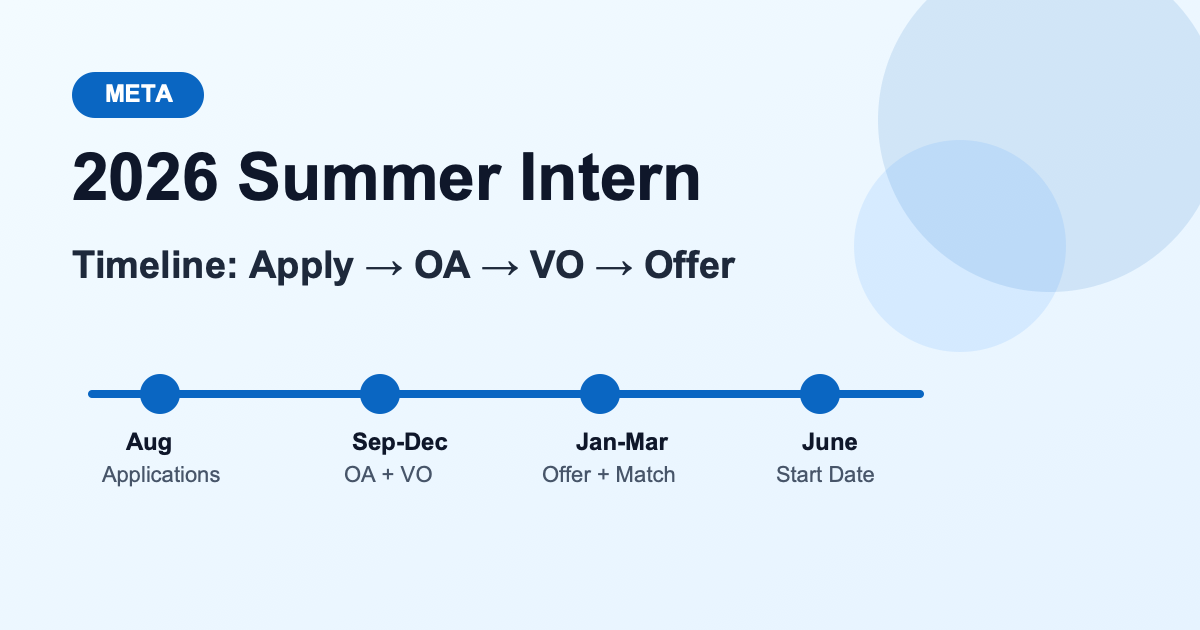
When the Meta opportunity finally came through, I laid out the entire timeline—and looking back, it really was a marathon. From the first online application to actually entering team match, it dragged on for nearly five months, with all sorts of reschedules and extra rounds in between. This post isn't about problems; it's purely a process-cadence debrief—to give those prepping for Meta a more realistic expectation.
1. Full Timeline
| When | Milestone | Notes |
|---|---|---|
| February | Online apply, E3 SWE backend product | No referral, pure cold application |
| Early April | Recruiter reach-out | No E3 HC, only E4 fullstack |
| Late April | Schedule the screen | Rescheduled twice in a row |
| Late May | Actually take the screen | Passed in 3 days, into VO |
| Late June → late July | Five-round VO (an extra coding round added) | Rescheduled again due to logistics |
| Late August | Follow-up round | Rescheduled 5 hours before the interview |
| Early September | Pass notice → team match | Explicitly 60 days to match a team |
2. Starting Point: February Cold Apply
It all started in February. I did an online application for E3 SWE backend product, no referral—pure cold application. At the time I was just giving it a shot, then kept prepping by following community posts.
3. April: Recruiter Reach-Out, but an HC Mismatch
In early April the recruiter reached out. But she said there was no E3 headcount at the moment, and E4 only had fullstack openings. Even though I come from a backend background, I decided to try, so I scheduled the screen for late April.
That screen got rescheduled twice: first a one-day-ahead notice that they couldn't fit it and needed to move it; the second time, more absurdly, the interviewer simply didn't show. By the time I actually took the screen it was late May—fortunately I got the pass three days later and officially moved into VO.
4. VO: Four Rounds Became Five, Then Another Reschedule
Because it was fullstack, I could only take the product architecture track, which I hadn't really prepped, so I proactively pushed the VO out to late June.
A normal VO is four rounds: two coding, one BQ, one system design. But I got an extra coding round added. I asked the coordinator, who explained it was internal training and wouldn't affect the final result. The VO got rescheduled again for logistics, finally landing in late July—five rounds across two consecutive days. Those days were nerve-wracking, but overall it went smoothly.
A week after finishing I'd heard nothing, so I pinged the recruiter, who replied instantly that she'd give an update within the week. The next day she told me overall it was okay, but the product part fell a bit short, and she wanted me to add a follow-up round.
5. Follow-Up: Dragging into Late August
The follow-up was also a hassle. The first follow-up got rescheduled 5 hours before the interview, moved to a week later—and I drew the same interviewer. By late August I finally completed it, but I felt I did slightly worse than the VO, especially one problem where the interviewer and I got stuck on a detail for nearly 5 minutes.
That week I was on edge until early September, when the recruiter emailed the pass notice. The next day she set up a call to formally tell me I was entering team match, and made clear I had only 60 days to match a team.
6. Debrief: Why It Stretched to Five Months
From "hello from Meta" to team match took a full five months. Two reasons:
- I felt under-prepared, so I pushed interviews back when I could (product architecture track was a last-minute pivot).
- Meta's process and reschedules were too frequent—the screen, VO, and follow-up stages all hit date changes, and it quietly turned into a marathon.
By the time I got the team-match confirmation, the dominant feeling was relief.
7. A Few Lessons for Meta Candidates
- Reschedules are the norm: screen, VO, and follow-up can all move, and interviewers can even no-show. Keep your composure; don't let one date change throw off your rhythm.
- HC mismatches are common: applying for E3 may get you pushed to E4, and backend may only have a fullstack track. Decide in advance whether you'd switch direction.
- VO may add a round on the fly: an extra coding round isn't necessarily bad (it could be training)—don't psych yourself out.
- Team match has a 60-day window: passing the VO doesn't mean you're done; team match still requires proactive networking and team chats.
FAQ
Q1: How long is Meta from application to team match?
It varies. This case took a full five months, mostly stretched by frequent reschedules and self-imposed delays. A smooth run could be two to three months, but be mentally ready for "very long."
Q2: If I applied for E3 and got pushed to E4 fullstack, should I take it?
Depends on whether you're willing to switch direction. A backend background on the product architecture track (fullstack) needs extra prep. This case chose to try, and ended up at team match.
Q3: Is an extra coding round in the VO a bad signal?
Not necessarily. The coordinator explained it was internal training that wouldn't affect the result. Meta VOs occasionally add a round—don't let it rattle you.
Q4: Is team match a sure thing?
Not entirely. Team match has a 60-day window; you need proactive networking and team chats to land on a concrete team, and timing out may mean restarting the process.
Preparing for Meta?
Meta's process is long and reschedule-heavy—cadence and mindset management are themselves part of the test. oavoservice offers full-loop Meta practice: timed mocks for the screen / five-round VO, product-architecture-track specialization, and team-match networking-strategy review. Coaches include former Meta senior engineers familiar with Meta's timeline cadence and each stage's evaluation focus.
Add WeChat Coding0201 now to get Meta questions and practice.
Contact
- WeChat: Coding0201
- Email: [email protected]
- Telegram: @OAVOProxy