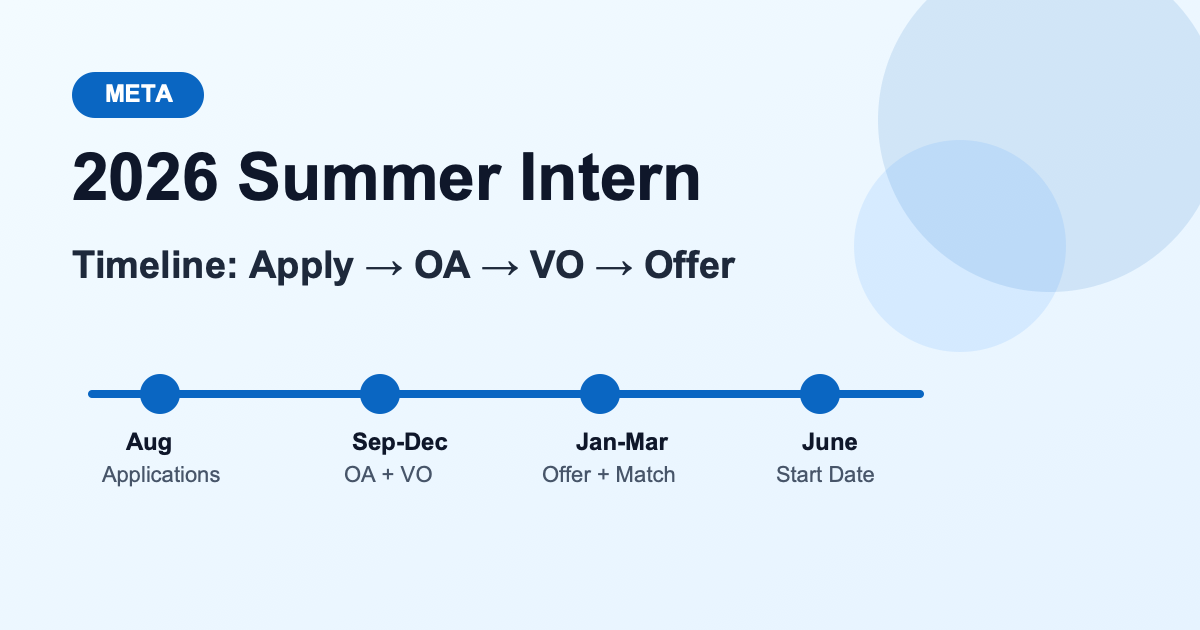
Many people have only a vague picture of Meta's interview process. This article walks through one at its real pace: first a technical phone screen, then a five-round Virtual Onsite once you pass (two Coding + two System Design + one BQ). Round by round, it reconstructs the real questions, focus areas, and on-the-spot strategy so you can capture the scoring points in each.
Meta Interview Process Cheat Sheet
| Stage | Round | Focus |
|---|---|---|
| Phone | 1 technical | Two coding, bug-free |
| VO | Coding × 2 | Data structure + classic high-frequency |
| VO | System Design × 2 | Feed / commerce feature |
| VO | Behavioral × 1 | Owner mindset + collaboration |
1. Technical Phone Screen
The phone screen was with a Manager who started off fairly serious. Two questions:
- Question 1: LeetCode 408 (Valid Word Abbreviation), not hard, solved on the first try. The interviewer probed leading zeros handling — a frequent follow-up; numbers in the abbreviation cannot have leading zeros.
- Question 2: a LeetCode 528 variant, rephrased with cities and distances, requiring you to figure out weighted random selection via prefix sum + binary search.
If you do well on the phone screen, you can quickly get recommended for a higher level, so write cleanly and explain your reasoning clearly.
# LeetCode 408 core: abbreviation match, watch for leading zeros
def valid_word_abbreviation(word, abbr):
    i = j = 0
    while i < len(word) and j < len(abbr):
        if abbr[j].isdigit():
            if abbr[j] == '0':      # leading zero is invalid
                return False
            num = 0
            while j < len(abbr) and abbr[j].isdigit():
                num = num * 10 + int(abbr[j]); j += 1
            i += num
        else:
            if word[i] != abbr[j]:
                return False
            i += 1; j += 1
    return i == len(word) and j == len(abbr)
2. VO Round 1 Coding: Data Structure Design
The interviewer was friendly. Question 1 was Merge Sorted Arrays, very basic, passed quickly. Question 2 asked you to design a data structure that, beyond add / get / delete (key, value), also supports a last operation (return the most recently inserted key).
The core is a hash map plus tracking insertion order:
class LastDict:
    def __init__(self):
        self.data = {}
        self.order = []          # track insertion order

    def add(self, key, value):
        if key not in self.data:
            self.order.append(key)
        self.data[key] = value

    def get(self, key):
        return self.data.get(key)

    def delete(self, key):
        if key in self.data:
            del self.data[key]
            self.order.remove(key)

    def last(self):
        return self.order[-1] if self.order else None
3. VO Round 2 Coding: Classic High-Frequency
The interviewer was a young Manager, relaxed atmosphere. Question 1 was LeetCode 54 (Spiral Matrix), question 2 was tree-related requiring DFS, both passed quickly. The second also touched Top K Frequent Elements (heap or bucket sort).
After finishing, I verbally described several test cases and simulated a run, and the interviewer confirmed. Meta's coding rounds care a lot about bug-free implementation and testing awareness — proactively running test cases scores points.
4. VO Round 3 System Design: Design Instagram Feed
The interviewer was an Instagram infra engineer who said upfront they would not interact and wanted me to design the feature fully on my own. The question was to design Instagram with feed generation. With solid prep you can cover:
- API design: posting and feed-pull interfaces
- Database schema: users, posts, follow relationships
- Component breakdown: feed service, post store, cache
- Pull vs push comparison: push for regular users, pull for celebrities
- Caching strategy: timeline cache, hot data
When the interviewer does not interact, you must explain the trade-offs thoroughly yourself and proactively raise the decision points.
5. VO Round 4 System Design: Instagram Commerce Feature
The question was to design a commerce feature on Instagram supporting Post Item, Search, Bid. The interviewer worked in Security, very interactive, and drilled into:
- Efficient Search: indexing methods (inverted index, trie)
- Anti-fraud for Bid: preventing self-bidding and order manipulation by buyers
Since it was highly interactive, you must catch each follow-up and adjust the design, showing understanding of security and real business scenarios.
6. VO Round 5 Behavioral
The interviewer was a Manager with a strong accent; I missed one question and asked for a repeat. Overall communication went smoothly as I described past projects and collaboration.
Meta's behavioral round is not like Amazon's near-total focus on Leadership Principles, but it still verifies whether the candidate has an owner mindset. Common questions: conflict, failure, most impactful project.
Summary: The Two System Design Rounds Are the Divide
Overall: do well on the phone screen and you can quickly be recommended for a higher level; in the VO, the coding rounds are fairly standard, testing bug-free implementation and testing awareness; but the two system design rounds are the core divide — Meta heavily values depth of design thinking and command of trade-offs.
FAQ
Q1: How many rounds does Meta have, and what is the process? First a technical phone screen (two coding), then a five-round Virtual Onsite once you pass: two Coding, two System Design, one Behavioral. Doing well on the phone screen may get you recommended for a higher level.
Q2: What do Meta's coding rounds test, and how hard? Mostly LeetCode medium high-frequency (e.g., 408, 54, Top K, data structure design), not extreme. The emphasis is bug-free implementation plus proactively running test cases; verbally simulating a run scores points.
Q3: What do Meta's system design rounds value most? Design depth and trade-offs. Two frequent ones are Instagram feed generation (pull/push model) and the commerce feature (Search indexing + Bid anti-fraud). Some interviewers won't interact, so explain the trade-offs thoroughly yourself.
Q4: How is Meta's BQ different from Amazon's? Meta does not focus on Leadership Principles nearly as much as Amazon; the behavioral round is lighter but still verifies an owner mindset. Common ones are conflict, failure, and most impactful project — answer with real projects.
Q5: How do you reach a higher level at Meta? Be clean and bug-free on the phone screen and coding rounds, maxing out delivery and testing awareness; the real differentiator is the two system design rounds — those who go deep on key trade-offs are more likely to land a higher level.
Preparing for a Meta interview?
If you can pass coding but struggle to go deep on system design, or want to rehearse the full phone-screen + five-round pace before onsite, let's talk: round-by-round topic breakdowns, a system design review framework, and delivery rehearsal tailored to Meta's process.
Contact
Need real interview questions and a custom prep plan? Message WeChat Coding0201 now and get the questions.
Email: [email protected] Telegram: @OAVOProxy