This Microsoft team loop was tightly packed: interviewers were mostly veterans, no screen share was required, and the vibe was relaxed but brisk. The four rounds differed clearly and collectively covered coding, system design, and BQ—you can tell their emphasis isn't single-axis grinding but the extended thinking after you solve: system-level scaling, high-concurrency optimization, trade-off analysis.
Microsoft Four Rounds at a Glance
| Round | Structure | Interviewer | Focus |
|---|---|---|---|
| 1 | Pure coding | M365 senior | Algorithm + high-concurrency extensions |
| 2 | 20min BQ + 40min coding | Cosmos DB senior | Alien Dictionary topological sort |
| 3 | 15min BQ + 45min system design | Azure manager | Ticket booking system |
| 4 | 5min resume + 25min verbal design | manager | Async notification system |
Round 1: Pure Coding + Extension Discussion
All problem-solving, no BQ. The interviewer gave an algorithm problem below LeetCode medium, but with a long prompt that took time to parse. I finished in ~15 minutes, and rather than stopping at correctness, he pushed on system-level optimizations: how to handle it under high concurrency, how to improve overall performance.
Mindset: Microsoft uses coding to drive a discussion of your thinking, not just to score whether you can write it. After finishing, proactively extend—"if the data scales 100x / under high concurrency, where's the bottleneck and how do you optimize it?"
Round 2: BQ + Alien Dictionary Topological Sort
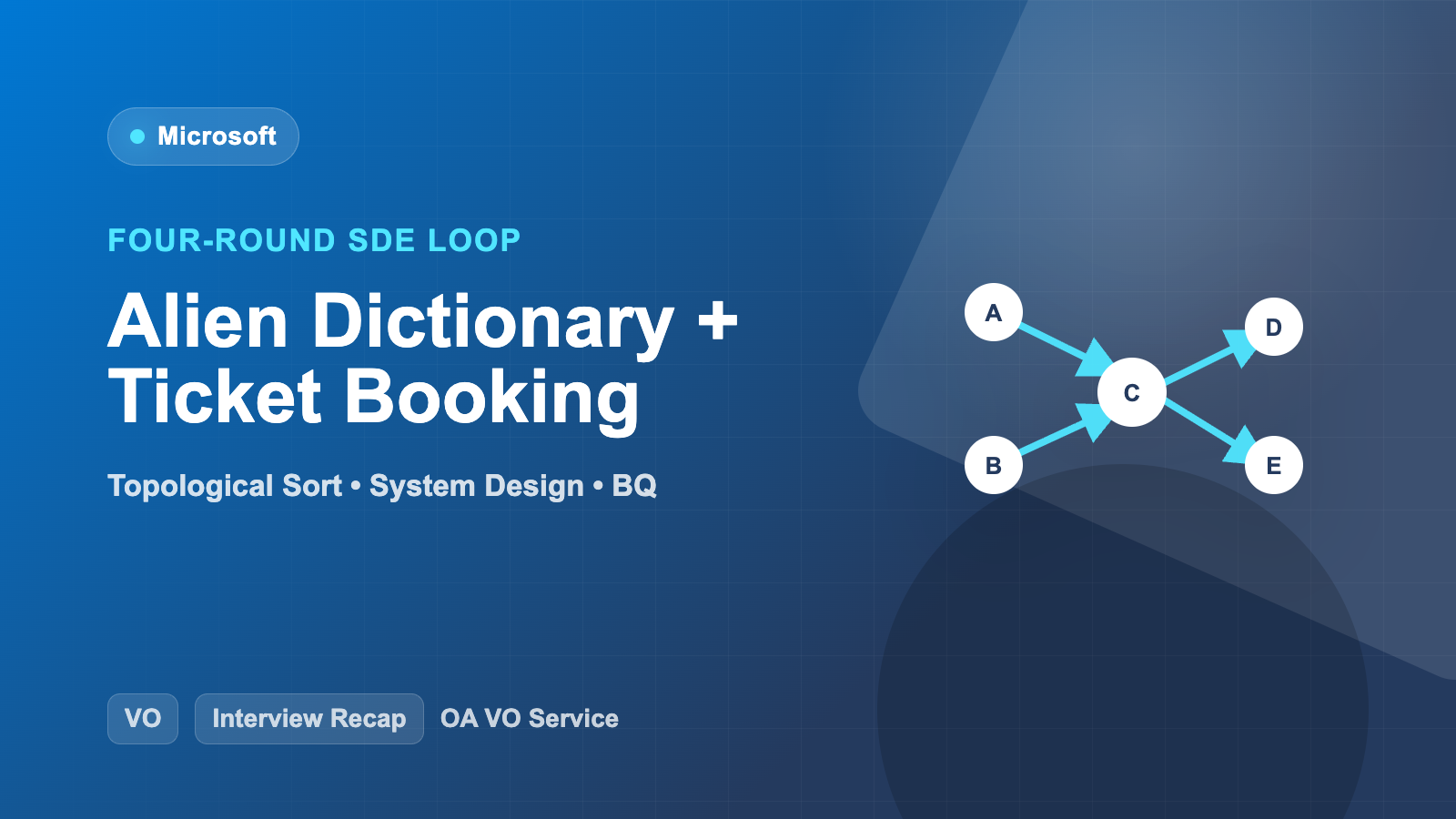
The first 20 minutes of BQ were relaxed, casual project talk with no deep technical dig. The 40-minute coding was a variant of LeetCode 269 Alien Dictionary.
Given a list of words sorted by an alien dictionary order, infer the ordering among letters.
I first tried DFS, but quickly hit errors handling cycles and multiple in-degrees, and the interviewer immediately probed edge cases. So I switched decisively to Kahn's algorithm (topological BFS), emitting results step by step with an in-degree table + queue.
from collections import deque, defaultdict

def alien_order(words):
    graph = defaultdict(set)
    indeg = {c: 0 for w in words for c in w}
    # compare adjacent words; the first differing char fixes an order
    for a, b in zip(words, words[1:]):
        for ca, cb in zip(a, b):
            if ca != cb:
                if cb not in graph[ca]:
                    graph[ca].add(cb)
                    indeg[cb] += 1
                break
        else:
            if len(a) > len(b):         # prefix contradiction: ["abc","ab"] invalid
                return ""
    q = deque(c for c in indeg if indeg[c] == 0)
    order = []
    while q:
        c = q.popleft()
        order.append(c)
        for nxt in graph[c]:
            indeg[nxt] -= 1
            if indeg[nxt] == 0:
                q.append(nxt)
    return "".join(order) if len(order) == len(indeg) else ""   # cycle => no solution
Key point: after switching to Kahn, I kept explaining why it avoids infinite loops and guarantees correctness, and specifically handled the easy-to-miss "prefix contradiction" edge case. Time: O(C) (C = total length of all chars). Space: O(1) (bounded alphabet).
Round 3: System Design — Ticket Booking System
After 15 minutes of BQ came the main system design: design a ticket booking system.
I first scoped requirements: seat booking under high concurrency, avoiding double booking, waitlist / refunds. But the interviewer quickly steered me to draw a high-level diagram directly, no need to expand to APIs or DB schema. Discussion centered on optimizations:
| Optimization | Approach |
|---|---|
| Avoid double booking | Seat-level lock / optimistic lock + version number |
| Surge hotspots | Inventory pre-deduction + queueing + rate limiting |
| Multi-DC consistency | Partition by venue; eventual consistency across regions |
| CAP trade-off | Booking leans consistency; briefly sacrifice availability |
The vibe felt like real-world brainstorming—grab the big direction fast.
Round 4: Verbal Design — Async Notification System
The opening 5 minutes on the resume were a formality, then the coding problem was implement an async notification system—not a standard algorithm problem but a verbal design.
I scoped requirements first, then proposed a queue-based architecture: producers push messages to a queue, consumers pull and dispatch asynchronously, plus a discussion of message persistence and retry on failure. In ~20 minutes I gave a workable design; the interviewer was pleased, and we spent the rest on idempotency handling and the latency vs throughput trade-off.
Mindset: this round checks whether you can land a workable system in limited time, not chase excessive complexity or perfection.
Summary
This Microsoft loop had no especially tricky problems: coding was medium-low but weighed extended thinking (system scaling, high concurrency, trade-offs); system design stayed high-level without nitpicking APIs and schema; BQ weight varied by interviewer, with low overall pressure. It fundamentally evaluates engineering intuition and communication, not raw LeetCode ability.
FAQ
What do Microsoft's four team-loop rounds test?
Pure coding, BQ + coding, BQ + system design, and resume chat + verbal design. They collectively cover coding / system design / BQ, with medium-low coding emphasizing extensions and high-level system design.
Is Microsoft's coding hard?
Medium-low with few tricks. But it won't stop at correctness—interviewers probe high-concurrency optimization, system scaling, and performance, which often move the score more than the problem itself.
How detailed should Microsoft's system design get?
High-level discussion, no need to expand APIs or DB schema. For ticket booking, draw a high-level diagram first and focus on avoiding double booking, hotspot mitigation, multi-DC consistency, and CAP trade-offs.
How do I prep for Microsoft's extension discussions?
After each coding problem, proactively extend along three axes—high concurrency / large data volume / performance optimization. If you want timed mocks of these problems, focused drills on topological sort / system design, or live VO support / VO proxy pairing, share the job description so we can predict the problem set and plan practice.
Preparing for the Microsoft interview?
Microsoft tests engineering intuition, extended thinking, and system-design communication. oavoservice offers full Microsoft coaching: timed extension-style coding mocks, topological-sort drills, and ticket-booking / notification design walkthroughs, plus live VO support / VO proxy pairing. Coaches include former big-tech senior engineers familiar with Microsoft's "probe system optimization after coding" scoring style.
Add WeChat Coding0201 to get Microsoft problems and mocks.
Contact
- WeChat: Coding0201
- Email: [email protected]
- Telegram: @OAVOProxy