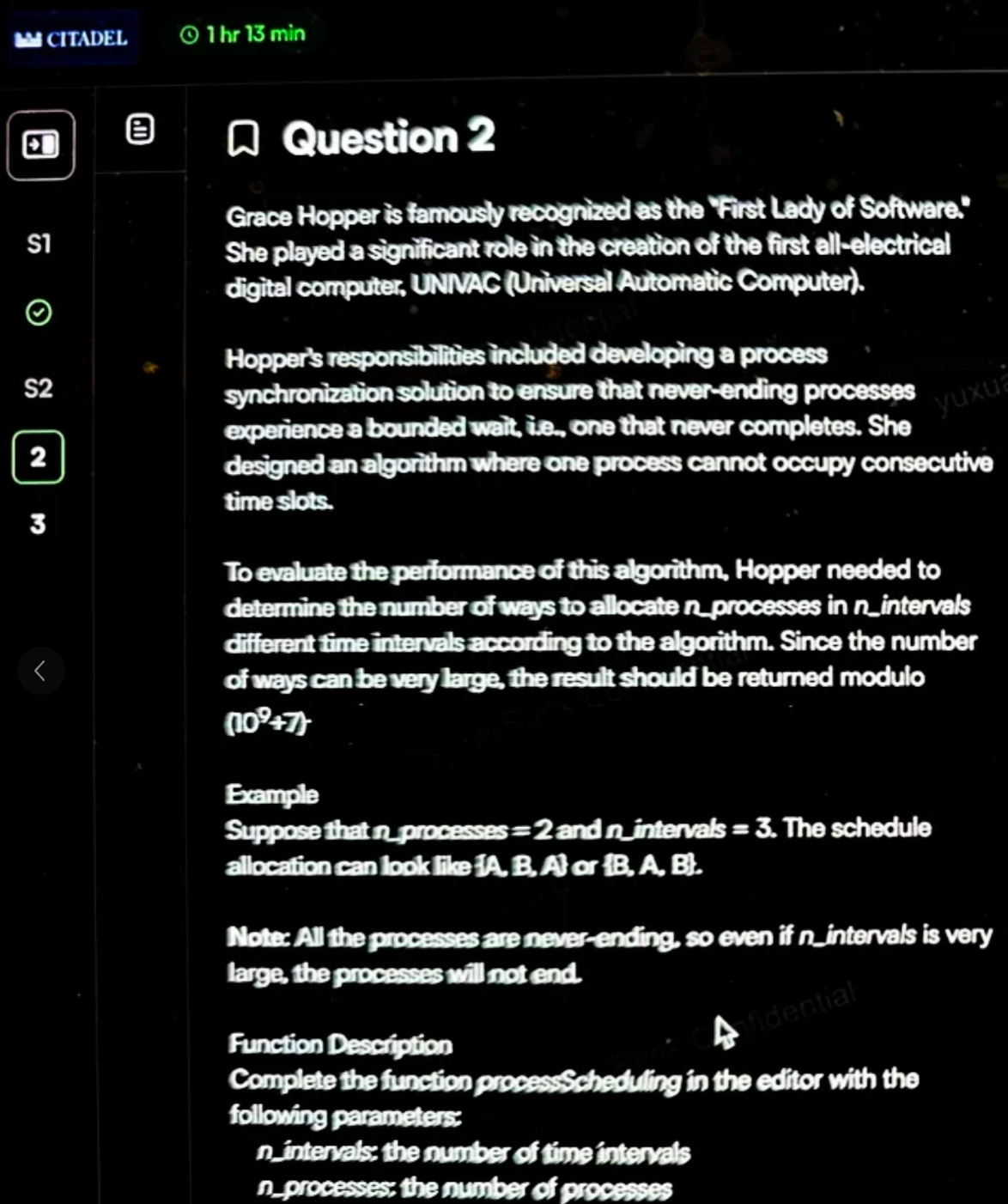
Since 2024, Ramp has funneled all SWE roles (NG / Backend / FullStack / Platform) through a single CodeSignal Industry Coding screen — the question pool reuses ~60%, but the cutoff and role-mapping logic keep shifting. This isn't a problem-list; it answers: "I have a Ramp OA invite — how do I prepare systematically?"
1. Ramp Hiring Landscape (2026 H1)
| Dimension | Status |
|---|---|
| HQ | NYC (80% HC) + SF + small remote |
| Open roles | SDE NG, Backend, FullStack, Platform, Data |
| ATS | Ashby + CodeSignal |
| OA format | CodeSignal Industry Coding (4Q / 70min) |
| Onsite cutoff | observed ≥ 720 / 850 |
| NG total comp | $190k–$240k |
Big change: from 2026-Q1, Ramp dropped OA pass rate from 35% to ~25% — mostly by raising the cutoff, not by changing the questions — so the existing question pool still applies.
2. CodeSignal Platform Mechanics
| Item | Detail |
|---|---|
| Question count | 4, increasing difficulty |
| Time | 70 min, single sitting |
| Scoring | Partial credit per Q; total 850 |
| Re-take | No, single shot |
| Anti-cheat | Tab logging, clipboard monitoring, partial camera |
| IDE | In-browser editor; 12 langs incl. Python / Java / JS / Go |
| Debug | Console available, no step-debug |
3. Q1–Q4 Time Budget
Q1 (200 pts)  ≈  Basic data structures             →  10 min
Q2 (250 pts)  ≈  Strings / state machine           →  15 min
Q3 (300 pts)  ≈  Business modeling (bank/refund)   →  20 min
Q4 (300 pts)  ≈  Combined implementation + tuning  →  25 min
                                                   --------
                                                   70 min
Observation: 80% of candidates scoring 720+ get Q1-Q3 fully AC + 60-70% on Q4. Burning all time on Q4 while skipping Q1 polish almost always fails.
4. Q3 Business Modeling: Bank Transaction System (always asked)
Stem: implement a Bank system supporting:
create_account(t, id)deposit(t, id, amount)withdraw(t, id, amount)(None if insufficient)transfer(t, src, dst, amount)top_spenders(t, n)(top n by cumulative spending)
class BankSystem:
    def __init__(self):
        self.accounts = {}      # id -> balance
        self.spending = {}      # id -> cumulative spending (used for top_spenders)

    def create_account(self, t, account_id):
        if account_id in self.accounts:
            return False
        self.accounts[account_id] = 0
        self.spending[account_id] = 0
        return True

    def deposit(self, t, account_id, amount):
        if account_id not in self.accounts:
            return None
        self.accounts[account_id] += amount
        return self.accounts[account_id]

    def withdraw(self, t, account_id, amount):
        if account_id not in self.accounts:
            return None
        if self.accounts[account_id] < amount:
            return None
        self.accounts[account_id] -= amount
        self.spending[account_id] += amount
        return self.accounts[account_id]

    def transfer(self, t, src, dst, amount):
        if src not in self.accounts or dst not in self.accounts:
            return None
        if src == dst or self.accounts[src] < amount:
            return None
        self.accounts[src] -= amount
        self.accounts[dst] += amount
        self.spending[src] += amount
        return self.accounts[src]

    def top_spenders(self, t, n):
        ranked = sorted(self.spending.items(), key=lambda kv: (-kv[1], kv[0]))
        return [f"{aid}({amt})" for aid, amt in ranked[:n]]
Time: O(1) per op, top_spenders O(k log k) Space: O(n)
Scoring tip: most candidates lose points on
top_spenderstie-breaker — "alphabetical id when spending is equal." Stating the sort tuple aloud is a high-scoring move.
5. Q4 Combined Implementation: Refund + Spending Limit State Machine
Q4 extends Q3:
- Refund requests pull spent amounts back (affects cumulative spending)
- Spending Limit: per-month cap; over-cap pays are rejected
- Cashback: 1% of every payment returns to balance
from collections import defaultdict
import heapq

class RampSystem(BankSystem):
    def __init__(self):
        super().__init__()
        self.limits = {}                 # id -> monthly_limit
        self.month_spend = defaultdict(int)  # (id, ym) -> spent
        self.refund_queue = []           # pending refunds, sorted by t

    @staticmethod
    def _ym(t):
        return t // (30 * 24 * 60 * 60 * 1000)  # simplified: ms -> month bucket

    def set_limit(self, t, account_id, limit):
        self.limits[account_id] = limit
        return True

    def pay(self, t, account_id, amount):
        if account_id not in self.accounts:
            return None
        ym = self._ym(t)
        used = self.month_spend[(account_id, ym)]
        limit = self.limits.get(account_id, float("inf"))
        if used + amount > limit or self.accounts[account_id] < amount:
            return None
        self.accounts[account_id] -= amount
        self.spending[account_id] += amount
        self.month_spend[(account_id, ym)] += amount
        cashback = amount // 100
        self.accounts[account_id] += cashback
        return self.accounts[account_id]

    def request_refund(self, t, account_id, amount):
        heapq.heappush(self.refund_queue, (t + 24 * 3600 * 1000, account_id, amount))
        return True

    def process_refunds(self, t):
        processed = []
        while self.refund_queue and self.refund_queue[0][0] <= t:
            due, aid, amt = heapq.heappop(self.refund_queue)
            self.accounts[aid] += amt
            self.spending[aid] = max(0, self.spending[aid] - amt)
            processed.append((aid, amt))
        return processed
Time: pay O(1), refund O(log r) Space: O(n + r)
Q4 scoring: 24-hour delay and over-limit rejection are two hidden cases newly added in 2026 — copying 2025 solutions costs ~30 points.
6. Role-Specific Mapping (after the same OA score)
| Role | Onsite rounds | Focus | Mapping advantage at same score |
|---|---|---|---|
| SDE NG | 4 | Algo + System Design + BQ | Generic |
| Backend | 4–5 | System design + Postgres / Redis | Strong backend projects |
| FullStack | 4 | React + REST API design | Frontend portfolio |
| Platform | 5 | infra / Kubernetes / CI | DevOps projects |
| Data | 4 | SQL + Python ETL | Data pipeline projects |
Observed: at OA 750, FullStack invites arrive fastest (~3 days); Platform slowest (10+ days, due to tighter HC).
7. 4-Week Prep Plan
Week 1: Full bank-system Q3 set + design pattern review
Week 2: Strings / sliding-window / queue (Q1 + Q2)
Week 3: Refund + Limit + Cashback combined (Q4)
Week 4: 3x timed mocks + error postmortem
Two timed 70-minute mocks per week — most failures are pacing, not problems.
8. Common Pitfalls
- Coding before fully reading: Ramp stems run ~600 words; the first 5 min on reading is not wasted
- Edge cases ignored: zero balance, transfer to self, refund larger than original spend
- No helpers in Q4: all logic in one function = hard to debug and error-prone
- Python
list.pop(0): main TLE source in Q4 streaming — usedeque - Output format mismatch: CodeSignal compares strict — extra space or missing newline costs points
9. FAQ
Q1: What OA score gets onsite?
A: Observed soft cutoff 720; NG 760+ secures invite, lateral may pass at ~700 with strong resume.
Q2: Reuse rate on the question pool?
A: Q3 bank system reuses ~100% (minor wording tweaks); Q4 swaps one twist per quarter.
Q3: Does Ramp sponsor H1B?
A: Yes. NYC HC dominates. H1B-friendliness ≈ Stripe / Plaid.
Q4: Onsite difficulty?
A: 4 rounds — algo, system design, project deep-dive, BQ. Algo at LC Medium; system design tilts toward payments / ledgers.
Q5: Python or Java?
A: Python preferred — 80% of candidates choose Python; class-based business modeling in Q3/Q4 is shorter. Java tends to TLE in Q4.
10. Need Ramp OA / VO Help?
Ramp's bank-system test is about business modeling + state-machine thinking, not LeetCode difficulty. If you're prepping:
- WeChat: Coding0201 · Contact
- Email: [email protected]
- Telegram: @OAVOProxy
We offer: this-week Ramp CodeSignal real questions, multi-variant bank-system drills, onsite system-design mocks, and joint prep with Stripe / Plaid pools.
Contact
Email: [email protected]
Telegram: @OAVOProxy
WeChat: Coding0201
Last updated: 2026-05-18 | Author: oavoservice interview team