The SIG PSA (Problem Solving Assessment) is one of the more rigorous quant OAs out there, covering probability theory, expected value, Bayesian reasoning, geometric optimization, and combinatorics. Below is a full breakdown of 9 recent questions with answers and solution notes.
Q1: Theatre Meeting Probability
Donald and Goofy each arrive at a theatre at a uniformly random time between 18:00 and 19:00. Donald will only wait 12 minutes for Goofy, but Goofy will wait up to 36 minutes for Donald. What is the probability they meet?
Answer: 3 / 5
Let arrival times D, G ∈ [0, 60] (minutes). They meet when −36 ≤ D − G ≤ 12. The non-meeting region consists of two right triangles with areas 48²/2 = 1152 and 24²/2 = 288. Total non-meeting area = 1440 out of 3600. P(not meet) = 2/5, so P(meet) = 3/5.
Q2: Shortest Path Home Through the Swamp
A dog runs at 3 m/s in the swamp and 5 m/s on the road. What is the shortest time (in seconds) for her to reach home from the position shown in the diagram?
Answer: compute from diagram coordinates
This is a classic refraction/Snell's law optimization. Let the dog travel through the swamp to an entry point on the road, then along the road. Minimizing total time requires sinθ₁/3 = sinθ₂/5, where θ₁ and θ₂ are the angles from vertical in the swamp and road segments respectively. Substitute the coordinates from the diagram to find the optimal entry point and compute total time.
Q3: Expected Turns for Two Consecutive Black Tiles
Iggy draws tiles with probability p of black each turn. What is the expected number of turns to place two black tiles consecutively?
Answer: 12 / 1 (when p = 1/3)
Let E = expected turns from scratch, A = expected turns after just drawing a black tile.
- A = 1 + (1−p)·E
- E = 1 + p·A + (1−p)·E
Solving these simultaneously gives E = 1/(p²) + 1/p. For p = 1/3: E = 9 + 3 = 12.
Q4: Age Logic Puzzle
Aaron, Bryce, and Craig have distinct integer ages. When speaking to someone older, the speaker always tells the truth; when speaking to someone younger, the speaker always lies.
- Bryce → Craig: "You're the youngest one."
- Aaron → Bryce: "Your age is exactly 70% greater than mine."
- Aaron → Craig: "Your age is the average of mine and Bryce's."
- Craig → Aaron: "I'm at least 8 years older than you."
Answer: Craig = 27
Since Aaron < Bryce, Aaron tells Bryce the truth: Bryce = 1.7 × Aaron. For integer ages, Aaron must be a multiple of 10. Set Aaron = 20, Bryce = 34. Since Aaron < Craig, Aaron tells Craig the truth: Craig = (20 + 34)/2 = 27. Since Craig > Aaron, Craig lies to Aaron: the statement "I'm at least 8 older" is false, meaning Craig − Aaron < 8. Indeed 27 − 20 = 7 < 8. All conditions check out: Craig = 27.
Q5: Expected Value on a 12-Sided Die
Roll a fair 12-sided die (uniform on {1, …, 12}) 10 times. Let X be the number of rolls divisible by 4. Find E[X].
Answer: 5 / 2
Multiples of 4 in {1, …, 12}: 4, 8, 12 — that's 3 values. Single-roll probability p = 3/12 = 1/4. X ~ Binomial(10, 1/4), so E[X] = 10 × 1/4 = 5/2.
Q6: Probability Largest Number Falls in an Interval
Three numbers are drawn independently and uniformly from U[0, 4]. What is the probability that the largest is between 0.5 and 1?
Answer: 7 / 512
P(max ∈ (0.5, 1)) = P(all ≤ 1) − P(all ≤ 0.5) = (1/4)³ − (0.5/4)³ = (1/4)³ − (1/8)³ = 1/64 − 1/512 = 8/512 − 1/512 = 7/512.
Q7: Placing Items on a Black-and-White Grid
A 3×3 grid has 2 black squares and 7 white squares. Place 2 indistinguishable apples and 1 orange such that at least one item is on a black square (at most one item per square). How many ways?
Answer: 147
- Total arrangements: choose 3 squares from 9, then choose which of those 3 holds the orange: C(9,3) × 3 = 84 × 3 = 252.
- All-white arrangements: C(7,3) × 3 = 35 × 3 = 105.
- At least one black: 252 − 105 = 147.
Q8: Toad Path Count
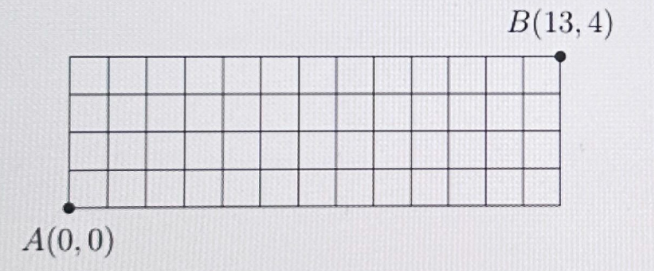
A toad moves from A(0,0) to B(13,4), only moving right or up, with step sizes strictly alternating between 1 and 3 (may start with either). How many valid paths exist?
Answer: compute via DP
Total displacement: 13 right + 4 up = 17 units. The alternating step constraint limits valid step sequences. One valid decomposition: 5 steps of size 1 and 4 steps of size 3 (total = 5 + 12 = 17), arranged in alternating order starting with 1 (sequence: 1,3,1,3,1,3,1,3,1). For each valid step sequence, count the number of ways to assign each step a direction (right or up) such that total right = 13 and total up = 4. Enumerate via dynamic programming over step index and cumulative right displacement.
Q9: Bayesian Inference — Most Biased Coin
Three biased coins have heads probabilities 9/10, 4/5, and 11/20 respectively. A coin is chosen uniformly at random and flipped — it lands tails. What is the probability the most biased coin (9/10) was chosen?
Answer: 2 / 15
- P(tails | 9/10) = 1/10
- P(tails | 4/5) = 1/5
- P(tails | 11/20) = 9/20
- P(tails) = (1/10 + 1/5 + 9/20) / 3 = (2 + 4 + 9) / 60 = 15/60 = 1/4
- P(9/10 | tails) = (1/3 × 1/10) / (1/4) = (1/30) / (1/4) = 4/30 = 2/15
Summary Table
| Question | Topic | Answer |
|---|---|---|
| Q1 | Geometric probability | 3/5 |
| Q2 | Geometric optimization (Snell's law) | from diagram |
| Q3 | Markov chain expectation | 12 |
| Q4 | Logic / truth-lie deduction | 27 |
| Q5 | Binomial expectation | 5/2 |
| Q6 | Order statistics | 7/512 |
| Q7 | Combinatorics | 147 |
| Q8 | Path counting (DP) | enumerate |
| Q9 | Bayes' theorem | 2/15 |
💬 Need OA / VO Support?
Ongoing coverage of quant OA questions from SIG, Jane Street, Optiver, Two Sigma, Citadel, and more. Feel free to reach out with questions.
WeChat: Coding0201
📬 Contact
Email: [email protected]
Telegram: @OAVOProxy