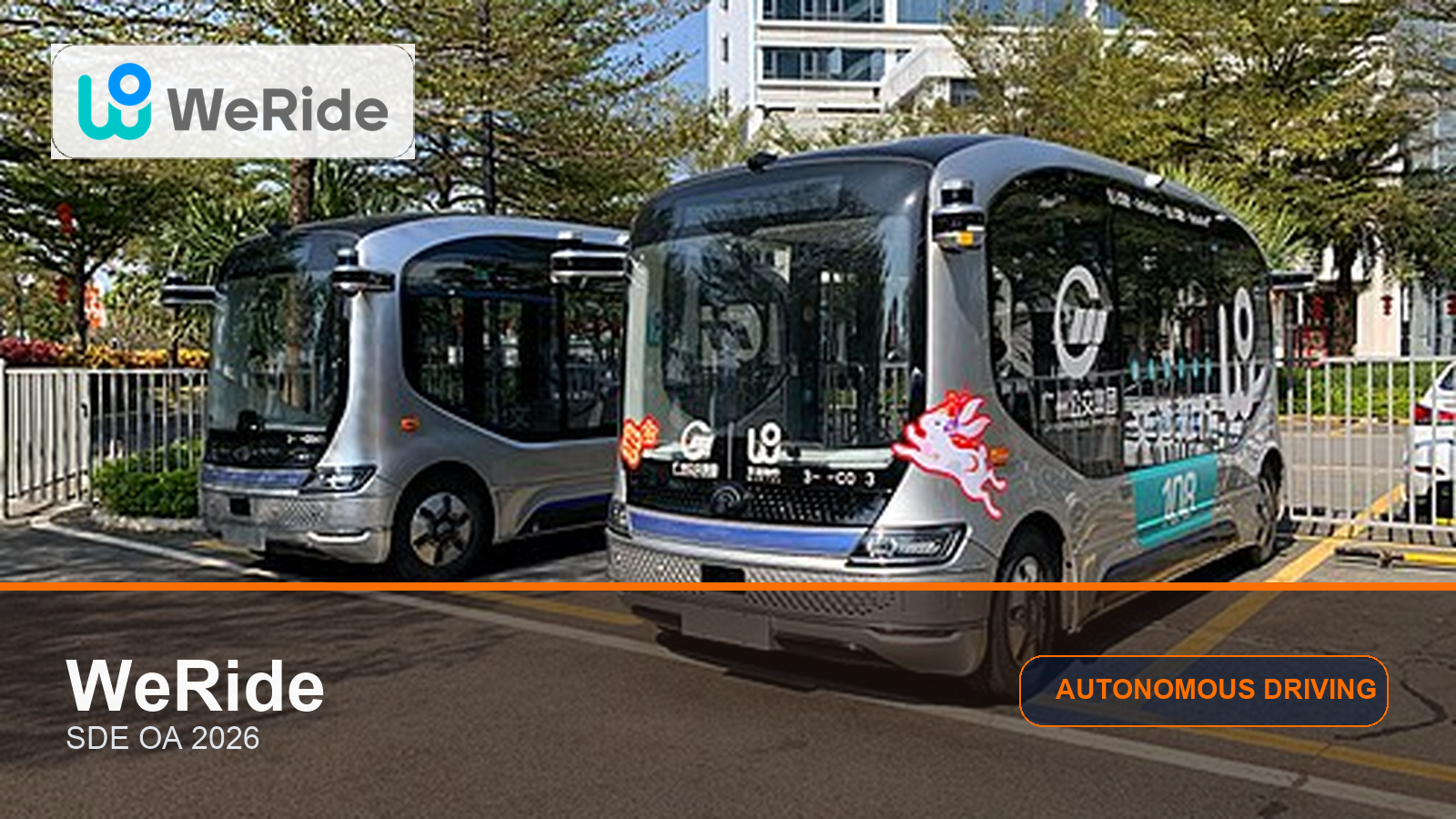
WeRide (文远知行) is one of the first Chinese robotaxi operators with a commercial license, and over the last two years its Bay Area office has expanded its SDE / MLE hiring significantly. Recent WeRide threads on 1point3acres show an unmistakable autonomous-driving flavor: sensor fusion, point-cloud clustering, shortest-path planning. This article ranks the question types by frequency and adds a realistic VO coaching / mock-interview plan.
WeRide OA at a Glance
| Dimension | Detail |
|---|---|
| Platform | CodeSignal / HackerRank (varies by role) |
| Duration | 70-90 minutes |
| Count | 3 problems (1 easy + 2 medium/hard) |
| Difficulty | Mostly LC Medium, occasional Hard |
| Focus | Graphs, simulation, geometry, strings |
Question Type 1: Sliding-Window Trimmed Mean (Sensor Denoising)
Problem
LiDAR / IMU streams contain bursty noise. Given a data stream data[] and window size k, output the trimmed mean (drop max and min, then average) for each length-k window.
Idea
- Maintain a sorted structure (
SortedList) over the window - On shift: insert one, remove one
- Use "window_sum − max − min" to get the trimmed sum in O(1)
Python
from sortedcontainers import SortedList

def trimmed_mean_window(data, k):
    if len(data) < k:
        return []
    sl = SortedList(data[:k])
    window_sum = sum(data[:k])
    res = [(window_sum - sl[0] - sl[-1]) / (k - 2)]

    for i in range(k, len(data)):
        sl.remove(data[i - k])
        window_sum -= data[i - k]
        sl.add(data[i])
        window_sum += data[i]
        res.append((window_sum - sl[0] - sl[-1]) / (k - 2))
    return res
Time O(n log k) Space O(k)
Question Type 2: HD Map Shortest Path with Battery Constraints
Problem
A robotaxi runs trips on a city graph. Nodes = intersections; edges = roads with cost cost and energy drop. Battery capacity B. Some nodes are chargers (instantly refill). Find the min-cost path from src to dst keeping energy ≥ 0 throughout.
Idea
- State:
(node, current_energy) - Run Dijkstra over the state space
- At charger nodes, energy resets to
Bon visit
Python
import heapq

def min_cost_with_battery(graph, n, src, dst, B, chargers):
    # graph[u] = [(v, cost, energy_drop)]
    pq = [(0, src, B)]
    visited = {}
    while pq:
        cost, u, e = heapq.heappop(pq)
        if (u, e) in visited and visited[(u, e)] <= cost:
            continue
        visited[(u, e)] = cost
        if u == dst:
            return cost
        for v, w, drop in graph[u]:
            ne = e - drop
            if ne < 0:
                continue
            if v in chargers:
                ne = B
            heapq.heappush(pq, (cost + w, v, ne))
    return -1
Time O(B · E log(B · V))
Question Type 3: Point-Cloud Connected Components
Problem
A 2D grid with 0/1 occupancy. Return the number of connected components (4-neighborhood). This is LeetCode 200's cousin, except WeRide often asks you to support dynamic add/remove.
Idea
- Static: BFS / DFS
- Dynamic: Union-Find with path compression + union by rank
- Removal is non-trivial; common workarounds are "offline / time-travel DSU" or full rebuild on remove
Python (static)
def count_clusters(grid):
    if not grid:
        return 0
    R, C = len(grid), len(grid[0])
    seen = [[False] * C for _ in range(R)]
    cnt = 0
    for i in range(R):
        for j in range(C):
            if grid[i][j] == 1 and not seen[i][j]:
                cnt += 1
                stack = [(i, j)]
                while stack:
                    x, y = stack.pop()
                    if 0 <= x < R and 0 <= y < C and grid[x][y] == 1 and not seen[x][y]:
                        seen[x][y] = True
                        stack.extend([(x+1,y),(x-1,y),(x,y+1),(x,y-1)])
    return cnt
Frequency Table from 1point3acres
| Topic | Frequency | Key technique |
|---|---|---|
| Sensor denoising / sliding window | ★★★★ | SortedList |
| Shortest path with constraints | ★★★★★ | Dijkstra + state expansion |
| Point-cloud / connected components | ★★★★ | BFS / DSU |
| Log parsing | ★★★ | Regex / state machine |
| Geometry (hull, closest pair) | ★★ | Divide & conquer |
VO Loop and VO Coaching Boundaries
WeRide's North America VO loop typically has 4-5 rounds:
- Algorithms: LC Medium-Hard
- System design: a subsystem of perception / planning / control
- C++ / Python depth: memory model, move semantics, ROS experience
- Behavioral: cross-team collaboration, high-pressure debug
- Hiring manager / team fit
oavoservice's combined VO Proxy + VO Coaching package
For WeRide's 4-5 round multi-domain VO (algorithms + system design + C++/ROS + behavioral), oavoservice provides a full bundle:
- VO Coaching / mocks: bucket the last 6 months of WeRide reports into a question set; mentor mocks at realistic pacing with timed hints; recorded debrief
- VO Proxy / live support: real-time answer assistance and reasoning checks during the actual interview — especially for perception / planning / control system-design rounds
- Behavioral playbook: STAR stories tailored to WeRide team style
- Whiteboard replay: mentor polishes your system-design explanation sentence by sentence
Reach out on WeChat Coding0201 for the full plan and pricing.
6-Day Sprint
| Day | Task |
|---|---|
| D1 | Bucket WeRide threads by topic (graph, sliding window, geometry) |
| D2 | Dijkstra / Bellman-Ford / SPFA — 1 each, with state expansion |
| D3 | LeetCode 200 / 695 / 547 + dynamic variants |
| D4 | System design: perception → planning → control pipeline |
| D5 | C++ / ROS refresher; pull out an old project if needed |
| D6 | Behavioral STAR: outage and cross-team stories, 2 each |
FAQ
Can I memorize WeRide 1point3acres OA posts directly?
No. About 30% of WeRide problems rotate each batch, but themes (graphs + sliding window + simulation) are stable. Memorize patterns, not statements.
What's the difference between WeRide SDE and MLE OA?
SDE leans toward classic data structures (graphs, strings, stacks/heaps). MLE leans toward ML pipelines, point-cloud processing and light probability. Both usually include one scenario problem with autonomous-driving flavor.
Can I apply to WeRide without autonomous-driving experience?
Yes. WeRide's North America roles mostly evaluate general SDE ability. Domain knowledge can be picked up through KITTI / Apollo / Autoware open-source projects; interviewers care more about whether you can solve novel problems with familiar tools.
Failed the OA — what's the cooldown?
Usually 6 months. Switching tracks (e.g., Infra → Perception) typically resets the cooldown.
Preparing for WeRide SDE OA / VO?
oavoservice tracks WeRide / Cruise / Waymo / Pony.ai OA and VO updates over time. Our mentors come from frontline AV teams and offer question bucketing, timed mocks, system-design debriefs, behavioral recordings as part of VO coaching.
👉 Add WeChat: Coding0201 — get WeRide high-frequency questions + VO coaching.
Contact
Email: [email protected]
Telegram: @OAVOProxy